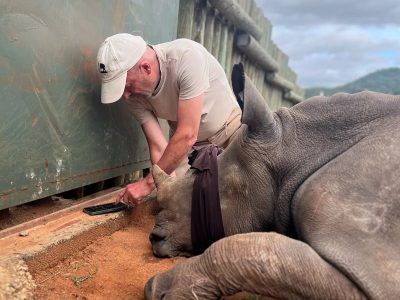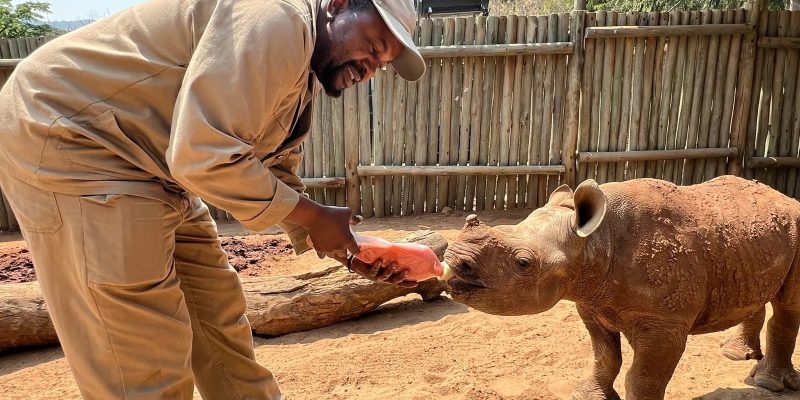
In March 2014, rangers in Kruger National Park found a seven-month-old white rhino calf standing next to the body of her poached mother. Kruger’s veterinary teams put her on life support and stabilizing drips, and when she was strong enough to move she was driven to a sanctuary in Mpumalanga that had never taken a rhino from Kruger before. They named her Satara, after the part of the park she came from, so that she would keep the name of the place she had lost.
Twelve years later, Satara has a calf of her own, born in the wild on 17 May 2026. Care for Wild Rhino Sanctuary announced the birth on 15 October 2026. Mother and calf are living in an intensive protection zone, monitored and guarded around the clock.
Why does one rhino calf matter this much?
Because of where she started, and because of what she is now doing without help.
Satara was the first orphan Kruger sent out. South Africa lost 1,215 rhinos to poaching in 2014, the worst year on record, and that year South African National Parks signed a memorandum of agreement with Care for Wild covering the rehabilitation, rewilding and long-term protection of Kruger’s orphaned and injured rhinos. Satara was the first animal under it. By the sanctuary’s own count she became the first of 135 rhinos it has taken in, and she is the mother of the 34th calf born to rhinos in its care.
A hand-raised orphan is not automatically a functioning wild animal. The distance between surviving in a boma and raising a calf unassisted in a protected landscape is the whole point of a rewilding program, and it is the part that takes years and usually goes unreported, because nothing in it photographs well.
“For over a decade, the rhino has been seen as a symbol of crisis in South Africa, but the birth of this new rhino life is changing that narrative. No longer inheriting a war against poaching, these calves are wild-born and growing up in the love, safety, and care of their rhino mothers.”
That is Petronel Nieuwoudt, who founded Care for Wild and who drove to Kruger herself to collect Satara in 2014.
Which zoo is behind this work?
None that we could find, and that is worth saying plainly rather than leaving blank.
We went looking for an accredited zoological institution funding Care for Wild, because a great deal of African field conservation is paid for by zoos and aquariums that never appear in the story. The sanctuary’s published partners and sponsors page names Investec, Caterpillar, the Oak Foundation, the Rhino Recovery Fund, Baby Rhino Rescue, Blankets for Baby Rhinos, Animal Survival International, the Singita Lowveld Trust and a list of South African businesses. It names no zoo and no aquarium. Searching from the other direction, which is usually more productive because zoos publish their conservation spending and field organizations often do not, turned up nothing either.
So this is a national parks agency and a privately funded sanctuary, with no zoo in the chain that we can evidence. For scale on what the sector does spend elsewhere: the Association of Zoos and Aquariums reports that in 2025 its 235 accredited and certified members put approximately $372.4 million into conservation work across 139 countries. No published breakdown isolates how much of that reached Africa, and we are not going to estimate one.
What the Red List says about white rhinos
Care for Wild attaches no conservation category to Satara in its announcement, which is the honest way to write it, so there is nothing here to correct. For readers who want the figure: the IUCN Red List assesses the white rhino, Ceratotherium simum, as Near Threatened, assessed on 6 January 2020 by R. Emslie, with an estimated 18,064 animals in the wild as of 31 December 2017 and about 10,080 mature individuals. The trend is listed as decreasing.
Near Threatened is a milder category than most readers expect for a rhino, and it is carrying two things at once. The southern white rhino recovered from a few dozen animals in the early twentieth century to roughly 18,000, which is one of the largest recoveries conservation has produced, and poaching has been pushing that number back down since 2008. Both halves are true. The assessment is also six years old now, and the poaching picture has moved since it was written.
We covered the same problem from the other end in Kenya recently, where Tsavo West’s rhino sanctuary expanded its fenced area to give a recovering population somewhere to grow into.
What happens to Satara now
She stays where she is. The sanctuary says she and the calf are in an intensive protection zone, monitored and guarded 24 hours a day, which is what the rest of this story rests on. A wild-born calf in a landscape where poaching has not stopped is only as safe as the perimeter around it.
Care for Wild has not released the calf’s sex or name, and published no photograph of the two of them with the announcement.
Source: Care for Wild Rhino Sanctuary, 15 October 2026.
Quick answers
- Who is Satara the rhino?
A southern white rhino, and the first orphaned rhino calf that Kruger National Park sent to Care for Wild Rhino Sanctuary. Rangers found her on 11 March 2014, about seven months old, standing beside her poached mother. She was named after the part of Kruger she came from.
- When did she give birth?
On 17 May 2026, twelve years after her rescue. Care for Wild announced the birth on 15 October 2026. It has not released the calf’s sex or name.
- Where are Satara and the calf now?
In an intensive protection zone at the sanctuary, monitored and guarded 24 hours a day. The sanctuary says that round-the-clock protection is what allows her to raise the calf in the wild.
- Why did SANParks send orphaned rhinos to a sanctuary?
Because of the scale of the 2014 poaching year. South Africa lost 1,215 rhinos that year, and South African National Parks signed a memorandum of agreement with Care for Wild covering the rehabilitation, rewilding and long-term protection of Kruger’s orphaned and injured rhinos rather than leaving the calves behind.
- How many rhinos has Care for Wild taken in?
Satara was the first of 135, by the sanctuary’s own count. Thirty-four calves have now been born to rhinos in its care, Satara’s among them.
- Which zoo funds Care for Wild?
We could not verify one. The sanctuary’s published partners and sponsors page names corporate and foundation funders including Investec, Caterpillar, the Oak Foundation and the Rhino Recovery Fund, and no zoo or aquarium. Searching from the institutions’ side found nothing either. We publish that as a finding rather than leaving the question blank.
- Is the white rhino endangered?
The IUCN Red List assesses the white rhino as Near Threatened, in an assessment dated 6 January 2020 by R. Emslie, with about 18,064 animals in the wild as of 31 December 2017, roughly 10,080 of them mature individuals, and a decreasing trend. Care for Wild attaches no category to Satara in its announcement.