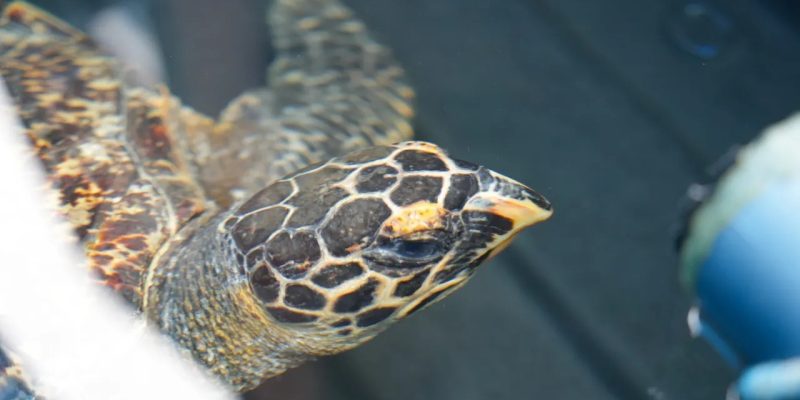
The subadult hawksbill turtle that washed ashore at Betty’s Bay on September 7 was missing her front right flipper, and the first thing the veterinarian established was that the limb had been gone a long time. The wound was old. It had healed completely. Whatever took it off had not been what put her on the beach.
She is called Amber now, and she is eating, diving and working a training target at the Two Oceans Aquarium’s Turtle Conservation Centre in Cape Town, three weeks into a rehabilitation the turtle team expects her to finish.
What the stranding season actually is
South Africa’s coastline strands turtles on a schedule. From September through February the Two Oceans Aquarium’s Turtle Conservation Centre takes in a run of subadult arrivals that the turtle community calls green season, after the species that dominates it. Hawksbills come in behind the green turtles rather than instead of them, and Amber arrived at the front of this year’s run.
The alert came through the aquarium’s Turtle Rescue Network, a volunteer chain along the coast rather than a staffed facility. Michelle Watson of the Kogelberg Wildlife Sanctuary got Amber off the beach between Sea Farm and Silver Sands and out of the weather. Sam Marais drove her to Cape Town in the back seat of a car. She arrived just after noon on the day she was found, dehydrated from the journey.
Seven kilograms, forty-two centimeters, and a healed stump
Siyolise Bezu, one of the center’s turtle aquarists, and Dr Bernice van Huyssteen, its turtle veterinarian, took her in. The examination found barnacles on her shell, a generally weak demeanor, and that old amputation. Dr van Huyssteen read the healed stump as evidence rather than damage: a turtle that loses a front flipper and survives long enough for the wound to close has already demonstrated something about the species. Amber weighed 7.1 kilograms and her shell measured just under 42 centimeters.
She got intravenous fluids, a glucose injection to steady her blood sugar, and a freshwater bath. For the first few days she stayed weak and would not eat, so the veterinarian started a precautionary course of antibiotics and the team kept the water in her tank low enough that lifting her head to breathe cost her nothing. She began eating. The water went up. She moved out of critical care into a larger holding tank in the main rehabilitation space.
The paddle is there to make her forget about people
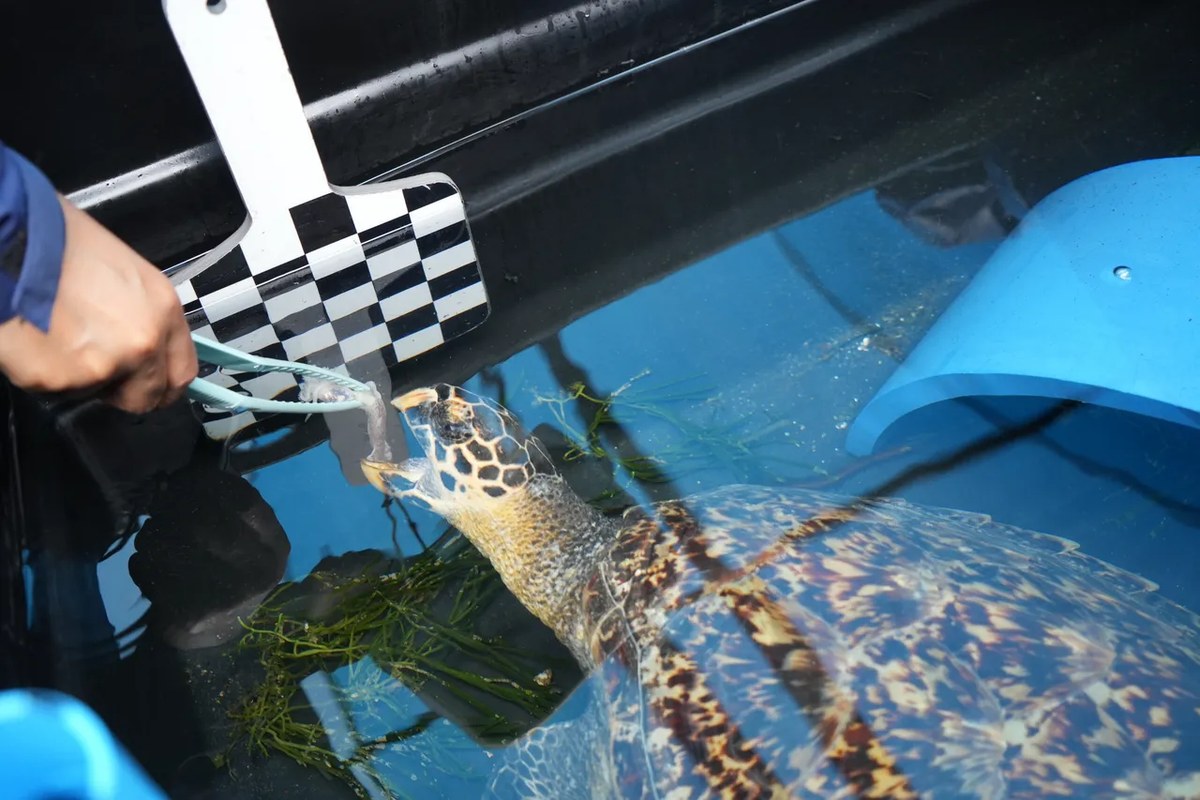
In early October, after she finished the antibiotics, turtle aquarist Razaan Samuels introduced Amber to a target: a patterned paddle lowered into the water with her food held in front of it. The turtle learns to associate the meal with the object.
That is the entire point, and it is a point about release rather than about training. A turtle rehabilitated by people and fed by people will go back to the ocean expecting people to be a source of food, which is a dangerous expectation for an animal that will spend the rest of its life around boats, fishing gear and divers. Target training moves the association off the human and onto a thing. Every turtle at the center is worked this way. Amber took to it immediately.
What a hawksbill does for a reef
Hawksbills eat sponges, and that diet is the reason a single juvenile matters to more than herself. Sponges compete with slow-growing corals for space on a reef, and a population of sponge-eating turtles holds that competition in check. A hawksbill returned to the water is a small piece of maintenance equipment going back into a system that is short of them.
The IUCN Red List assesses the hawksbill, Eretmochelys imbricata, as Critically Endangered under criterion A2bd, and the Two Oceans Aquarium’s description of the species matches the assessment exactly. Worth knowing is what the category rests on and when it was set. The assessment is by Jeanne Mortimer and Michael Donnelly for the IUCN SSC Marine Turtle Specialist Group, dated June 30, 2008, and it measures the number of mature females nesting annually across 25 index sites worldwide. Those sites showed an 84 to 87 percent decline over three hawksbill generations. It is a figure about nesting females at monitored beaches over a long window, not a global headcount taken recently, and the assessment is now eighteen years old.
Who paid for Amber
The Two Oceans Aquarium is the zoological institution in this story. Its own staff, its own veterinarian and its own rehabilitation tanks are doing the work, which is the straightforward version of a question that usually takes more digging on this continent.
Amber’s adoption was taken up by the Morukuru Goodwill Foundation, a private South African foundation that also adopted Habanero, another of the center’s three-flippered turtles. We looked for an accredited zoo or aquarium outside Cape Town with money or staff attached to Amber’s care and did not find one, and there is no reason there should be: this is a South African aquarium rehabilitating a South African stranding with its own people. The aquarium has handled this before, including the loggerhead the center named Pearl.
Amber is not releasable yet. She is a juvenile with three flippers, a full appetite and a training target she already understands, and the turtle team’s stated expectation is that the rest of her recovery is a matter of time rather than doubt.
Quick answers
- What happened to the hawksbill turtle called Amber?
She washed ashore at Betty’s Bay, between Sea Farm and Silver Sands on the Western Cape coast, on September 7, 2026, missing her front right flipper. The Two Oceans Aquarium’s Turtle Rescue Network moved her to the aquarium’s Turtle Conservation Centre in Cape Town the same day.
- Did she lose the flipper in the stranding?
No. The aquarium’s turtle veterinarian, Dr Bernice van Huyssteen, examined the limb on arrival and found the amputation was an old wound that had healed completely. Whatever caused it was not what put her on the beach.
- How is she now?
Three weeks after the rescue she is diving and eating well. She was weak and off her food for the first few days and was given fluids, a glucose injection and a precautionary course of antibiotics, then moved from critical care into a larger holding tank in the main rehabilitation space.
- What is target training and why do rehabilitated turtles get it?
A patterned paddle is placed in the water with the turtle’s food in front of it, so the animal learns to associate feeding with the object rather than with people. It matters at release: a turtle that expects humans to be a food source will approach boats, divers and fishing gear. Every turtle at the centre is trained this way.
- Why do turtles strand on this coast between September and February?
The aquarium calls it green season, after the green turtles that dominate it. Subadult turtles of several species come ashore on a seasonal pattern in that window, and hawksbills arrive alongside the green turtles rather than instead of them.
- How endangered is the hawksbill turtle?
The IUCN Red List assesses Eretmochelys imbricata as Critically Endangered under criterion A2bd, in an assessment by Jeanne Mortimer and Michael Donnelly for the IUCN SSC Marine Turtle Specialist Group dated June 30, 2008. It measures nesting females at 25 index sites worldwide, which showed an 84 to 87 percent decline across three hawksbill generations. The Two Oceans Aquarium’s description of the species matches the assessment.
- Which zoos or aquariums are funding Amber’s care?
The Two Oceans Aquarium is doing the work itself, with its own veterinarian, aquarists and tanks. Her adoption was taken up by the Morukuru Goodwill Foundation, a private South African foundation that also adopted another three-flippered turtle at the centre. We looked for an accredited zoo or aquarium outside Cape Town with money or staff attached to this animal and did not find one.