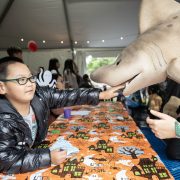

The Seattle Aquarium is expanding the hands-on programming in its Ocean Pavilion. Four new activities in the second-floor Discovery Lab launched in July, six more are due later this year, and one of them hands you a job title that until now belonged only to staff: shark nanny.
The Discovery Lab is a flexible programming space next to the Animal Care area, opened with the Ocean Pavilion just over two years ago. Activities run daily between 10 a.m. and 4:30 p.m., with no fixed schedule, so what is on the table varies by day and by who is staffing it.
What a shark nanny actually does
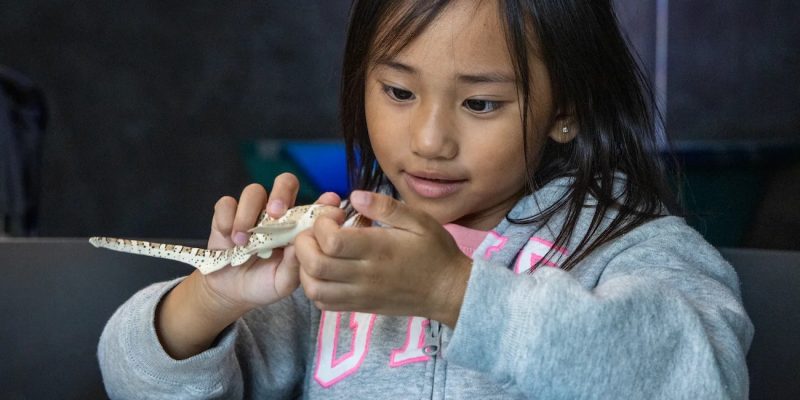
The aquarists working on the Seattle Aquarium’s Indo-Pacific leopard shark project call themselves shark nannies, and the activity puts guests through a simplified version of the same sequence.
It starts with the real egg casing of Oatmeal, an Indo-Pacific leopard shark hatched at the aquarium who now lives in The Reef, the Ocean Pavilion’s largest habitat. From there, guests work an interactive model of a sea pen, gathering clams and snails for young sharks to hunt, which is how the real animals learn to feed themselves before release. The last step is practicing a tag placement on a plush shark.
The project behind it is STaR, for Stegostoma tigrinum Augmentation and Recovery, a global species recovery effort the Seattle Aquarium co-founded. The idea is to rebuild wild populations by releasing sharks raised in aquariums into places the species has been fished out of. The IUCN Red List assesses Stegostoma tigrinum as Endangered, which matches how the aquarium describes it.
One small correction while we are here. The aquarium’s write-up spells the genus “Stegastoma.” The accepted spelling is Stegostoma, and the species has carried the name Stegostoma tigrinum since a 2019 revision retired the older Stegostoma fasciatum. The same animal is called a zebra shark in much of the world, which is how it appears in most fisheries literature, and an Indo-Pacific leopard shark in conservation work, partly to keep it clear of the unrelated California leopard shark.
Sam McNeely, a marine science interpretive diver who helped build the activity, described two young guests who gathered food for their sharks, learned to tell them apart by their patterns, and then named them.
“They named them after themselves,” he said. “This gave them a sense of belonging and purpose in caring for their shark and the recovery of the species, just like it does for the real shark nannies.”
A card game where you are the coral
The second activity is a card game about coral morphology, which is the shape a coral colony grows into: short and flat, branching, boulder-like, or solitary. Each shape is a trade-off. Players place their corals into a three-dimensional reef space and then find out how those choices hold up when the scenario card turns over. A boulder coral meets a plankton feeding frenzy. A solitary coral meets a storm.
The stake behind the game is a number worth repeating: coral reefs cover less than one percent of the ocean floor and support a quarter of all known marine life.
The adults are not just supervising
The aquarium expected children. It got their parents too.
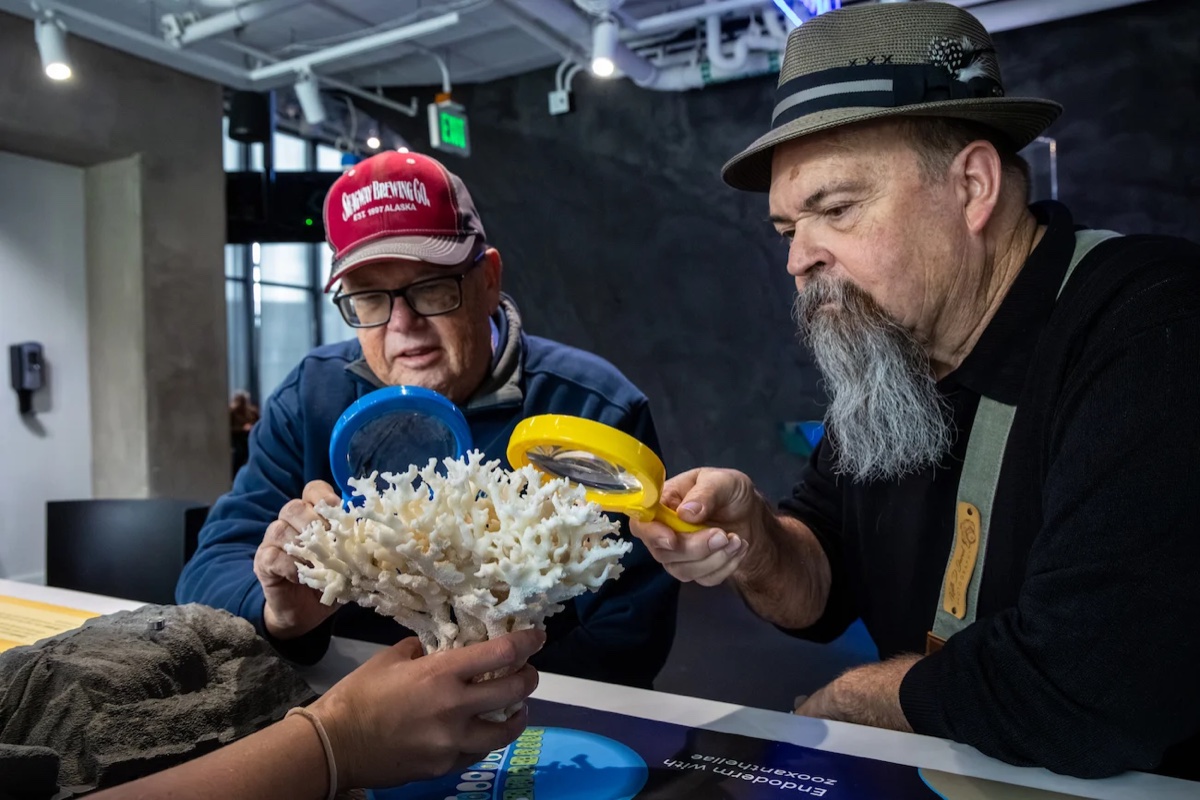
“One of the biggest joys has been how much our adult visitors have enjoyed these programs, as well as the kids,” said Jessica Colla, a marine science interpreter who works in the Discovery Lab. “Many of my interactions start by talking to the children, and then I realize their parents are just as curious.” One family stayed over an hour, moving between activities and asking about the research behind them. The child left wanting to come back as a volunteer.
Nicole Killebrew, manager of Visitor Engagement, puts the same thing in operational terms. “We’ve seen a very high level of engagement,” she said. “Folks are inclined to stop and ask what’s going on and initiate engagement. And I think that the way that the activities are being facilitated is allowing us to dive more deeply into some of the conservation stories.”
That is the design working. The activities were built with input from the staff who talk to guests all day, and each one is adjustable on the spot, which is what lets the same table serve a four-year-old and a retiree in the same ten minutes.
Reading an animal by its mouth
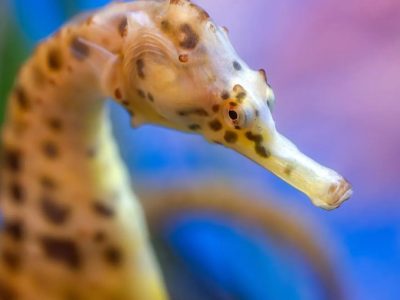
The third activity is about feeding strategies on a tropical reef, and it is the most physical of the set. Guests handle a moray eel jaw, a porcupinefish’s teeth and a sea urchin’s mouth, and work out what each one tells you about a diet. Plush animals cover the rest: seahorses, which suction their food, and blueband gobies, which sift it.
If you are going
The Discovery Lab is on the second floor of the Ocean Pavilion, near the Animal Care area. Activities run between 10 a.m. and 4:30 p.m. daily, subject to staffing, and rotate without a published timetable, so the move is to ask a staff member what is out that day when you arrive. Seeing the whole rotation takes more than one visit, which is the aquarium’s own argument for a membership.
The aquarium credits Boeing with supporting the expanded programming.
The Seattle Aquarium’s conservation work reaches a good way past the building. Last month it published baseline research underpinning a possible sea otter reintroduction in Oregon. The Discovery Lab is where that side of the institution gets handed across a table to someone holding a plastic shark.
Source: Seattle Aquarium, October 9, 2026.
Quick answers
- What is the Seattle Aquarium Discovery Lab?
A flexible programming space on the second floor of the Ocean Pavilion, next to the Animal Care area, where guests do hands-on marine conservation activities with staff.
- What is new there?
Four new activities launched in July 2026 and six more are due later in the year. The first four cover raising Indo-Pacific leopard sharks, coral morphology, reef feeding strategies, and a fourth program in the same rotation.
- When do the activities run?
Between 10 a.m. and 4:30 p.m. daily, subject to staffing. There is no fixed timetable and the activities vary by day, so ask a staff member what is out when you arrive.
- What is a shark nanny?
The name the aquarists working on the Indo-Pacific leopard shark recovery project use for themselves. In the guest version, you start with the real egg casing of Oatmeal, a shark hatched at the aquarium, gather clams and snails on a model sea pen, and practice placing a tag on a plush shark.
- What is STaR?
Stegostoma tigrinum Augmentation and Recovery, a global species recovery effort the Seattle Aquarium co-founded. It aims to rebuild wild populations by releasing sharks raised in aquariums into places the species has been fished out of.
- Is the Indo-Pacific leopard shark endangered?
The IUCN Red List assesses Stegostoma tigrinum as Endangered. The same animal is called a zebra shark in most fisheries literature. It is unrelated to the California leopard shark, Triakis semifasciata.
- Is the Discovery Lab only for children?
No. Staff report that adult visitors engage as much as the children do, and the activities are built to be adjusted on the spot for whoever is at the table.