
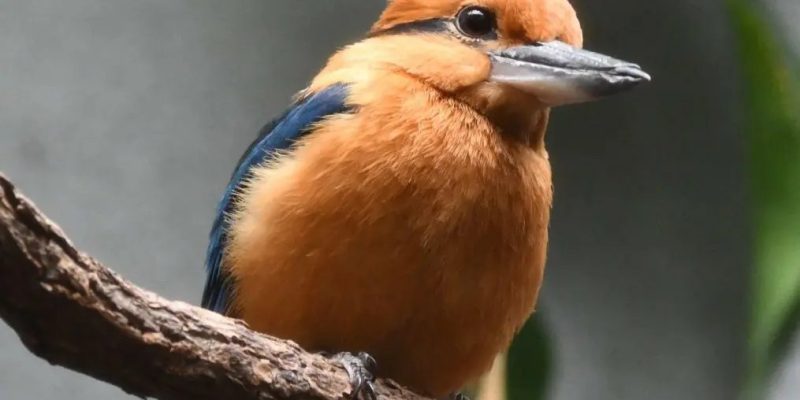
Ten Sihek, the cinnamon-colored kingfisher that has not lived wild on Guam since the 1980s, are heading into quarantine ahead of an expected release at Palmyra Atoll later this year. Two of them come from the Saint Louis Zoo. If quarantine goes well, up to eight of the ten will be released, which would nearly double the world’s only wild population of the species.
That population began with nine birds, released on Palmyra in 2024, thirty-six years after the last wild Sihek was seen. Those nine are the entire wild presence of the species.
What does Extinct in the Wild actually mean?
It is a formal IUCN Red List category and it is the last one before Extinct. A species is Extinct in the Wild when the only known living individuals are in cultivation, in captivity, or in a naturalized population well outside the historic range. The Red List assessment for the Sihek, made by BirdLife International on June 18, 2024, records the category and gives the number of mature individuals in the wild as zero.
The bird got there quickly. Known as Sihek by the indigenous CHamoru people, it was a common enough sight on Guam within living memory. The accidental introduction of the brown tree snake to the island in the 1940s took out much of Guam’s native bird, bat and lizard fauna, and the last confirmed wild sighting of a Sihek was in 1988. Everything that has happened since has run through zoo aviaries.
Eight institutions, ten birds, one flight
The ten Sihek come from eight AZA-accredited institutions: Brookfield Zoo Chicago, the Cincinnati Zoo and Botanical Garden, Disney’s Animal Kingdom, the National Aviary, the Oregon Zoo, the San Diego Zoo Safari Park, the Sedgwick County Zoo and the Saint Louis Zoo. All ten travel first to Disney’s Animal Kingdom, where they will spend about two months in a behind-the-scenes biosecure quarantine facility. The Sihek Recovery Program, the international collaboration coordinating the effort, will then decide which birds make the 5,400-mile journey to Palmyra, traveling with project staff.
Six of the ten are female, which is the detail the program is most pleased about. Males outnumber females roughly two to one across the managed population, so a cohort that runs the other way is worth more to a founding wild population than its headcount suggests.
“Palmyra Atoll provides the Sihek a safe, wild home to thrive in and establish a breeding population, with the goal of one day returning the species to Guam, once the threat from snakes is controlled,” the Sihek Recovery Program said. “Until then, our work moves the Sihek on a path toward recovery and away from the very real risk of extinction, giving this small but mighty bird a chance to reclaim its place in the wild.”
Why Palmyra and not Guam?
Because the brown tree snake is still on Guam. Palmyra Atoll, in the north Pacific, has no such predator. It is fully protected as a Nature Conservancy preserve and research station inside a United States Fish and Wildlife Service National Wildlife Refuge, which makes it about as controlled an environment as a wild place gets. The intention is not that Sihek stay there. It is that a self-sustaining wild population exists somewhere while the snake problem on Guam is worked on.
The plan is to repeat these releases annually until twenty Sihek are established as breeding pairs on Palmyra. The birds already there have built nests and laid eggs, but no chick has hatched in the wild yet. That first hatch, whenever it comes, will be the first wild-born Sihek since the 1980s.
A note on the category
The Saint Louis Zoo’s own summary of this news describes an effort to save a “critically endangered species.” The IUCN Red List category is Extinct in the Wild, which is one step further along, and it is the category the Sihek Recovery Program announcement carried on the same page. We default to the assessment where the two differ. It is a small difference in wording and a large one in meaning: Critically Endangered describes a species hanging on in the wild, and Extinct in the Wild describes one that is not there at all. Either way, there are fewer than 150 Sihek alive anywhere, and the ten now in quarantine are a meaningful fraction of them.
This is the kind of work that only exists because a set of institutions agreed to hold a species for decades with no guarantee of a payoff. The Saint Louis Zoo has been on the reintroduction end of it before, sending American red wolf pups to be fostered into a wild family in North Carolina and running a rescue of humped tree snails out of a typhoon’s path. Palmyra is a longer bet than either. A kingfisher that has been gone from its island since 1988 is being given somewhere else to be a wild bird, on the theory that it will be needed back home eventually.
Quick answers
- What is a Sihek?
A cinnamon-colored kingfisher native to Guam, also known as the Guam kingfisher, Todiramphus cinnamominus. Sihek is the name used by the indigenous CHamoru people of Guam and the one the recovery program uses.
- What is happening to the ten Sihek?
They are traveling to Disney's Animal Kingdom for about two months in a behind-the-scenes biosecure quarantine facility. The Sihek Recovery Program will then decide which birds make the 5,400-mile journey to Palmyra Atoll, where up to eight are expected to be released later this year.
- Which zoos are contributing birds?
Eight AZA-accredited institutions: Brookfield Zoo Chicago, the Cincinnati Zoo and Botanical Garden, Disney's Animal Kingdom, the National Aviary, the Oregon Zoo, the San Diego Zoo Safari Park, the Sedgwick County Zoo and the Saint Louis Zoo. Two of the ten birds come from the Saint Louis Zoo.
- Is the Sihek extinct?
It is Extinct in the Wild on the IUCN Red List, assessed by BirdLife International on June 18, 2024. That is the category for a species whose only known living individuals are in captivity, in cultivation, or in a naturalized population outside the historic range. Fewer than 150 Sihek are alive anywhere.
- Why release them on Palmyra Atoll instead of Guam?
Because the brown tree snake, introduced to Guam accidentally in the 1940s, is still there. Palmyra Atoll has no such predator and is protected as a Nature Conservancy preserve and research station inside a United States Fish and Wildlife Service National Wildlife Refuge. The long-term goal is still a return to Guam.
- How many Sihek live in the wild?
Nine birds were released on Palmyra Atoll in 2024, the first Sihek in the wild in thirty-six years, and they are the world's only wild population. Releasing up to eight more would nearly double it.