
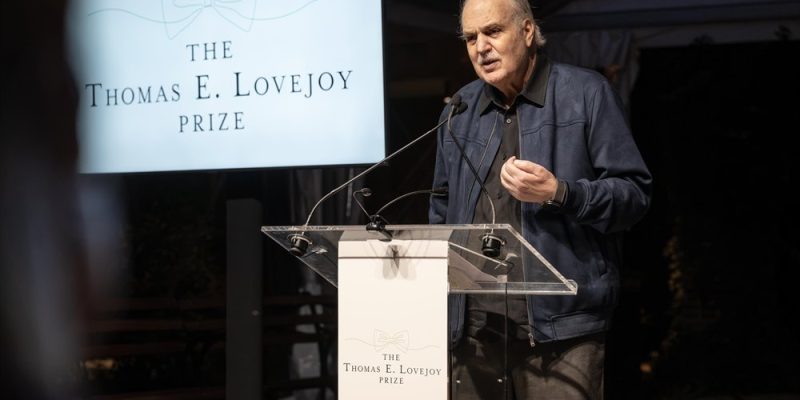
The 2026 Thomas E. Lovejoy Prize went to Dr. Carlos Afonso Nobre, the Brazilian earth scientist who first modeled the Amazon tipping point, at a ceremony held at the Central Park Zoo on the evening of Wednesday, September 23. The prize was presented during New York City Climate Week by five organizations jointly: Conservation International, the Global Environment Facility, The Nature Conservancy, the Wildlife Conservation Society and World Wildlife Fund.
It is a slightly unusual sight, a climate science award handed out in a zoo, and it is worth pausing on why the venue fits.
What Dr. Nobre actually found
In the 1990s, Nobre was among the first scientists to identify and model what is now called the Amazon tipping point. The idea is mechanical rather than rhetorical. The Amazon largely waters itself: moisture rises off the forest, falls again inland, and rises again, so the rainforest manufactures a good share of its own rainfall. Strip out enough trees and that cycle can no longer close. Past some threshold of deforestation and warming, the forest stops being able to sustain the climate that sustains it, and large areas convert to something drier and more open. The point of the model was to establish that the threshold exists and to put numbers near it.
Those numbers are close. Nobre puts current deforestation at 18 percent of the total forest and the threshold at 20 percent, with global warming reaching 1.5 degrees Celsius by 2030 on the current path. Beyond the tipping point, he estimates that more than 70 percent of the forest could degrade within 30 to 50 years.
We need to implement immediately nature-based solutions: Global TAFF (transition away from fossil fuels) by 2040; zero deforestation, degradation and fires by 2030; large scale forest restoration; valuing Indigenous Peoples and Local Communities’ knowledge; and implementing a socio-bioeconomy of standing forests and flowing rivers. We all want to save the Amazon and our planet.
Dr. Carlos Afonso Nobre
A career, not a paper
Nobre began as a researcher at Brazil’s National Institute of Amazonian Research and spent 30 years at the National Institute for Space Research. He is now Senior Scientist and Professor at the Institute for Advanced Studies at the University of Sao Paulo.
The institution-building is the less famous half and probably the more durable one. He helped design the Large-Scale Biosphere-Atmosphere Experiment in Amazonia, and he founded the Center for Weather Forecasting and Climate Studies, the Center for Earth System Science, and Brazil’s National Center for Monitoring and Early Warning of Natural Disasters. He co-chairs the Science Panel for the Amazon, and through his Amazonia 4.0 initiative he has pushed a specific argument: that science and technology can build an economy out of the forest left standing, including for Indigenous Peoples and local communities, rather than out of clearing it.
He has contributed to the Intergovernmental Panel on Climate Change, and he belongs to the Brazilian Academy of Sciences and the U.S. National Academy of Sciences. He is also the first Brazilian scientist elected to the Royal Society in more than a century.
Who was Thomas Lovejoy?
The conservation biologist who put the word biodiversity into general use, and who spent his career on the Amazon specifically. Lovejoy died in 2021, and the prize that carries his name goes to one person a year for advancing Amazon conservation through science, vision, collaboration and respect for natural and cultural diversity.
The three previous recipients are Belen Paez of Ecuador, Marc Dourojeanni of Peru and Martin von Hildebrand of Colombia. Nobre is the first Brazilian on that list, which for a prize about the Amazon is a notable gap to have closed.
Dr. Carlos Afonso Nobre has devoted his career to helping the world understand that the future of the Amazon is inseparable from the future of our climate, biodiversity, and people. His groundbreaking science on the Amazon tipping point has not only sounded an alarm, but helped point us toward the solutions needed to keep this extraordinary ecosystem healthy and resilient.
Dr. Adam Falk, President and CEO, Wildlife Conservation Society
Why the zoo is the right room
The Central Park Zoo is run by the Wildlife Conservation Society, one of the five organizations behind the prize, and WCS is a field conservation organization that happens to operate four zoos and an aquarium in New York City. That structure is the answer to the question the venue raises. Gate revenue from animals people want to see is what funds the work nobody buys a ticket for, and a Manhattan zoo during Climate Week puts a room full of people who fund Amazon science in the same building as the sea lions that helped pay for it.
The Central Park Zoo is a small zoo by acreage and a busy one by footfall, sitting in the middle of the park at 64th Street. Most of the year its news is closer to the ground, like the twin ruffed lemurs that debuted there earlier this month. On Wednesday evening it was where someone stood up and explained how close the largest rainforest on earth is to a threshold, to an audience with the means to do something about it.
Source: Wildlife Conservation Society, September 23, 2026.
Quick answers
- What is the Amazon tipping point?
The threshold past which the Amazon can no longer sustain its own rainfall. The forest recycles a large share of the moisture that falls on it, and beyond enough deforestation and warming that cycle fails and large areas convert to drier, more open vegetation. Dr. Nobre was among the first scientists to identify and model it, in the 1990s.
- How close is the Amazon to the tipping point?
Dr. Nobre puts deforestation at 18 percent of the total forest against a threshold of 20 percent, with warming reaching 1.5 degrees Celsius by 2030 on the current path. Past the threshold he estimates more than 70 percent of the forest could degrade within 30 to 50 years.
- What is the Thomas E. Lovejoy Prize?
An annual award for an individual advancing Amazon conservation through science, vision, collaboration and respect for natural and cultural diversity. It honors conservation biologist Thomas Lovejoy, who died in 2021, and is presented jointly by Conservation International, the Global Environment Facility, The Nature Conservancy, the Wildlife Conservation Society and World Wildlife Fund.
- Who has won the Lovejoy Prize before?
Belen Paez of Ecuador, Marc Dourojeanni of Peru and Martin von Hildebrand of Colombia. Dr. Nobre is the first Brazilian recipient.