
Bats did not begin in Asia, Africa or North America. They began in Europe. That is the headline finding of a study published in Nature on September 23, the largest combined analysis of bat genomes and bat fossils ever assembled, and Wildlife Conservation Society scientists working in the Republic of Congo supplied one of the animals that made it possible.
The paper, Reference genomes and fossils revise bat family phylogeny and biogeography, is the work of the Bat1K consortium: 137 researchers from 64 countries, by WCS’s count. It combines chromosome-level genome assemblies from 103 bat species, 42 of them newly sequenced and covering all 21 living bat families, with a morphological dataset of 699 anatomical characters scored across 65 species, 44 of which are pre-Quaternary fossils.
Why nobody could answer this before
Because the two kinds of evidence had never been analyzed together properly. Genomes tell you how living species are related and roughly when their lineages split. Fossils tell you where animals actually were and when. Run them separately and you get two partial answers that do not constrain each other, which is how bat origins stayed contested for decades.
The team used fossilized birth-death and dispersal-extinction cladogenesis methods, which model extinct and living species in one framework rather than bolting fossil dates onto a molecular tree afterward. That is the methodological point the authors make about their own work: it significantly reduced the unrepresented basal branch lengths that molecular-only dating produces, meaning the long stretches of early evolutionary history that a genome-only analysis has to infer with nothing to check it against.
The result placed the origin of bats, and therefore of mammalian powered flight, in Europe. The paper puts it in the late Paleocene, the closing stretch of an epoch that ran from roughly 66 to 56 million years ago. WCS’s announcement rounds this to around 65 million years ago; the published abstract gives the epoch rather than a figure, and we are reporting what the paper says. From Europe, the earliest bats are thought to have dispersed into Africa, establishing a Europe-Africa hub from which bats later expanded into Asia, the Americas and Australia.
Echolocation came early, and that is the surprise
The fossil evidence settles a second long argument. A fossil bat called Vielasia sits in the oldest branch of the bat tree, the group the authors call Eochiroptera, and it has the anatomy of an animal that used laryngeal echolocation, which is biosonar produced in the voice box rather than by tongue clicks. Its position means echolocation predates the diversification of modern bats.
Put plainly: flight and biosonar were both in place near the very beginning. Bats did not become flying mammals first and learn to navigate by sound later. They arrived with the whole toolkit, and the tens of millions of years since have been variations on it. That is a decent explanation for why there are now more than 1,500 bat species, roughly one in five of all living mammals.
The study also reconstructed ancestral chromosome states, supporting 26 chromosomes in the common ancestor of all living bats, and redrew the family tree in several places. Myzopodidae, the Madagascan sucker-footed bats, turn out to be the earliest branch within Vespertilionoidea, and two superfamilies, Emballonuroidea and Vespertilionoidea, resolve as sister groups.
Where a zoo comes into it
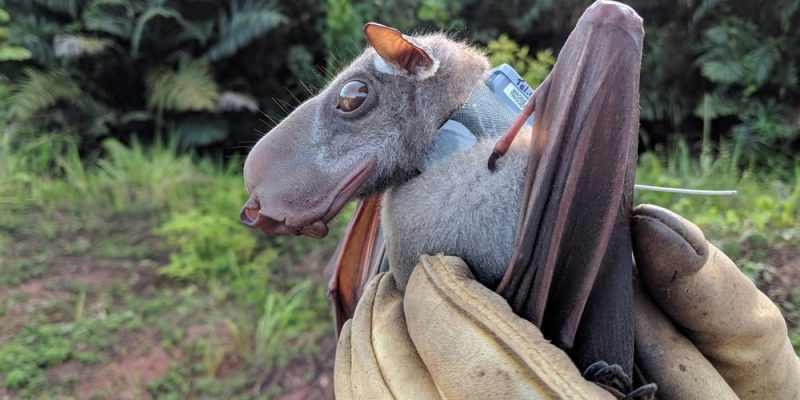
Through a bat with a face like a small horse. WCS scientists Sarah Olson and Alain Ondzie provided the biological samples used to produce the genome of the hammer-headed bat, Hypsignathus monstrosus, the largest bat on mainland Africa and one of the stranger-looking mammals anywhere. The males have an enormous resonating muzzle and gather in noisy display groups along rivers.
We’re proud that WCS’s fieldwork helped bring the hammer-headed fruit bat into this global investigation of bat evolution. Findings like these, on bat origins, flight, and disease resistance, only happen when field conservationists and scientists work side by side.
Dr. Sarah Olson, Director of Health Research, Wildlife Conservation Society
This is a proud moment for our Congo team. The samples we collected on the ground are now part of one of the largest bat genome studies ever done, alongside contributions from dozens of countries.
Dr. Alain Ondzie, Congo Field Veterinarian, Wildlife Conservation Society
Building this dataset took decades of collected samples from some of the rarest bats in the most awkward places to reach: the bumblebee bats of Thailand and Myanmar, widely considered the smallest mammals on earth; the sucker-footed bats of Madagascar, which grip smooth leaves with suction cups on their wrists and ankles; and New Zealand’s lesser short-tailed bat, which walks the forest floor using its folded wings as forelegs.
What it is good for next
Bats are unusually resistant to disease and live extraordinarily long lives for their size, and until now there was no solid evolutionary framework to investigate why. There is one now. A genomic map of how one mammal lineage acquired flight, biosonar, longevity and disease resistance is a starting point for tracing the genes behind each, with implications that run past bats into human research on aging and immunity.
That framing is not incidental for the Wildlife Conservation Society, which is headquartered at the Bronx Zoo and runs a health program that puts veterinarians in the field precisely where wildlife, livestock and people meet. The same organization has been building tools to measure whether conservation work actually achieves what it sets out to. A hammer-headed bat sampled in the Congo, turning up years later in a Nature phylogeny that rewrites where an entire order of mammals came from, is a good argument for collecting carefully and waiting.
Source: Wildlife Conservation Society, September 23, 2026.
Quick answers
- Where did bats originate?
In Europe, according to a study published in Nature on September 23, 2026. The analysis places the origin of bats, and therefore of mammalian powered flight, in the late Paleocene, an epoch that ran from roughly 66 to 56 million years ago. The finding refutes earlier proposals of African and North American origins.
- How big was the bat genome study?
It used chromosome-level genome assemblies from 103 bat species, 42 of them newly sequenced, covering all 21 living bat families, combined with 699 anatomical characters scored across 65 species including 44 pre-Quaternary fossils. The Wildlife Conservation Society counts 137 researchers from 64 countries in the Bat1K consortium behind it.
- Did bats evolve flight or echolocation first?
Effectively neither. The fossil bat Vielasia sits in the oldest branch of the bat tree and shows the anatomy of laryngeal echolocation, which means echolocation predates the diversification of modern bats. Flight and biosonar were both established near the origin of the group.
- What did the Wildlife Conservation Society contribute?
WCS scientists Sarah Olson and Alain Ondzie provided the biological samples used to produce the genome of the hammer-headed bat, Hypsignathus monstrosus, the largest bat species on mainland Africa.