
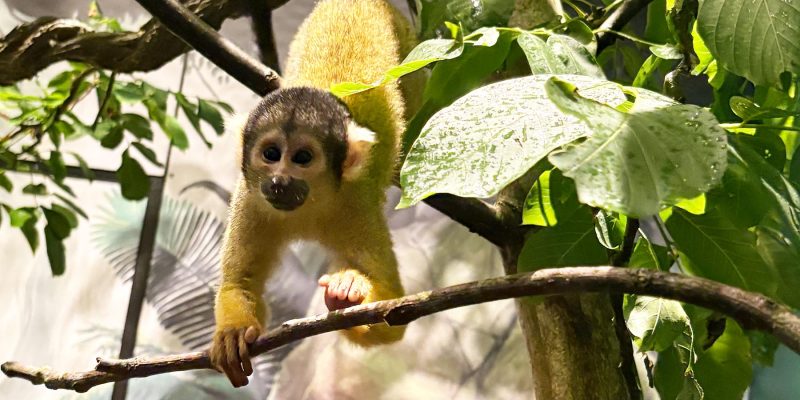
Nine female squirrel monkeys have moved into a rebuilt enclosure in the jungle section at Tierpark Hagenbeck, and they are a species the Hamburg park has never kept before. Hagenbeck announced the move on July 16, 2026.
The enclosure itself is the news. Hagenbeck’s own tradespeople rebuilt it over several months, and the park’s apprentices did the planting. The result is built around what squirrel monkeys actually do: these are small, restless, highly arboreal South American primates that spend their days moving, so the space is filled with climbing routes and enrichment, along with places to get away from each other and from the public.
What the park is planning next for the enclosure
Hagenbeck said it intends, in time, to house the squirrel monkeys together with green-winged macaws and armadillos. That arrangement has a name in zoo practice: a mixed-species exhibit, where animals that share a habitat in the wild share one enclosure in a collection. The park’s argument for it is the standard one and it has two halves. Animals in a mixed exhibit encounter each other, which produces more of the behavior they would show in the wild and more to react to day to day. Visitors, meanwhile, see a slice of a South American forest rather than one species in one box.
For now the monkeys have the space to themselves while they settle.
“Unsere Totenkopfaffen erkunden nun erst einmal ihr neues Revier und dürfen sich in aller Ruhe eingewöhnen. Wir beobachten gespannt, wie sie ihre Umgebung Schritt für Schritt entdecken und die vielen Kletter- und Beschäftigungsmöglichkeiten für sich nutzen,” said section keeper Mark Hollensen: “Our squirrel monkeys are exploring their new territory for now and are allowed to settle in at their own pace. We are watching with interest as they discover their surroundings step by step and make use of the many climbing and enrichment opportunities,” in a statement translated from German.
Which species, and how threatened is it?
Hagenbeck did not say. The release uses only the German common name Totenkopfaffen, which covers the whole genus Saimiri, and it does not identify which of the squirrel monkey species the nine females belong to. Because the species is unstated, there is no single IUCN Red List assessment to attach to them: the genus spans several species whose assessments differ, and picking one would be inventing a fact the park did not provide.
What the park did say is general and accurate: squirrel monkeys are under growing pressure in their native range, with habitat destruction and the illegal wildlife trade named as the threats, and Hagenbeck argues that modern zoos contribute to keeping threatened species going through husbandry, education and coordinated breeding programs.
The move is the second piece of enclosure work Hagenbeck has publicized this summer, alongside the rebuilt flamingo pond at the Africa panorama. The park also returned its Art Nouveau entrance gate to its original site, which reopened to visitors in August.
The announcement is on the park’s press pages: Hagenbeck auf Langstrumpfs Spuren.
Quick answers
- What moved into Tierpark Hagenbeck's jungle section?
Nine female squirrel monkeys, a species the Hamburg park had never kept before. Hagenbeck announced the move on July 16, 2026.
- Is the enclosure new?
It was rebuilt. Hagenbeck's own tradespeople reworked it over several months and the park's apprentices planted it. The design is built around climbing routes, enrichment and places for the monkeys to retreat from each other and from the public.
- Will other animals share the space?
That is the plan. Hagenbeck said it intends in time to house the squirrel monkeys with green-winged macaws and armadillos, a mixed-species exhibit in which animals that share a habitat in the wild share one enclosure in a collection. For now the monkeys have it to themselves while they settle.
- Which squirrel monkey species are they?
Hagenbeck did not say. The release uses only the German common name Totenkopfaffen, which covers the whole genus Saimiri. Because the species is unstated there is no single IUCN Red List assessment that applies, since the genus spans several species whose assessments differ.