
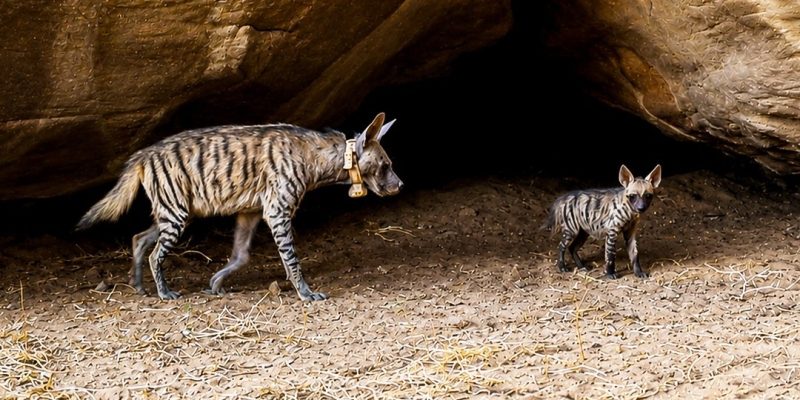
In August 2026, field teams watching a den in the NEOM Nature Reserve in northwestern Saudi Arabia photographed a female striped hyena walking out into the open with a cub behind her. It is the first birth recorded there since four striped hyenas were released into the reserve in November 2025, and it is the answer to the only question that finally matters about a reintroduction: not whether the animals survive, but whether they breed.
The National Center for Wildlife, the Saudi agency that runs the country’s wildlife breeding and reintroduction work, announced the birth on August 17 and credited the monitoring to a joint effort with NEOM.
What happened before the release
The hyenas did not go straight from a breeding pen to open desert. The center selected two pairs and put them through a conditioning and care program at its own holding facility first, which included veterinary examinations, ongoing health checks, and preparation for life in a wild habitat. A separate specialist team went out to the release site and assessed whether it was ready and ecologically suitable for the animals, which is the step that gets skipped most often and costs the most when it is.
In November 2025 the four animals were moved into the NEOM Nature Reserve under the supervision of the center’s veterinary teams and released at prepared sites inside it. After that the work became watching: tracking collars, field cameras, and people on the ground. The center and NEOM also ran a planned supplementary feeding program together, designed to support the hyenas’ natural foraging behavior rather than replace it while they adjusted to the habitat.
One of the collars is visible in the photograph the center released. The adult in it is wearing hers while she walks her cub out from under a sandstone overhang.
Why a birth is the real test
A reintroduction can look successful for a long time without being one. Animals that are released, tracked and fed will often stay alive and stay put, and that is worth something, but it does not yet make a population. Breeding in the wild does, because it means the animals have found food, found each other, found a den site they trust and raised young in it without help. The center’s own framing is that a first birth marks the point where a release turns into a population that might establish itself.
Dr. Mohammed Ali Qurban, chief executive of the National Center for Wildlife, put it this way in the center’s Arabic-language statement: “إن تسجيل أول ولادة للضبع المخطط بعد إعادة توطينه يمثل محطة مهمة ضمن برامج إكثار الأنواع الفطرية وإعادة توطينها” (“Recording the first birth of the striped hyena after its reintroduction represents an important milestone within the programs for breeding and reintroducing wild species”), in a statement translated from Arabic. He described the work as a chain that starts with captive breeding and rehabilitation and runs through habitat assessment, site selection and continuous monitoring after release, and said the collaboration with NEOM offers a model for working with large development projects.
Qurban added that the center has had real results breeding striped hyenas under human care, with a number of pups born at its breeding centers, and that putting those animals back into natural habitat is the more advanced stage: the point of the breeding is the wild population, not the breeding.
How threatened is the striped hyena?
The IUCN Red List assesses the striped hyena, Hyaena hyaena, as Near Threatened globally, with a decreasing population. It is a scavenger with an enormous range, from Morocco across the Sahel, through the Middle East and into India, and it is thinning out across most of it.
The center’s announcement makes no claim about the species’ category at all. It says the animal plays an important ecological role by feeding on carrion, and that its numbers have fallen in parts of its range because of hunting and poisoning. Both of those sit comfortably alongside the assessment, which lists persecution and poisoning among the threats. There is nothing here to correct, which is worth saying as often as the opposite is.
We looked for the zoo money and did not find any
ZooReviews traces the zoological funding behind conservation stories, because accredited zoos and aquariums pay for a great deal of field work that never carries their name. On this one the trace comes back empty.
The National Center for Wildlife is a Saudi government agency and the hyenas were bred at its own breeding centers. NEOM is a state-backed development company, and the reserve is part of its site. No accredited zoo or aquarium appears anywhere in the announcement, in the breeding, in the release or in the monitoring, and we found none behind it. That is a finding rather than a gap. Saudi Arabia has been building state capacity for this kind of work rather than importing it, and the striped hyena program is what that looks like from the outside.
For scale: the Association of Zoos and Aquariums reports that in 2025 its 235 accredited and certified facilities spent approximately $372.4 million on conservation across 139 countries. No published breakdown isolates how much of that reached Africa and the Middle East, so we are not going to invent one.
The same agency has been running a Bryde’s whale survey in the Red Sea since 2023, which we covered in our report on the Farasan Islands sightings, and the pattern is the same: government science, published in Arabic, thinly covered in English.
What happens next
The center says specialist teams are still following the cub’s condition and growth. Four adults and one confirmed cub is not a population, and the release is ten months old. But a female striped hyena chose a den in a reserve she had been in for less than a year, raised a cub in it, and walked it out into the daylight in front of a camera. That is further than most reintroductions get in their first year.
Quick answers
- What was born in the NEOM Nature Reserve?
A striped hyena cub. Field teams recorded the female emerging from her den with the cub for the first time in August 2026. It is the first birth documented since four striped hyenas were released into the reserve in November 2025.
- Where did the hyenas come from?
They were bred under human care at the National Center for Wildlife's own breeding centers in Saudi Arabia. Two pairs were selected and put through a conditioning and care program at the center's holding facility, including veterinary examinations and health monitoring, before release.
- How is the released group being monitored?
With tracking collars, field cameras and direct observation on the ground. The National Center for Wildlife and NEOM also ran a planned supplementary feeding program intended to support the animals' natural foraging behavior while they adjusted to the habitat.
- How threatened is the striped hyena?
The IUCN Red List assesses the striped hyena, Hyaena hyaena, as Near Threatened globally, with a decreasing population. The center's announcement claims no category for the species and says its numbers have fallen in parts of its range because of hunting and poisoning.