
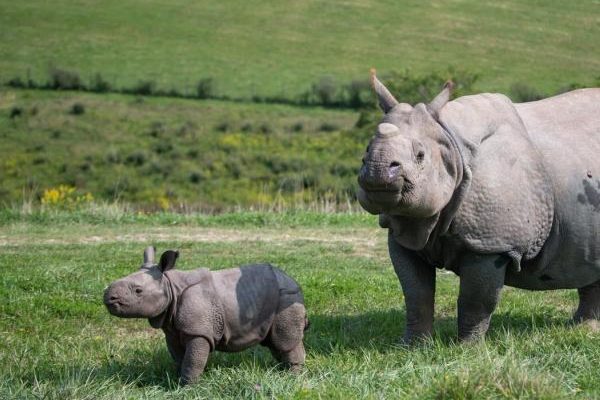
Six institutions have formed the American Institute of Rhinoceros Science, a research consortium aimed at the questions zoos still cannot answer about the rhinos in their care. The Wilds is one of them.
AIRS is funded by a National Leadership Grant from the Institute of Museum and Library Services and led by Dr. Terri Roth, vice president of conservation and science at the Cincinnati Zoo and Botanical Garden and director of its Center for Conservation and Research of Endangered Wildlife.
The collaborators are The Wilds, Disney’s Animal Kingdom, George Mason University, the South-East Zoo Alliance for Reproduction and Conservation, and Stellenbosch University in South Africa.
Four questions, chosen in advance
The consortium is working through priorities identified by the Association of Zoos and Aquariums’ Rhinoceros Research Council in 2019:
- Physical fitness and how it relates to health
- Iron storage in browsing rhinos
- Reproductive success
- Behavioral and environmental factors that maximise rhino wellbeing
The second one is the least famous and among the most consequential. Browsing rhino species, black and Sumatran, accumulate iron in their tissues under human care in a way they do not appear to in the wild, and iron overload has been implicated in a range of health problems that shorten lives in zoos. It is a problem created by captivity itself, which makes it exactly the kind of thing a zoo consortium is obliged to solve.
The design decision that matters
AIRS states plainly that its four priorities are interrelated and should not be studied in isolation. Over three years the scientists will run work within each pillar on overlapping subjects and examine effects across all of them, with data from every study compiled into a central database available to all members.
That is a deliberate rejection of how this research usually happens. The normal pattern is one institution, one question, one small sample, published separately, and rhinos are large, few, and expensive enough that no single facility has the numbers to say anything statistically solid.
Fitness, iron, reproduction and behavior are also not independent in the animal. An unfit rhino and an infertile rhino may be the same rhino for the same reason. Studying them together across six institutions is the only way to see that.
Why The Wilds is in it
The Wilds is nearly 10,000 acres of reclaimed Ohio strip-mine land where large herbivores live in pasture-scale herds rather than exhibit-scale enclosures. For questions about fitness, movement and herd behavior, that is a materially different research environment from a conventional zoo yard, and it is why a facility most people have never visited turns up as a partner on work like this.
Multi-institution consortia are becoming the standard answer to small-sample problems in zoo science, the same logic behind coordinated breeding recommendations across accredited institutions.