
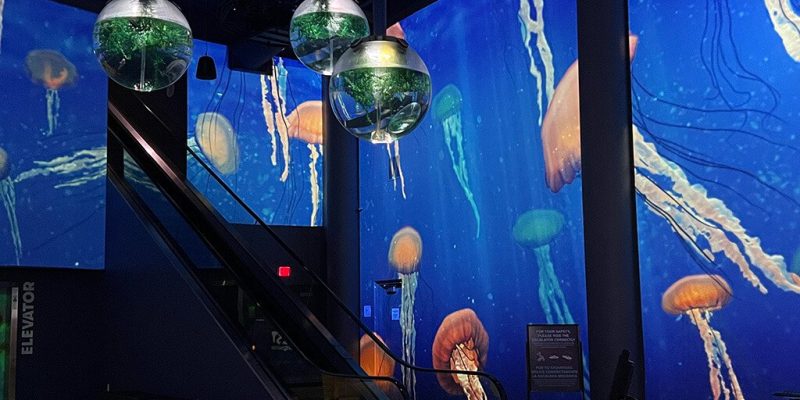
Most aquariums treat the lobby as a place to queue. OdySea Aquarium in Scottsdale, Arizona spent serious money turning its lobby into the first exhibit, with a 360-degree projection-mapped installation that opened in June 2025.
Six animated sequences run across 23-foot walls: jellies, corals, sea lions, penguins, sharks and otters, with ambient ocean sound underneath. The pitch is that guests are in the ocean the moment they walk through the door rather than waiting to reach a tank.
The room fought back
The technical problem here is more interesting than the concept, because OdySea’s lobby is close to the worst possible room for projection mapping.
It is oval rather than square. It contains a central ticketing desk, an escalator, several internal doors, and nine enormous Aqua Globes suspended from the ceiling, each holding live fish. The globes were founder and CEO Amram Knishinsky’s idea nearly a decade ago, and removing them was never on the table.
So the projection had to work around all of it: curved walls, an irregular footprint, and a set of immovable objects hanging in the middle of the image. Early proposals suggested confining the projection to one wall, or using lower-intensity projectors. The team rejected both.
“We want guests to feel like they’re in the middle of the deep blue sea the second they walk in,” Knishinsky said. “Not watching it, in it.”
Animated at ten times HD
The content was built by Paul Washburn, creative director at Malvern Entertainment, whose credits include Monsters University, Cars 3 and The Good Dinosaur with Pixar and Sony Pictures Animation. He assembled more than a dozen animators, art directors and digital artists with backgrounds at Netflix, Disney and Lucasfilm, led by animation director Simon Thomas of Start Studios.
The resolution requirement was close to ten times standard HD, because the animation had to span the full length of curved walls and still hold up at close range.
“When you’re animating at that scale, there’s no room for shortcuts,” Washburn said. “Every frame, every shadow, every flick of movement has to hold up at 30 feet wide.”
The part that makes it an aquarium project
The animation team worked with OdySea’s animal care staff on anatomical accuracy and behavioral authenticity for every species shown, studying in-house footage of the aquarium’s own animals alongside wildlife reference.
That is the detail that separates this from a screensaver. An animated sea lion that moves like a real sea lion teaches something; one that moves like a cartoon teaches the wrong thing to every child who then walks upstairs and watches the actual animal. Getting a Pixar-credited animator to take direction from a curator is the whole ballgame.
Screens in animal facilities are a live argument in the field, and the successful versions tend to be the ones pointed at the animals rather than competing with them. Adventure Aquarium’s Kaleidoscope Cove made a similar bet, building its interactives around the same ideas its tanks are about.