
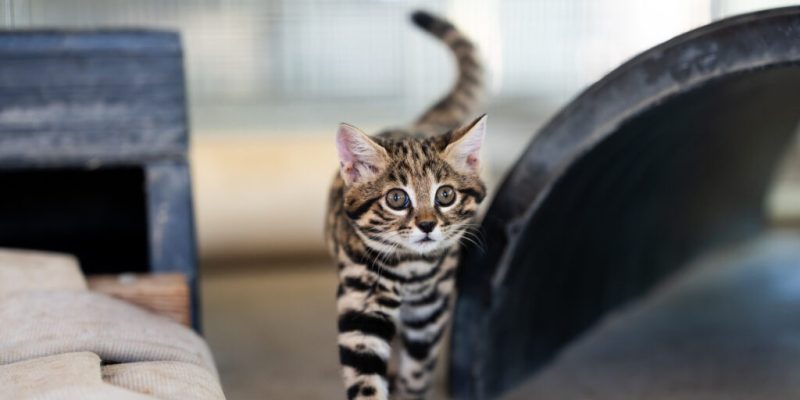
A black-footed cat kitten and a sand cat kitten have been born at The Living Desert Zoo and Gardens in Palm Desert, California, and the zoo is using the occasion to open a window onto the building where most of its conservation work actually happens. Both species reproduce rarely in human care anywhere in the world.
The black-footed kitten carries an extra distinction. Its own mother was born through successful breeding at The Living Desert, which makes this a second generation produced at the same facility.
Two of the hardest small cats in the business
The black-footed cat is one of Africa’s smallest and most formidable wild cats. The sand cat is built for extreme desert, and both are considered complex species to manage. Reproduction under human care has historically been limited, and there is still a great deal to learn about what these animals need to breed and raise young successfully.
Black-footed cats are among the most challenging small carnivores to breed and rear in professional care. Part of that is temperament and part is biology: they are naturally solitary, and in the wild a male and a female come together only briefly to mate. Every birth adds hard information about behavior, reproductive biology and kitten development, and that information travels straight back out to the institutions and field programs working on the species.
“These births are incredibly meaningful,” said Allen Monroe, President and CEO of The Living Desert. “Supporting the survival of a species takes extraordinary care, collaboration, and commitment, and we are incredibly proud and honored to play a role in that effort. These births provide valuable insights that contribute to ongoing efforts to ensure these species can persist for generations to come.”
Inside DC3
The work centers on the Desert Carnivore Conservation Center, known as DC3, a behind-the-scenes facility built in 2016 for the breeding, research and conservation of small desert carnivores. It was designed around a specific gap: species that are underrepresented in zoos, difficult to study and harder still to reproduce. DC3 has produced multiple successful births in recent years.
The approach inside is less about intervention than about giving the animals room to be themselves. Care staff build habitats and daily routines around habitat complexity, choice-based environments and enrichment that encourages exploration and hunting behavior. Cats that get to make their own decisions behave more like wild cats, and cats behaving like wild cats breed better. That is the working theory, and the births keep supporting it.
A very small club
The Living Desert is one of just 14 institutions worldwide that hold and manage black-footed cats, and one of 22 that manage sand cats. It works with the Association of Zoos and Aquariums through Species Survival Plan programs and through the Black-Footed Cat Consortium, which is where breeding recommendations, population management and shared research come together. Daily monitoring, veterinary care and detailed tracking of developmental milestones all feed that pool.
Black-footed cats are classified as Vulnerable by the International Union for Conservation of Nature, with fewer than 10,000 mature individuals estimated to remain across southern Africa.
“These animals play an important role not only in their ecosystems, but also as ambassadors for conservation,” said RoxAnna Breitigan, Chief Operating Officer of The Living Desert. “Everything we do behind the scenes, from research to breeding, supports our mission to preserve biodiversity and prevent extinction.”
The best hunter in the cat family
Here is the fact worth carrying out of the building. Despite being one of the smallest wild cats on Earth, the black-footed cat is the most successful hunter of any feline species, with hunting success rates estimated at around 60 percent. The African lion, one of the largest cats in the world, has one of the lowest.
Guests at The Living Desert may only catch a brief look at either of these desert carnivores, which is what small, secretive, nocturnal cats do. The kittens behind the scenes are the reason there will be more of them to catch a look at.