
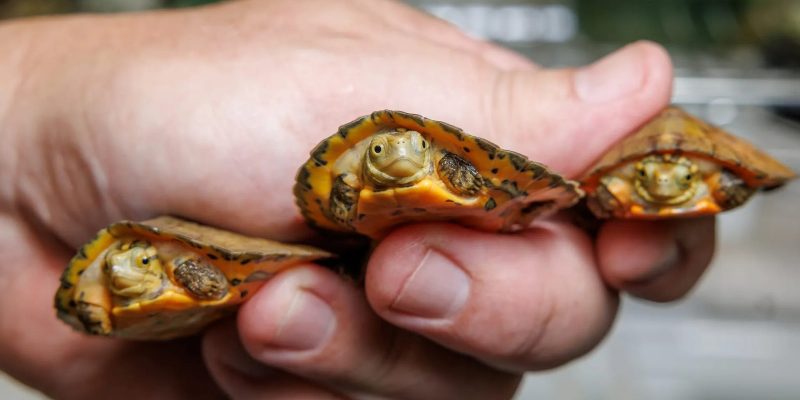
Seven turtles hatched at the Tennessee Aquarium between mid-May and early July 2026, and the man responsible calls it a slow year.
The Chattanooga aquarium holds the largest publicly viewable collection of freshwater turtles in North America. The new arrivals include three Four-eyed Turtles, listed as critically endangered, a Beal’s Four-eyed Turtle and a Spotted Turtle, both endangered, an endangered Ringed Map Turtle, and a Hilaire’s Side-necked Turtle, which carries no listing.
The Ringed Map Turtle is the first of its species to hatch at the aquarium since 1998.
“Actually a good number”
“This is the time of year when we get most of our turtle hatchings, but we haven’t had quantities of anything this year,” said herpetology collection coordinator Bill Hughes. “But we didn’t really want to hatch a lot this year, so three Four-eyed Turtles is actually a good number.”
Hughes is entering his 22nd year at the aquarium. In 2007 he hatched the first Four-eyed Turtle ever produced in human care. The aquarium has since added 72 of them to the managed population, sending some to other accredited institutions including the Bronx Zoo, Zoo Knoxville and Cameron Park Zoo in Waco, Texas.
Since opening in 1992 the aquarium has hatched 1,166 turtles across 56 species and subspecies, an average of about 34 a year.
Keeper of the seasons
Hatching turtle eggs comes down to controlling substrate, water access, heat and humidity. For species with no history in human care, finding the right combination is largely guesswork.
The Hilaire’s Side-necked Turtle shows how far that can go. The species comes from south-central South America and lays its eggs during the cool, dry season, when a hatchling would struggle. The eggs handle this by pausing development, a process called diapause, until conditions improve. Once developed, the babies delay hatching again until rains and rising water tell them it is safe.
To reproduce that arc, Hughes starts the eggs cool and dry in an incubator, warms them slowly, then spritzes them to simulate the arrival of the rainy season.
“One signal makes them develop; another signal makes them go ‘Hey, it’s time to hatch,'” he said.
What he learns does not stay in Chattanooga. Specialists trade findings between institutions, which is how a species moves from unheard-of in human care to routine. “Information gets propagated,” Hughes said. “When I started the stud book for Spiny Turtles, it was not common for them to hatch in human care.”
More eggs are close to hatching, including another pair of Ringed Map Turtles and clutches from Central American Wood Turtles and Yellow-blotched Map Turtles, all developing in incubators. The hatchlings can be seen in the Turtle Nursery in the River Journey building.