
Thirty-four endangered humped tree snails are living at the Saint Louis Zoo after biologists pulled them off Guam days before a category five typhoon made landfall.
The snails, Partula gibba, arrived following an emergency rescue in early July 2026 coordinated with the U.S. Fish and Wildlife Service, the Hawaii Snail Extinction Prevention Program, the United States Marine Corps and the University of Guam. The zoo announced their arrival on August 17.
They are the first humped tree snails ever kept at the Saint Louis Zoo, and the first of their species to come under professional care at any institution accredited by the Association of Zoos and Aquariums. The species survives in a few small, isolated groups across Guam and the Commonwealth of the Northern Mariana Islands.
Two storms, months apart
Typhoon Sinlaku hit the region in April 2026 and did severe damage. What it left behind is what made the second storm so dangerous.
“Sinlaku destroyed the canopy for the two known remaining subpopulations in Guam, and microhabitat conditions were extraordinarily harsh,” said Dr. Curt Fiedler of the University of Guam College of Natural and Applied Sciences. “In the aftermath, one subpopulation was apparently wiped out, and the other was down to tens of individuals. We felt that a similar storm event hitting Guam could result in all Partula gibba being extirpated.”
Fiedler’s team has monitored the species for several years with funding from Naval Facilities Engineering Systems Command Marianas. As Super Typhoon Bavi intensified in early July, they moved.
A narrow window before lockdown
On Friday, July 3, Fiedler and his biologists worked with the U.S. Marine Corps to collect dozens of snails from one of the last known populations at Marine Corps Base Camp Blaz in Dededo. They had until the base closed ahead of Bavi’s expected arrival on July 6.
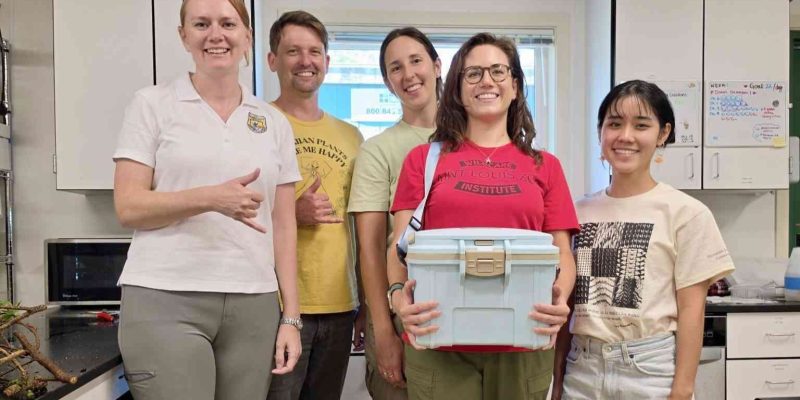
U.S. Fish and Wildlife Service staff evacuating the island carried the snails to Hawaii. The Snail Extinction Prevention Program lab in Honolulu, which coordinates breeding and reintroduction for 40 snail species found only in Hawaii, held them while the Saint Louis Zoo prepared.
The snails now live at the zoo’s Bayer Insectarium under the WildCare Institute Partula Snail Program, which manages assurance populations of some of the world’s rarest tree snails.
“This recovery would not be possible without the support and dedication of our partners every step of the way,” said Kayla Garcia, the zoo’s zoological manager of invertebrates. “Moments like this reinforce how critical it is to work together for the species that need us.”
The zoo notes that typhoons in the western Pacific have grown more frequent and more intense in recent decades, damaging forest habitat and infrastructure across Guam and the Northern Marianas.