
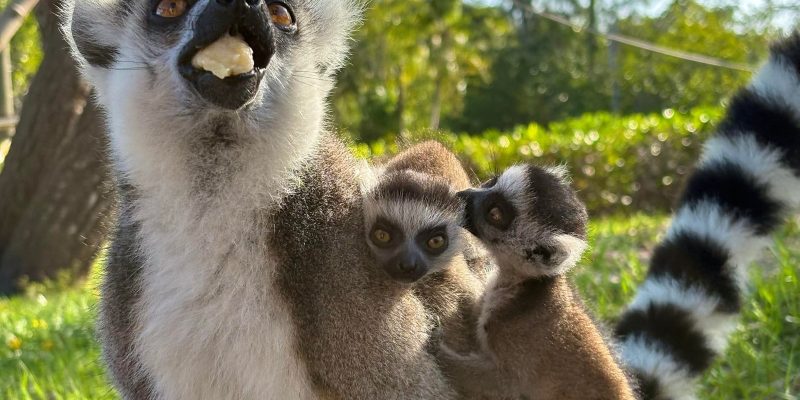
Naples Zoo at Caribbean Gardens announced the birth of twin ring-tailed lemurs on March 25, 2025, two males named Rano and Afo. The names are Malagasy. Rano, which the zoo renders as “Rah-noo,” means water. Afo, “Ah-foo,” means fire. Their older brother, born a year earlier to the same pair, is Velo, “Vay-lou,” which means life.
The parents are PJ and Julien, matched for breeding by the Association of Zoos and Aquariums Species Survival Plan. An SSP is the mechanism that decides which animals at which institutions should have offspring together, working from a studbook of the whole North American population, so that a species held across dozens of zoos stays genetically diverse instead of quietly collapsing into a few related family lines. PJ and Julien were paired by that calculation rather than by proximity.
The zoo reported PJ as an attentive mother to both infants, and Velo as taking to his role as older brother.
Why are twins normal for this species?
Ring-tailed lemurs commonly produce twins, which sets them apart from most primates their size and matters for how the infants are carried. A newborn rides on its mother’s front, gripping her fur, and transfers to her back as it gets stronger. Two at once means an animal roughly the size of a house cat carrying two passengers while moving through trees and foraging for herself.
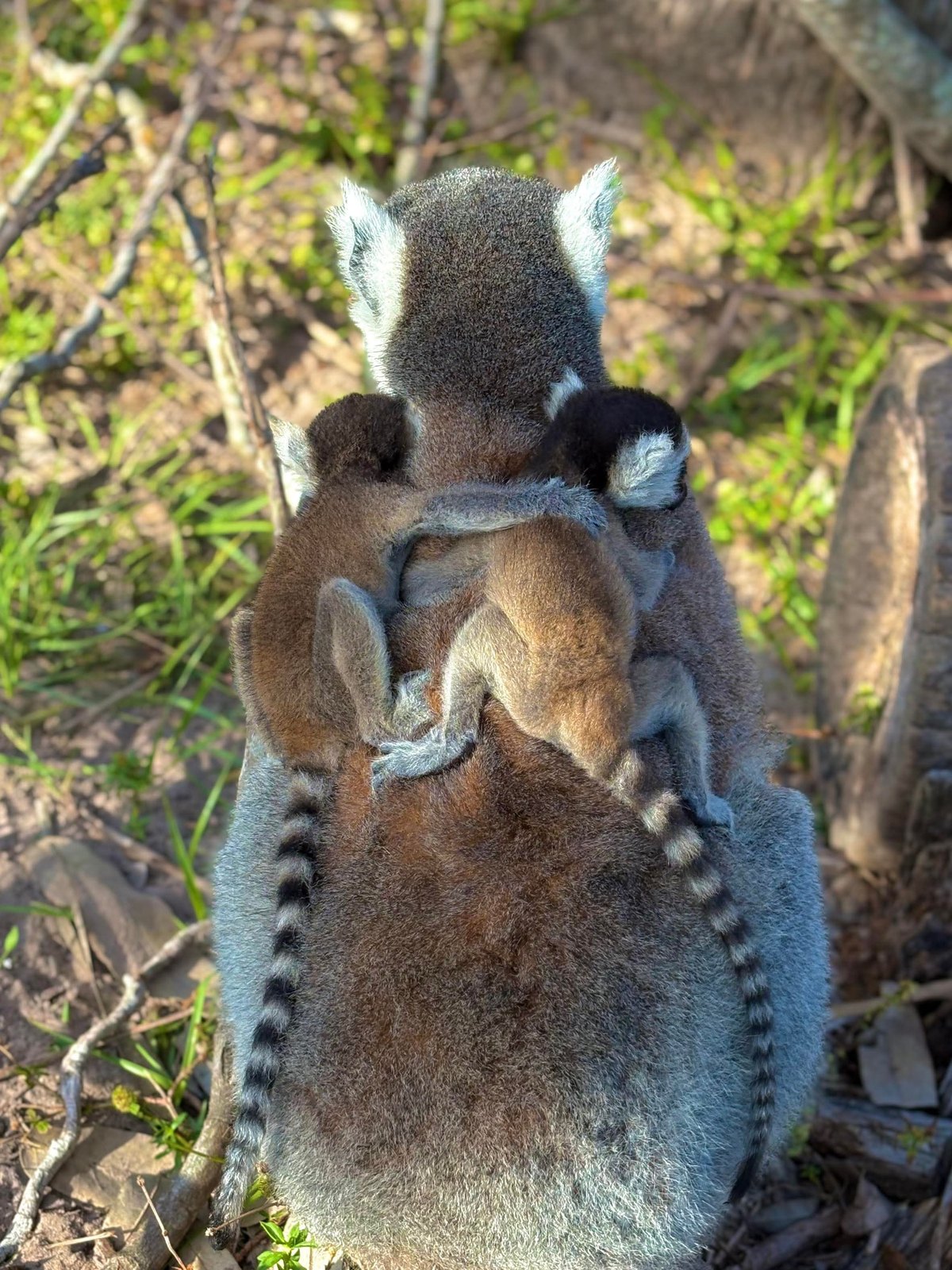
They also live in female-led troops, which is unusual among primates and ordinary among lemurs. The practical consequence for a zoo troop is that the infants grow up inside a social group with an established structure rather than a pair bond, which is the arrangement they would have in Madagascar.
How many ring-tailed lemurs are left?
This is where the honest answer is less satisfying than the one usually quoted. The ring-tailed lemur is listed as Endangered on the IUCN Red List, assessed on 9 May 2018 by M. LaFleur and L. Gould and published in 2020. The assessment records the population as decreasing and severely fragmented, and it gives no global figure for the number of mature individuals at all. The field, in other words, does not have an agreed count.
Naples Zoo cites fewer than 2,000 surviving in the wilds of southwestern Madagascar, about half the number of thirty years ago. That figure comes from survey work rather than from the Red List, and it is worth labeling as such, because the Red List is the document most readers can go and check and it declines to put a number on this species. The category is not in dispute. Endangered is what the assessment says and Endangered is what the zoo says.
What the assessment is specific about is why. The threats listed are livestock farming and ranching, hunting and trapping, logging, fire, drought and temperature extremes, which is the same list the zoo gives in shorter form as habitat loss and illegal hunting, including inside protected areas. A species can be common in the places it still occupies and endangered because those places keep getting smaller.
What Naples Zoo does in Madagascar
The zoo has supported lemur conservation in Madagascar for close to thirty years, and it serves as the international headquarters of the Madagascar Fauna and Flora Group, a consortium of zoos, botanical gardens and universities working in the east of the country on field conservation, research, education and training local capacity.
That is a more substantial claim than most zoos can make about a species on display. The headquarters of a multi-institution consortium is an operating responsibility, not a membership certificate, and it means the troop on the islands at Naples is attached to work in the animals’ range rather than standing in for it.
Guests see the lemurs from the water. The Primate Expedition Cruise runs a catamaran on the zoo’s Lake Victoria past islands where primates live in open habitat with no bars between them and the boat, a 15 to 20 minute trip with a guide narrating, included in admission. Twins on a mother’s back, moving through trees on an island, is roughly the view the species gives you in Madagascar, minus the plane.
Lemur twins have been a recurring piece of good news across the field, from ruffed lemur twins at the Central Park Zoo to collared lemur twins at the Bronx Zoo. Naples Zoo’s own recent run has leaned toward the Florida wild as much as the Malagasy one, including a Florida panther kitten rescue. Rano and Afo are the Madagascar side of the same institution, born into a troop that is itself a small piece of a population being managed as one.
Quick answers
- When were the Naples Zoo lemur twins born?
March 25, 2025. The zoo announced two males, named Rano and Afo, born to PJ and Julien.
- What do the names Rano and Afo mean?
They are Malagasy. Rano, which the zoo renders as Rah-noo, means water. Afo, Ah-foo, means fire. Their older brother Velo, Vay-lou, means life.
- Do ring-tailed lemurs usually have twins?
Yes. Twins are common in this species, which is unusual among primates of its size. Infants ride on the mother’s front at first and move to her back as they get stronger.
- How many ring-tailed lemurs are left in the wild?
There is no agreed figure. The IUCN Red List lists the species as Endangered, assessed on 9 May 2018 and published in 2020, and records the population as decreasing and severely fragmented, but gives no global count of mature individuals. Naples Zoo cites fewer than 2,000 in southwestern Madagascar, a figure from survey work rather than from the Red List.
- What does Naples Zoo do in Madagascar?
It has supported lemur conservation there for close to thirty years and serves as the international headquarters of the Madagascar Fauna and Flora Group, a consortium of zoos, botanical gardens and universities working in eastern Madagascar.
- Where can visitors see the lemurs at Naples Zoo?
From the Primate Expedition Cruise, a 15 to 20 minute guided catamaran trip on the zoo’s Lake Victoria past islands where primates live in open habitat. It is included in admission.