
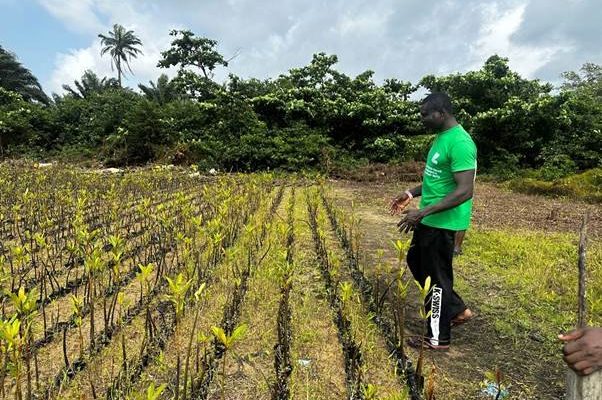
Twenty-three hectares of degraded mangrove in the Niger Delta have been replanted with 80,000 mangrove planting units, across two sites in two Nigerian states, and in one of them the work began by pulling out a palm.
The Nigerian Conservation Foundation published the account on November 19 as part of its Catalyzing Local Action for Climate Justice in Nigeria project, which is supported by the Ford Foundation. The numbers split as eight hectares at Bodo and Baa in Rivers State, with 40,000 planting units, and 15 hectares at Akassa and Curlew Island in Bayelsa State, with a further 40,000 propagules and 80 community members working on the restoration alongside the Safe Earth Foundation.
Why a palm is the problem
The invasive species in this story is nypa palm, introduced to the region decades ago, and the Bodo and Baa work involved removing it before anything could be planted. Nypa competes with native mangrove for space along the same waterlines, and the foundation treats its spread as a threat to the ecological balance of the coastal wetlands rather than as untidy vegetation.
It is not the only pressure. The foundation lists oil pollution, deforestation and unsustainable resource use alongside the palm, and describes mangrove loss as something that runs straight through to people: fish habitat is affected, shoreline protection weakens, and the natural resources local livelihoods rest on become less reliable. Mangroves here are breeding and feeding grounds for fish and other aquatic species, a buffer for vulnerable shoreline and a carbon store, which is three arguments for the same trees.
The restoration is a recruitment exercise
The foundation’s framing is that planting trees is not the hard part. Sustained restoration, local participation and durable stewardship are, and the project is built around engagement with traditional and religious leaders as well as with the people who fish the water.
That is a practical judgment rather than a courtesy. Coastal restoration depends on knowledge of tides, waterways, vegetation and who uses which stretch of water, and the foundation argues that the people living closest to a site can make implementation and monitoring work better than an outside team can. Eighty community members at Akassa and Curlew Island is a workforce, and it is also eighty people with a reason to notice if the seedlings start disappearing.
The account carries a community voice from Bodo, where Christian Tombarikpene recalls how severely oil pollution had affected the area and how little mangrove vegetation was left when the foundation’s team first arrived.
One project, several levers
The mangrove planting is one strand of the same Ford Foundation-supported project that has been running livelihood work along the coast. In the same week the foundation described training 100 people across two communities in turning nypa palm fibres into bags, baskets, flower vases and book covers, with tools, starter materials and basic business guidance, and the installation of solar-powered cold storage at Oyorokoto in Rivers State and the Okuntu fishing settlement in Delta State, two deep freezers and eight solar panels in the first of them, used by 40 women at each site.
The logic connecting them is that mangroves are cut for fish smoking, so anything that lets a household preserve a catch without firewood takes pressure off the same trees the restoration is replanting. We reported an earlier instalment of that argument when the foundation introduced more efficient fish smokers in Bayelsa, for the same reason.
Which zoos or aquariums paid for this?
None that we can find, and the funder here is named openly, which makes the answer unusually clean. The Nigerian Conservation Foundation credits the Ford Foundation for the Catalyzing Local Action for Climate Justice in Nigeria project, and the Safe Earth Foundation as a partner at Akassa and Curlew Island. No accredited zoo or aquarium appears anywhere in the account, and we have not been able to attach one from the foundation’s side either.
That is a finding rather than a gap. A private American philanthropy funding mangrove restoration in Rivers and Bayelsa is a different funding ecology from the one that pays for most of the field conservation we cover, where the money frequently traces back to gate receipts at a zoo several thousand miles away. The Association of Zoos and Aquariums reports that 235 accredited and certified facilities spent about 372.4 million dollars on conservation across 139 countries in 2025, and no published breakdown isolates an African share, so there is no figure to set against the Ford Foundation’s. What there is, is a named funder and an absent one, and both are worth printing. We have covered the foundation’s work on its own terms before, from the tourism award its Lekki Conservation Centre won to twenty years of its Walk for Nature in Lagos.
Quick answers
- How much mangrove was restored?
Approximately 23 hectares across two sites, with 80,000 mangrove planting units deployed: eight hectares at Bodo and Baa in Rivers State with 40,000 units, and 15 hectares at Akassa and Curlew Island in Bayelsa State with a further 40,000 propagules.
- Why was nypa palm removed?
Nypa palm was introduced to the Niger Delta decades ago and competes with native mangrove for space along the same waterlines. The Nigerian Conservation Foundation treats its spread as a threat to the ecological balance of the coastal wetlands, so it was cleared at Bodo and Baa before replanting.
- Who paid for the work?
The Ford Foundation, through the foundation’s Catalyzing Local Action for Climate Justice in Nigeria project. The Safe Earth Foundation worked on the Akassa and Curlew Island restoration. No accredited zoo or aquarium appears in the funding for this project.