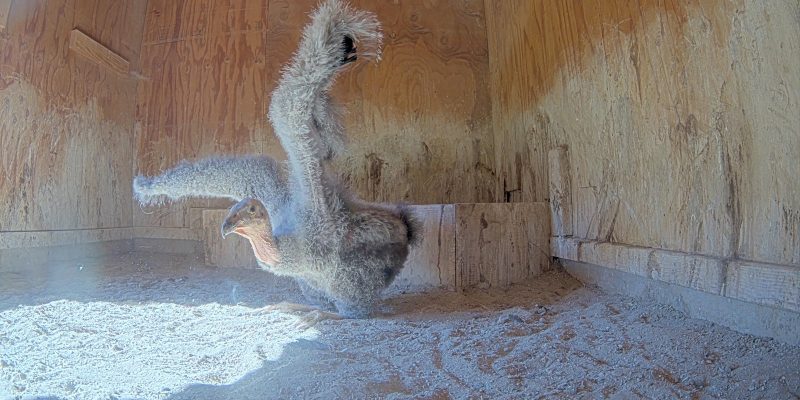
Twelve California condor chicks hatched at the Oregon Zoo this year, and in September they started doing the thing the whole operation is built around: leaving the nest box. The first chick stepped out in August. The other eleven were hopping and flapping behind it.
The work happens at the zoo’s Jonsson Center for Wildlife Conservation, on Metro-owned open land in rural Clackamas County, well away from the main zoo and deliberately so. Young condors that see very few people are young condors with a better chance of surviving and breeding once they are released.
What a condor chick’s first year looks like
“They’re not full-fledged condors yet,” said Nicole LaGreco, who oversees the zoo’s condor recovery efforts. “But they’ll be feathered and flying on their own soon enough, getting ready to soar off into the wild.”
The schedule is long by bird standards. A chick stays with its parents for at least eight months, then spends about a year in large outdoor pre-release pens before it goes anywhere. That is roughly two years from egg to release site, which is why a dozen chicks in one season is a meaningful number rather than a routine one.
The cohort ahead of them has already moved. Nine condors from last year’s group left the conservation center in early September for wild release sites in California and Arizona, where they will eventually join free-flying birds.
The numbers behind the recovery
The California condor was among the original species listed under the Endangered Species Act in 1973. By 1982 there were 22 left in the wild, and by 1987 the last of them had been brought into human care, which is as close to the edge as a species gets while still having a future.
The zoo puts the world population today at more than 600 birds, most of them flying free. The IUCN Red List assesses Gymnogyps californianus as Critically Endangered, which matches the zoo’s own description, and it is worth being precise about what the Red List counts: its 2020 assessment gives 93 mature individuals, against a December 2019 total of 337 birds in the wild and 181 in human care, 518 in all. The gap between 93 and 600 is not a disagreement. One figure counts every condor alive; the other counts the birds that have produced viable offspring, which is the quantity that decides whether a population can sustain itself. Both are true, and the smaller one is the one that explains why the species is still listed where it is.
The Red List notes something else worth knowing: the population rose above the Critically Endangered threshold in 2019, and the species stays in that category under the Red List’s five-year rule, which holds a listing in place until a recovery has demonstrably held.
What the Jonsson Center has produced
More than 150 chicks have hatched at the center since 2003, and more than 100 Oregon Zoo-reared birds have gone out to field pens for release. Several eggs laid by the zoo’s condors have been placed into wild nests to hatch under wild parents, which is a quieter contribution than a release and arguably a better one.
Upgrades and equipment at the center have come through support from U.S. senators Jeff Merkley and Ron Wyden, the Avangrid Foundation, and donations to the Oregon Zoo Foundation.
Why remoteness is the point
A condor that associates people with food is a condor that will approach a road, a campsite or a power line. Keeping the rearing facility deliberately out of the way is a welfare and survival decision rather than a logistical one, and it is the reason visitors to the Oregon Zoo do not see this part of its work. The twelve chicks growing their flight feathers this autumn will not be on exhibit. They are going somewhere better.
The zoo runs other native-species recovery work closer to home; our report on its northwestern pond turtle hatchlings covers the reptile end of the same program.
Source: Oregon Zoo, September 14, 2026.
Quick answers
- How many condor chicks hatched at the Oregon Zoo in 2026?
Twelve, at the zoo’s Jonsson Center for Wildlife Conservation in rural Clackamas County.
- How long before a condor chick is released?
A chick stays with its parents for at least eight months, then spends about a year in large outdoor pre-release pens, so roughly two years from egg to release site.
- How is the California condor listed?
The IUCN Red List assesses Gymnogyps californianus as Critically Endangered, in an assessment published in 2020.
- How many California condors are there?
The Oregon Zoo puts the current world population at more than 600 birds, most of them flying free. The 2020 IUCN assessment counts 93 mature individuals, against a December 2019 census of 337 wild and 181 in human care. The two figures count different things.
- What has the Jonsson Center produced?
More than 150 chicks hatched since 2003 and more than 100 Oregon Zoo-reared birds sent out to field pens for release.
- Why is the condor center kept away from the zoo?
Remoteness limits how much contact young condors have with people, which raises their chances of surviving and breeding once released.