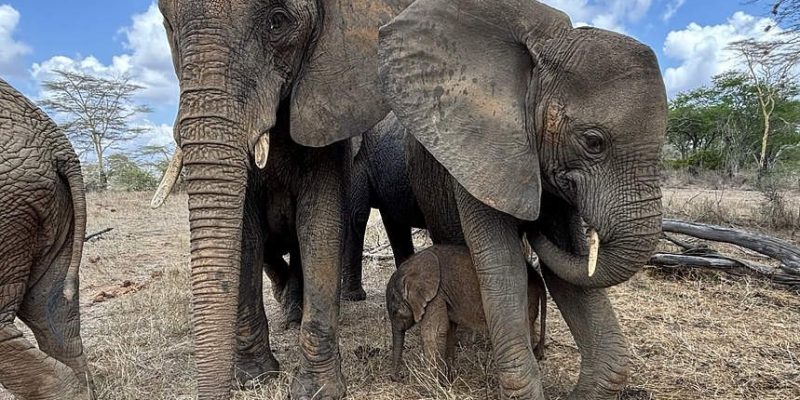
At two o’clock in the morning on October 29, just after a sprinkling of rain, keepers at the Sheldrick Wildlife Trust’s Umani Springs reintegration unit in Kenya’s Kibwezi Forest heard something drop, then a chorus of rumbles and trumpets. They got out of bed and found an elephant named Murera cleaning a brand-new calf. The keepers joined in, throwing shovelfuls of dust over the baby so she would dry faster. The Trust has named her Mwezi, which is Swahili for moon, because she was born under a near-full one.
Mwezi is Murera’s second daughter. That sentence is worth stopping on, because fourteen years ago the veterinarians who examined Murera recommended that she be put down.
What happened to Murera in 2012
Murera was rescued in 2012, at the height of Kenya’s poaching crisis. She had trodden on a poisoned spike trap, which tore open her hind leg, and while she was struggling to keep up with her herd she appears to have fallen and dislocated the opposite hip. Between the two injuries her entire hind end was effectively out of commission. She arrived at the Trust’s Nairobi Nursery in a state its keepers describe as broken in body and in spirit.
The recommendation to euthanise her was overruled by Daphne Sheldrick, who founded the Trust and who judged there was a sliver of hope worth working with. The keepers agreed with her. It was not a quick decision to vindicate. As Peter, one of the senior nursery keepers, remembers it: “At the beginning, it was very hard for all of us… At one point she gave up and stopped feeding, but we persisted and tried to encourage her to eat and showed her our love.”
Murera’s hip never fully recovered, and that is the fact that shapes everything since. She cannot range the way a sound elephant does. She lives at Umani Springs, a reintegration unit in the Kibwezi Forest where the browse is rich and close at hand, and she still chooses to come back to the stockades at night rather than sleep out in the forest with the others. That choice is why the Trust has an unusually complete record of her adult life, including both of her pregnancies.
What a reintegrated orphan actually is
The word the Trust uses for an elephant like Murera is ex-orphan, and it is doing real work. An ex-orphan is not a captive animal and not a wild-born one. She was hand-raised through infancy on milk formula, moved through a graduated set of units as she grew, and now lives at liberty in a protected forest, mixing with wild elephants, breeding on her own terms, and returning to human company as much or as little as she chooses. Murera returns most nights. Other Umani elephants, the ones the keepers call nightclubbers, sleep out and show up at the gate in the morning.
The two exceptions to Murera’s routine were both honeymoons: the absence that produced her first daughter, Mwana, and another in early 2025, when she spent the better part of a week being courted by a large bull. Her keepers describe a pregnancy of nearly two years, which is ordinary for an African savanna elephant and among the longest gestations of any mammal, during which she got bigger, slower and moodier, and in the final week refused to walk to the milk feeding point at all, waiting for her bottles to be hand-delivered instead.
Who was in the room
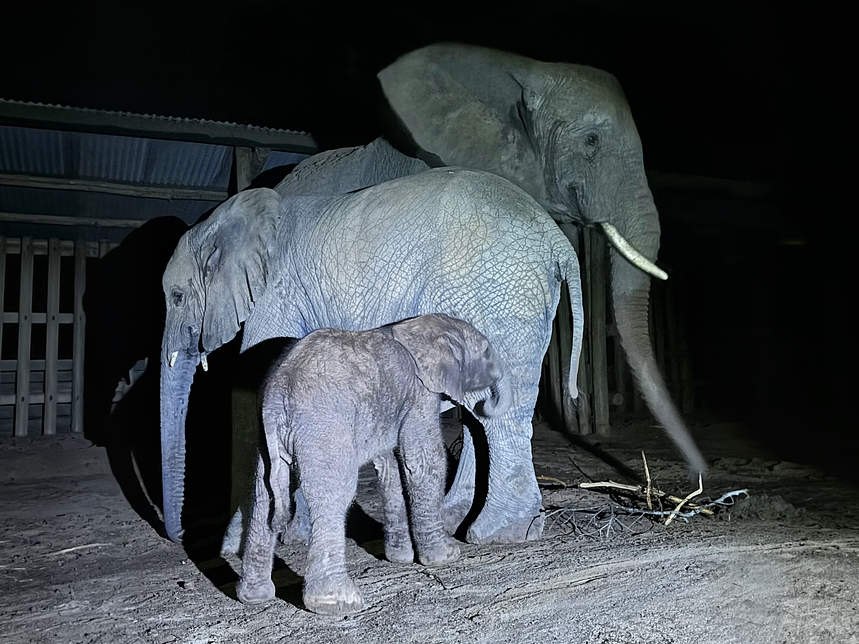
The detail that makes this more than a headline is what the other elephants did. Mwana, Murera’s first daughter, had apparently spent the whole pregnancy in denial, and spent the first minutes hovering behind her mother, unsure what the bundle on the ground was. When Mwezi got shakily to her feet and rumbled, Mwana stepped forward to meet her sister.
Amali, meanwhile, was pushing at the stockade wall trying to get in, so the keepers opened the gate and let her join. Kerrio and Latika stayed in their rooms until morning. By dawn the elephants who had slept out in the forest were waiting at the gate: word of the birth had traveled through the Kibwezi Forest overnight, by whatever means elephants use, and the whole Umani group had come home to meet her.
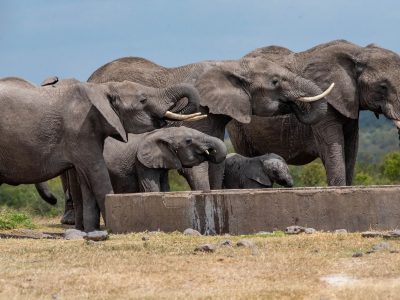
Then came the competition over who would mind the baby. Lima Lima, Sonje and Zongoloni, all mothers themselves, removed themselves from the running. Enkesha decided the field was too crowded and excused herself. Kiasa, Amali and Quanza are sharing the duties. The group has also changed its daily routine around Murera, browsing close to the stockades and taking mud baths and milk bottles there rather than walking out, which is what a herd does for a female who has just given birth and needs to rest.
Where the species stands
The African savanna elephant, Loxodonta africana, is assessed by the IUCN Red List as Endangered under criterion A2bd. That assessment was made on November 13, 2020 and published in amended form in 2022, and the population trend is recorded as decreasing. The Red List gives no global figure for mature individuals.
The amendment is worth a sentence, because it is the kind of thing a bare category hides. After the 2021 listing was petitioned, the IUCN Standards and Petitions Committee removed one sub-criterion and the assessors added text stating that a Vulnerable listing is a plausible outcome given the uncertainties in the data. The species is Endangered on the current assessment, and the assessors have themselves written down that the evidence is not airtight. Both halves are true and we would rather print both than either alone.
Generation length for the species is put at twenty-five years, which is the number that explains why a single birth to a single female is news. Elephants recover slowly or not at all.
Which zoos are paying for this?
We looked, and we could not verify any.
The Sheldrick Wildlife Trust publishes a partners page listing conservation organizations, government agencies and corporate supporters. No accredited zoo or aquarium appears on it, and neither the Trust’s account of Mwezi’s birth nor its material on the Umani Springs unit names a zoological institution as a funder. That is a finding rather than a gap, and a consistent one: the Trust is funded principally through its fostering program and direct donation, and it publishes a position opposing the capture of infant elephants for captivity, which is a real difference of view and not something to write around.
Where the chain does run through a zoo in this region we say so, as with the Saint Louis Zoo and Smithsonian partnerships behind Chad’s largest faunal reserve. Here it does not. For the sector-wide figure: the Association of Zoos and Aquariums reports that in 2025 its 235 accredited and certified facilities spent approximately $372.4 million on conservation across 139 countries. No published breakdown isolates the African share, so we are not going to estimate one.
What this one counts as
A calf born to a rehabilitated orphan is the clearest result the whole hand-rearing enterprise produces. It is the point at which an animal that was rescued stops being a recipient of care and starts adding to the population. The Trust counts these: in October it recorded its ninety-fifth known grandcalf, a wild-born animal whose mother was herself rescued and raised, when the ex-orphan Chaimu walked into the Ithumba stockades with a newborn. We covered that one here: an orphan’s daughter, and Tsavo’s 95th grandcalf.
Murera’s version carries an extra line of argument, and it is the one worth leaving with. The elephant who has just had her second daughter is the elephant the veterinarians said should be put down. The keepers who hand-fed her through the weeks when she stopped eating are the ones who stood in the dark on October 29 throwing dust over her baby. Mwezi exists because somebody in 2012 decided the hard case was worth the work.
Source: Sheldrick Wildlife Trust, “Murera Gives Birth to her Second Baby Girl, Mwezi,” November 3, 2026.
Quick answers
- Who is Murera?
An African savanna elephant rescued by the Sheldrick Wildlife Trust in 2012 after treading on a poisoned spike trap and dislocating a hip. She lives at the Trust's Umani Springs reintegration unit in Kenya's Kibwezi Forest.
- When was Mwezi born?
In the early hours of 29 October 2026, under a near-full moon. Her name is Swahili for moon. She is Murera's second daughter, after Mwana.
- What is an ex-orphan elephant?
An elephant that was hand-raised from infancy and has since been returned to life at liberty in a protected area, mixing and breeding with wild elephants. Murera still chooses to return to the stockades at night because of her hip.
- Why did veterinarians recommend euthanasia in 2012?
Her hind leg had been torn open by a poisoned spike trap and the opposite hip was dislocated, leaving her hind end effectively out of commission. Daphne Sheldrick overruled the recommendation.
- What conservation status does the species carry?
The African savanna elephant, Loxodonta africana, is assessed by the IUCN Red List as Endangered under criterion A2bd, on an assessment dated 13 November 2020 and published in amended form in 2022. The trend is decreasing.
- Do any zoos or aquariums fund the Sheldrick Wildlife Trust?
Not that we could verify. The Trust's partners page names conservation organizations, agencies and corporate supporters but no accredited zoo or aquarium, and it publishes a position opposing the capture of infant elephants for captivity.