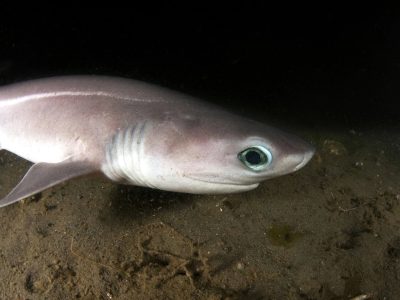
Four spotted gully sharks went back into the surf at Mgwalana in the Eastern Cape on October 19, carried down the beach one at a time on a stretcher. What makes the morning worth writing about is not the walk into the water. It is what each of the four is carrying under its skin: an acoustic tag with a ten-year battery, on a coastline wired to listen for it.
The Two Oceans Aquarium published its account of the release on October 31. Three of the sharks were male and one female. They had spent a few years in the aquarium’s Kelp Forest Exhibit in Cape Town and had simply outgrown it.
Getting four sharks to the Eastern Cape
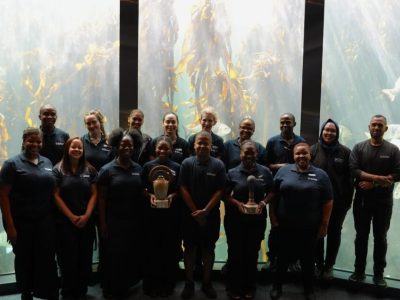
The aquarium’s curatorial and collections team drove them there in a purpose-built oxygenated chamber. At Mgwalana the team picked a stretch of beach where the water was calm, carried each shark into the surf on a stretcher, and held it there long enough to let it meet the ocean temperature before the straps came off.
“Each of the sharks swam off into the ocean strongly and confidently,” said Kevin Spiby, the aquarium’s curator of operations and animal husbandry. “Gully sharks display no parental care, so their natural instincts are hardwired into them from birth. This allows them to adjust easily back to life in the ocean after a period at the Aquarium.”
Mgwalana is not an arbitrary choice. It is where these sharks were caught, and the aquarium says the species is abundant there. All eleven of the sharks it has released under this program have gone back to the same beach.
The tag goes in a month before the animal goes out
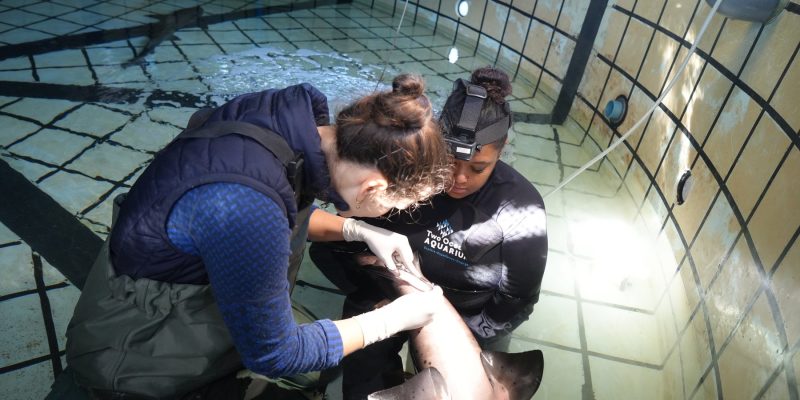
The release date is the end of a process, not the start of one. In the run-up, the four sharks came out of the Kelp Forest Exhibit and into separate holding for closer observation. Veterinarian Dr Ilse Jenkinson ran repeated health assessments on each one, including blood work, measurements and physical examination, and surgically implanted a VEMCO acoustic tag just under the skin.
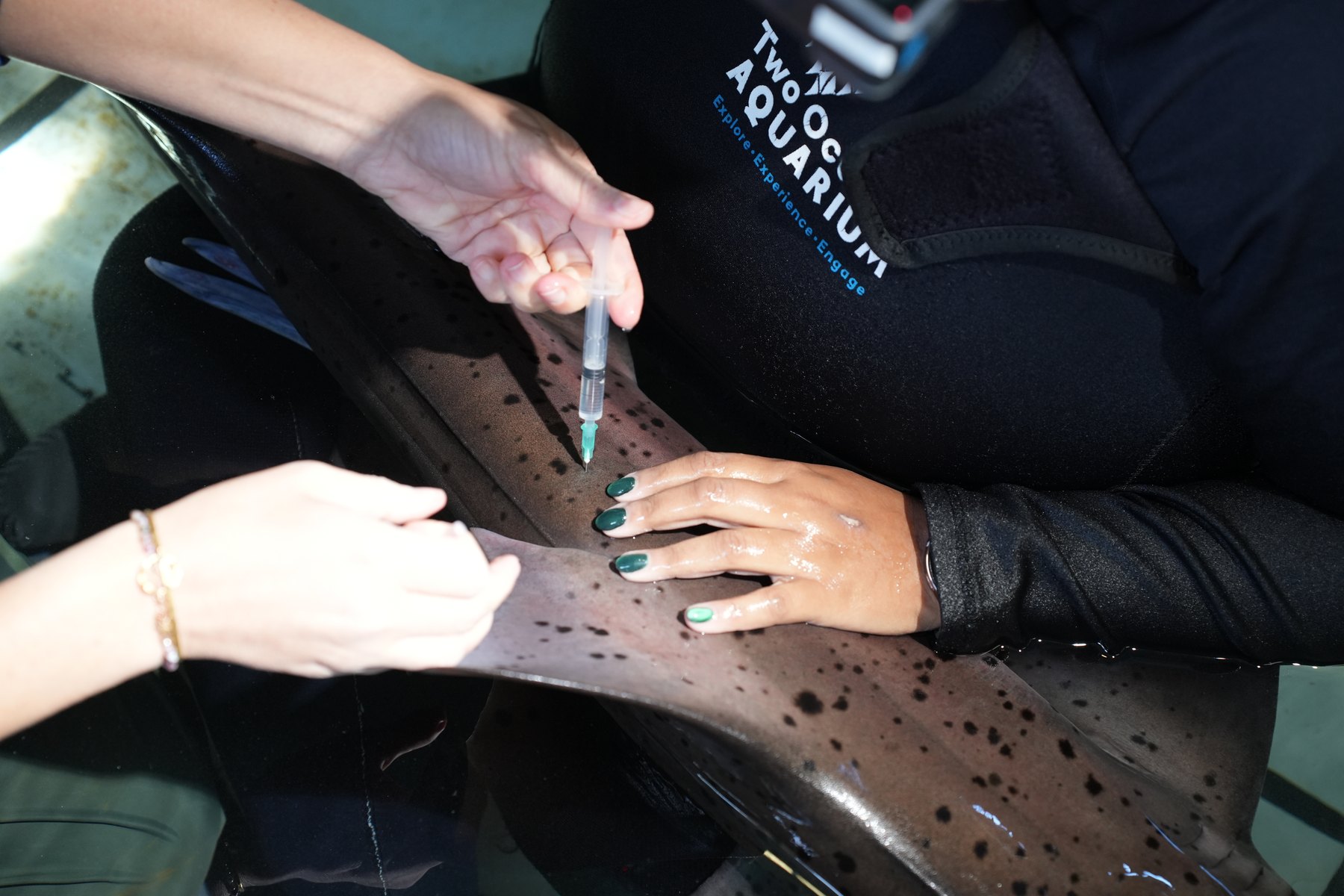
Then everyone waited. The sharks were not cleared for release until the surgical sites had fully healed, roughly a month later. That interval is the part of a release story that usually goes unmentioned, and it is the reason the animals can be let go at all.
What the coastline hears
Each tag emits a 69 kHz signal carrying a unique identifier. Receivers anchored to the seafloor log that identifier with a date and a time whenever a tagged animal passes within range.
The receivers are not the aquarium’s. They belong to the Acoustic Tracking Array Platform, a national network run by the South African Institute for Aquatic Biodiversity, which is a National Facility of the National Research Foundation. SAIAB field teams service the receivers, pull the data and send the aquarium a report on its own animals. An aquarium in Cape Town can therefore learn that one of its sharks passed a point several hundred kilometers away without going anywhere near it.
Eleven sharks, 357 detections, 650 kilometers
Four of this program’s earlier sharks went back in August 2024 and three more in February 2026. The platform has since reported 357 detections across those four tagged animals, ranging from 33 to 199 detections for an individual, picked up by 22 receiver stations spread over about 650 kilometers of coast, from the Port of Ngqura in Algoa Bay up to Aliwal Shoal on the southern KwaZulu-Natal coastline.
That is a wider range than a shark released at one Eastern Cape beach might be expected to keep to, and it is the kind of answer the method exists to produce. The aquarium is careful that it is early: several stations’ data still needs consolidating, and a ten-year tag has barely started work.
“It is an exciting prospect that our gully sharks have a whole decade of tracking potential ahead of them,” Spiby said. “The data they contribute will help us better understand the success of our tagging and release programs, as well as provide invaluable insight into how they adapt back into the wild.”
One tag kept moving, and that is a finding too
The largest female from the August 2024 release was picked up off Port Alfred about a month after she went in, by receivers run by Rhodes University’s Southern African Fisheries and Ecology Research Lab. She stayed in that area for eleven days and then dropped off the network entirely for 218 days.
Her tag surfaced again near Port St Johns, close to 400 kilometers further up the coast, moving at an average of 9.2 kilometers a day. Given the long silence and that rate of travel, the platform’s reading is that the shark was most likely taken by a larger shark, which then carried the tag.
The aquarium publishes this rather than leaving it out, which is the right call. A release program that only reports the animals it can still hear from is not measuring anything. This one can distinguish between a shark it has lost track of and a shark that has probably been eaten, and the difference matters when the question is how released animals actually fare.
A note on the listing
The aquarium’s account describes the four as ambassadors for “their endangered species” and refers to spotted gully sharks as a vulnerable marine species. The Red List does not put them in either category. Triakis megalopterus was assessed on August 1, 2019 and is listed as Least Concern, with no CITES listing. We default to the assessment.
That said, the concern behind the wording is not invented, and it is worth separating from the label. The species is confined to a short stretch of the world: southern Angola down to South Africa’s Eastern Cape, and only rarely as far as KwaZulu-Natal. A range that narrow means a national fishery or a local collapse is a global event for the animal, and published work on the species in the Western Cape has specifically examined its spatial vulnerability to exploitation. A Least Concern shark endemic to one coastline is still a shark worth putting 22 receivers behind.
Who is paying for this
Here the money is easy to trace, because the zoological institution is the one doing the work. The Two Oceans Aquarium held the animals, ran the veterinary program, bought and implanted the tags and drove the sharks to the Eastern Cape. The research partners are not zoos: the Acoustic Tracking Array Platform sits inside SAIAB, a National Research Foundation facility, and the Port Alfred detection came from a Rhodes University lab. We looked for a second accredited zoo or aquarium behind this release and did not find one, which is unsurprising when the aquarium is the whole of the animal-side operation.
The Association of Zoos and Aquariums reports that 235 accredited and certified facilities spent roughly $372.4 million on conservation across 139 countries in 2025, and no published breakdown isolates what any part of Africa received. This is the cheaper kind of contribution and the easier one to overlook: four animals that had outgrown an exhibit, turned into eleven data streams on a coastline that had none.
The aquarium has done this before with a different species. In March 2026 it returned the last of two surviving ragged-tooth sharks, seized at Cape Town International Airport in 2018, to the surf at Struisbaai, a case we covered in Eight Years of Evidence in a Case Never Brought.
Quick answers
- How many spotted gully sharks has the Two Oceans Aquarium released?
Eleven. Four went back in August 2024, three in February 2026 and four more on 19 October 2026. All eleven were released at Mgwalana in the Eastern Cape, which is where they were originally caught.
- What kind of tag do the sharks carry?
A VEMCO acoustic tag, implanted surgically just under the skin by veterinarian Dr Ilse Jenkinson. The tag emits a 69 kHz signal carrying a unique identifier and has a battery life of about ten years. The sharks were not cleared for release until the surgical sites had healed, roughly a month later.
- Who picks up the signal?
The Acoustic Tracking Array Platform, a national network of seafloor receivers managed by the South African Institute for Aquatic Biodiversity, a National Facility of the National Research Foundation. SAIAB field teams retrieve the data and report back to the aquarium on its own animals.
- What have the earlier releases shown?
357 detections across four tagged sharks, ranging from 33 to 199 for an individual, logged by 22 receiver stations across roughly 650 kilometers of coast, from the Port of Ngqura in Algoa Bay to Aliwal Shoal in southern KwaZulu-Natal.
- What happened to the shark whose tag kept moving?
The largest female from the August 2024 release was detected off Port Alfred about a month after release, stayed eleven days, then disappeared from the network for 218 days. Her tag reappeared near Port St Johns, almost 400 kilometers away, having averaged 9.2 kilometers a day. The platform's reading is that she was most likely preyed on by a larger shark that then carried the tag.
- Is the spotted gully shark endangered?
No. The aquarium's account calls it an endangered species, but Triakis megalopterus was assessed on 1 August 2019 and is listed as Least Concern, with no CITES listing. It is, however, restricted to southern Angola through South Africa's Eastern Cape, so a local decline would be a global one.