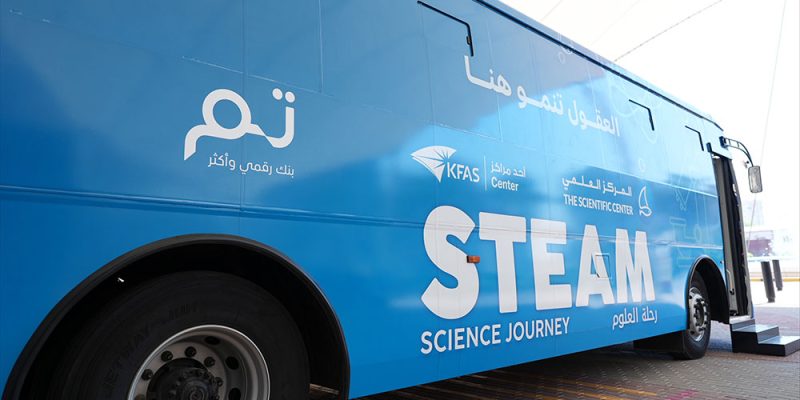
The Scientific Center Kuwait has sent its STEAM Bus back out for the 2026/2027 academic year, and the first stop was the English Early Education Group. The bus is a classroom on wheels that drives science experiments to schools across Kuwait rather than waiting for the schools to come to it, and this season it runs in collaboration with Tam Bank.
The Scientific Center is one of the centers of the Kuwait Foundation for the Advancement of Sciences, and it is better known for what sits inside its building on the Gulf: the Mijbil Almutawa Aquarium, one of the largest aquariums in the Middle East, alongside an IMAX theater and the World of Science galleries. The bus is the part of the operation that leaves.
What is actually on the bus
The program carries hands-on activities and experiments that combine science, technology, engineering, arts and mathematics. The center describes the aim as taking scientific concepts that read as abstract in a textbook and turning them into something a student does with their hands, in the service of critical and creative thinking and problem-solving.
That is a fair description of why outreach buses exist at all. A field trip to an aquarium is a budget line and a bus charter and a permission slip, and for a school without those things the exhibit may as well not be there. Reversing the direction of travel removes the whole problem.
Eng. Mosaed Abdulaziz Al-Yaseen, General Manager of The Scientific Center, said in the announcement: “The launch of the new STEAM Bus season represents a continuation of The Scientific Center’s mission to spread knowledge and promote scientific literacy among school students by providing interactive educational experiences that make science more accessible and enjoyable. We are proud of our collaboration with Tam Bank in supporting this program, which will help expand its impact, reach a wider group of students, and encourage them to learn, explore, and innovate.”
Ahmed Al-Othman, Chief Executive Officer of Tam Bank, framed the bank’s side as reach: “We are proud to collaborate with The Scientific Center in supporting the STEAM Bus program, which provides students with interactive educational experiences that develop their skills, broaden their horizons, and inspire them to discover their passion across various scientific fields.” He added that the partnership is intended to expand the program’s reach to more students.
Who pays for this, and who does not
ZooReviews traces the funding behind conservation and education programs in this region as a matter of practice, and the answer here is unusually legible because both parties said it out loud. The money is a bank’s, the institution is a national science foundation’s, and no accredited zoological body is involved. That is normal for a facility of this kind: The Scientific Center is itself the institution doing the work, not a field organization being funded by one elsewhere.
It is worth noting because the pattern across this region usually runs the other way. Most of the conservation stories out of Africa and the Middle East are NGOs whose funding has to be traced back to accredited zoos and aquariums abroad, and the trace fails about as often as it holds. A Gulf aquarium running its own national outreach program on domestic corporate money is a different shape entirely, and a healthier one.
Where this sits
School outreach is not the glamorous end of the beat, and it is close to the whole point of an institution like this one. Most people meet their first shark or their first centrifuge in a room arranged by somebody whose job was to put it in front of them. The Scientific Center ran its Eco Talks series earlier in September, and the STEAM Bus season is the larger commitment: a full academic year, repeated visits, a route rather than an event.
For a comparison from the other end of the continent, the Two Oceans Aquarium in Cape Town spent a week this year turning 42 teenagers into marine biologists on its Young Biologist Course. Different country, different format, same bet: get the science in front of students early and some of them do not leave.
The bus continues its journey to other schools across Kuwait through the academic year.
Quick answers
- What is the STEAM Bus?
A mobile classroom run by The Scientific Center in Kuwait City that drives hands-on science activities and experiments to schools across Kuwait, combining science, technology, engineering, arts and mathematics. The 2026/2027 season launched on 15 September 2026.
- Where did this season start?
At the English Early Education Group. The bus continues to other schools across Kuwait through the academic year.
- Who is The Scientific Center?
One of the centers of the Kuwait Foundation for the Advancement of Sciences. Its building on the Gulf holds the Mijbil Almutawa Aquarium, one of the largest aquariums in the Middle East, along with an IMAX theater and the World of Science galleries.
- Who is paying for it?
Tam Bank is the collaborating sponsor for this season, and the center itself sits under the Kuwait Foundation for the Advancement of Sciences. No accredited zoological body is involved, which is normal here: the aquarium is the institution doing the work rather than a field organization being funded by one abroad.
- What do students actually do on board?
Hands-on activities and experiments intended to turn abstract scientific concepts into something students handle themselves, aimed at developing critical and creative thinking and problem-solving.
- Why send a bus instead of inviting schools in?
A visit to an aquarium costs a school a charter, a budget line and a day. For a school without those, the exhibits may as well not exist. Reversing the direction of travel removes the barrier entirely.