
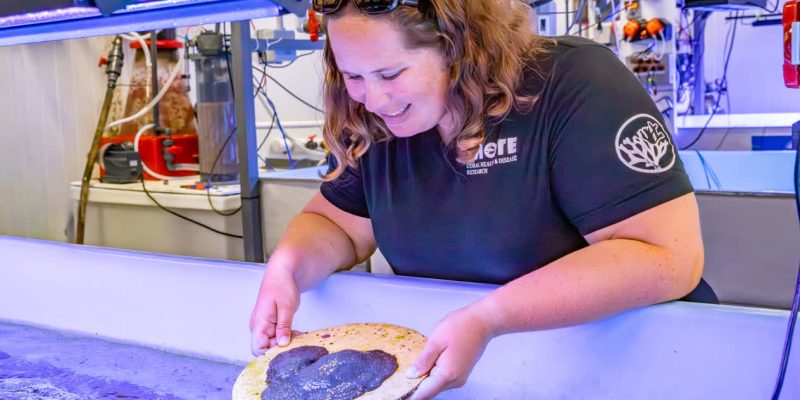
Mote Marine Laboratory tested 154 genetically distinct mountainous star corals against the disease that has killed millions of corals on Florida’s reef. Twelve of them held up.
The result was published in Scientific Reports on June 6, 2026, and Mote described it on July 13. It is the largest laboratory transmission experiment yet run for stony coral tissue loss disease.
What they did
Four sequential laboratory transmission experiments, more than 2,500 samples collected, and every coral sorted into one of four disease-response categories by the severity and progression of tissue loss. The species was Orbicella faveolata, mountainous star coral, a major reef-builder.
Of the 154 genotypes, 12 with multiple experimental replicates were consistently resistant. The team then checked those results against colonies already outplanted on reefs in the Lower Florida Keys during the early phase of the outbreak, and several of the lab-resistant genotypes also showed lower disease risk in the field.
The paper’s own summary of the finding is not triumphant. It describes overall low levels of inherent resistance in the restoration stock.
“This project represents years of collaboration and one of the most comprehensive efforts to understand how an important reef building coral species responds to stony coral tissue loss disease. Evaluating more than 150 genetically distinct individuals allowed us to identify patterns of disease resistance.”
Dr. Sara Williams, lead author and staff scientist, Mote’s Coral Health and Disease Research Program
What the disease has done
Stony coral tissue loss disease was first identified near Virginia Key, Miami, in the fall of 2014. Florida’s Fish and Wildlife Research Institute records the spread: to the northern reefs in Martin County by 2017, and to Dry Tortugas National Park by late spring 2021.
The numbers from FWC are hard to sit with:
- Nearly 90 percent of Florida’s Coral Reef affected, more than 109,700 acres
- Nearly half of Florida’s 45 stony coral species impacted
- Prevalence of 66 to 100 percent of colonies surveyed, for the most susceptible species
- Once a colony starts losing tissue it will likely die within weeks to months
- Millions of corals have likely died as a direct result
It has shown no seasonality and no interruption, not even from Hurricane Irma. The Florida Department of Environmental Protection has tracked it beyond Florida to Jamaica, Mexico, St. Maarten, the U.S. Virgin Islands and the Dominican Republic. The cause is still not identified, though bacteria are implicated and antibiotics slow it.
What this changes for restoration
Mote already routes known disease-resistant corals into its outplanting. The paper’s caution is that resistance alone does not predict restoration success, because outplant survival depends on local conditions and other stressors, and long-term survival was more variable than the lab results.
The conclusion is that coral selection has to be multi-trait rather than single-trait. Picking the corals that survive one disease is how you end up with a reef that cannot survive the next heat wave.
“Restoration efforts must increasingly focus on building diverse and resilient coral populations as Florida’s Coral Reef continues to face unprecedented challenges. Identifying and incorporating disease-resistant corals into restoration programs is one important step towards long-term reef recovery and ecosystem resilience.”
Dr. Sara Williams
The next objective is a biological marker for resistance, which would let researchers screen genotypes without running another experiment on this scale.
“By improving our understanding of natural disease resistance in corals, studies like this provide critical knowledge to help restoration practitioners build more resilient reefs for future generations.”
Dr. Michael P. Crosby, president and CEO, Mote Marine Laboratory
Collaborators included NOAA’s Atlantic Oceanographic and Meteorological Laboratory, the University of Miami, Stony Brook University and others. The work was funded through Florida’s Department of Environmental Protection and the Florida Fish and Wildlife Conservation Commission.
It is the analytical half of the same program that had Mote hauling corals off the reef ahead of the summer heat.
Source: Mote Marine Laboratory; Scientific Reports; Florida Fish and Wildlife Research Institute.