
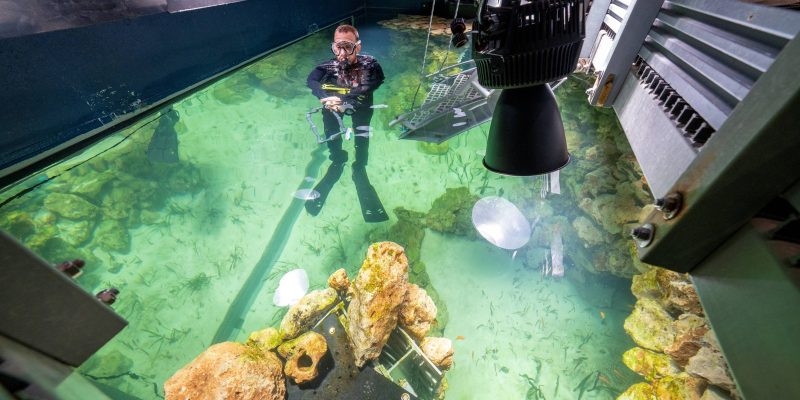
Koninklijke Burgers’ Zoo in Arnhem is building the largest seagrass aquarium in the world, and the hardest part is not the engineering. It is keeping the grass alive.
The tank holds more than 50,000 liters and recreates an Indonesian seagrass meadow. It is the zoo’s third major aquatic ecosystem, after a large Indonesian coral reef and a Belize mangrove, both already built inside Burgers’ Ocean.
Why seagrass and not something prettier
Seagrass meadows are the connective tissue between mangroves and coral reefs, and they do an enormous amount of unglamorous work.
They are nurseries. Young fish that will later live on the reef spend their vulnerable months in the grass, where the blades break up a predator’s line of sight. They filter water and trap debris. They store nitrogen and significant amounts of carbon. And they build up fine sediment, which over time can become the foundation a mangrove grows in.
They are also disappearing, under climate change, pollution, destructive fishing, reef degradation and coastal construction. Restoration efforts are underway worldwide, absorbing a lot of time and money, which is precisely why somebody needs to work out how to grow the stuff reliably.
The problem the team is actually solving
Getting seagrass to survive and grow is one of the hardest things an aquarium can attempt. The Burgers’ Ocean biologists and keepers have been working on it behind the scenes for several years. The meadow currently consists of a few sprouts and will need time.
The failure they are planning for is a strange one: success. Growing seagrass is continuously in autumn, shedding leaves the whole time. If the meadow takes hold and grows well, the dead leaves could clog the filters and pipework that keep the tank alive. The team is trying to anticipate that, along with the nutrient balance in the water, before it becomes a problem.
That is a good description of what technical husbandry actually is. Not building the tank, but predicting how it will fail in three years and designing around it now.
Who is watching
Wageningen University, the Netherlands Institute for Sea Research and the University of Groningen are scientifically monitoring how the project develops.
That distinction matters. A zoo exhibit with three universities taking measurements is not only an exhibit. If Burgers’ works out how to grow and maintain a seagrass meadow at this scale, the technique is worth considerably more to restoration projects in the field than it is to the people walking past the glass.
Source: Koninklijke Burgers’ Zoo. Reported from the Dutch.