
On October 26, 2025, inspectors at Rio de Janeiro’s Galeão International Airport stopped a passenger boarding an international flight with 24 bird eggs strapped to her body under her clothes, held in place with nylon stockings. The eggs were at an advanced stage of development. Some of them hatched the next day.
Nine of those birds are alive, and they have just moved into a new home at São Paulo Zoo.
What survived
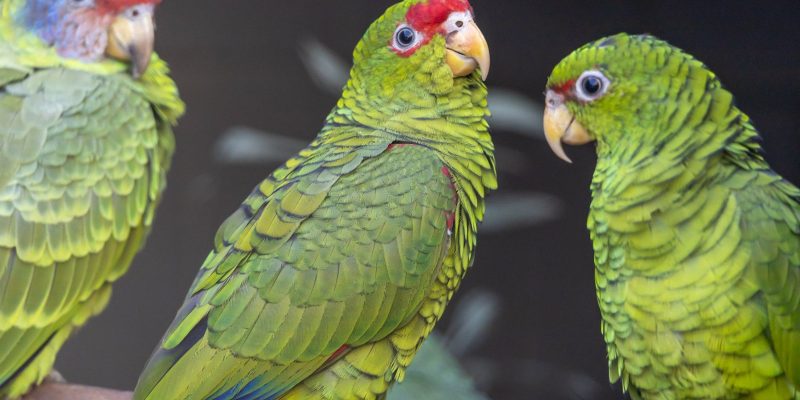
The nine are six Red-tailed Amazons (Amazona brasiliensis) and three Red-spectacled Amazons (Amazona pretrei). Both are Brazilian species. Both are threatened: the Red-tailed Amazon is listed as Near Threatened on the IUCN Red List, the Red-spectacled Amazon as Vulnerable.
Nine out of 24 is the number to sit with. These were not eggs that failed on their own. They were eggs carried through an airport against a human torso, and two thirds of them did not produce a bird that lived.
The ones that did were seized by Ibama, Brazil’s environmental agency, and sent for specialised care. They hatched into intensive monitoring, reached São Paulo Zoo in March at five months old, and went through quarantine and clinical assessment before being cleared.
The Conservation Grove
The nine have now been moved into the zoo’s Conservation Grove, an area built to hold threatened bird species where visitors can see them and read about the work keeping them going.
Their neighbours are a roll call of how bad it can get. Spix’s macaws (Cyanopsitta spixii), extinct in the wild for two decades before reintroduction began. Lear’s macaws (Anodorhynchus leari), down to a few dozen birds in the 1980s. Black-fronted Piping-guans (Pipile jacutinga), an Atlantic Forest bird squeezed by hunting and habitat loss.
The Amazons have arrived among species that were nearly lost and were pulled back by exactly this kind of work.
What happens next
The zoo’s technical team is now working on forming breeding pairs. The long-term aim is to build and strengthen populations under human care, with the possibility of offspring going to other conservation programmes.
Both species sit inside Brazil’s National Action Plan for Atlantic Forest Birds, coordinated federally through ICMBio, the Chico Mendes Institute for Biodiversity Conservation. Both are also covered by species-management and planned-breeding programmes run through AZAB, the Brazilian Association of Zoos and Aquariums.
That structure is the difference between rescue and conservation. A confiscated animal that lives out its life in a holding facility is a rescue. A confiscated animal entered into a managed breeding programme, inside a national recovery plan for its species, becomes part of the answer to the thing that took it in the first place.
Telling them apart
Both species are mostly green, which is what makes them hard to distinguish and easy to traffic as generic “parrots.”
The Red-spectacled Amazon has a red mask and red on the wings. The Red-tailed Amazon has a red forehead and lores, a purplish crown and throat, and bluish sides to the head. The Red-tailed Amazon lives in the Atlantic Forest along the southern coast of São Paulo and Paraná states; the Red-spectacled Amazon in Santa Catarina and Rio Grande do Sul.
Both are Atlantic Forest birds, from one of the most fragmented forest systems on earth, and both are worth money to the people who take them.
Confiscation-to-conservation pipelines like this one are becoming a significant source of animals for managed programmes. Primarily Primates in Texas took in three trafficked spider monkeys under much the same logic.