
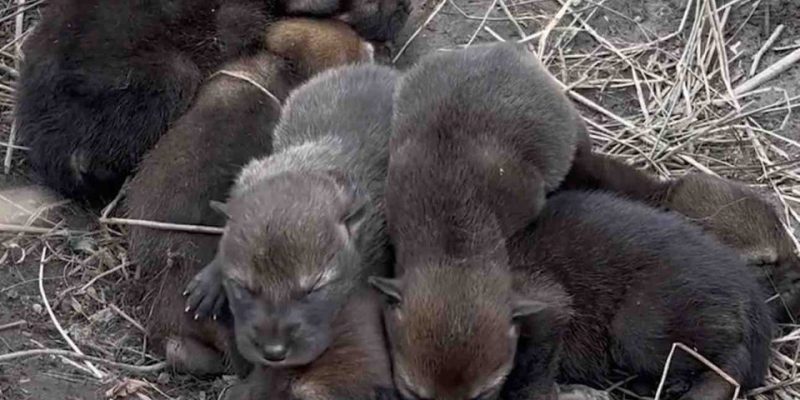
Three critically endangered American red wolf pups born at the Saint Louis Zoo are being raised by a wild wolf family in North Carolina, and refuge trail cameras have confirmed all three are alive and thriving. The zoo shared the outcome on August 31, 2026. It is the first foster of its kind in Saint Louis Zoo history.
Fewer than 40 American red wolves remain in the wild, all of them in northeastern North Carolina. Against a number that small, three young wolves growing up in a wild den is not a rounding error. It is a measurable addition to the species.
What fostering is
Fostering takes pups born in professional care and places them into a wild litter, where a wild mother raises them alongside her own. Done successfully, it moves genetic diversity into a population that badly needs it. Genetic diversity keeps a population healthy and resilient by increasing disease resistance, reducing the effects of inbreeding and supporting long-term growth.
The work happens under the U.S. Fish and Wildlife Service and in partnership with the Association of Zoos and Aquariums Saving Animals from Extinction (SAFE) program.
“Every pup matters,” said Regina Mossotti, Vice President of Animal Care at the Saint Louis Zoo and Program Leader for the AZA SAFE American Red Wolf Program. “With less than 40 American Red Wolves left in the wild, fostering is an important tool for the species. These pups now have the chance to support a future for one of the world’s most endangered animals.”
The only eligible pups in North America
The timing is unforgiving. Fish and Wildlife biologists watch breeding behavior in the wild population, while AZA SAFE coordinates breeding recommendations for wolves in professional care. When a wild litter is born, SAFE has a narrow two-week window to find pups of a matching age at a zoological institution. A foster has to happen inside the first 14 days of life, the period when a wolf mother is bonding with her litter and is most likely to accept new pups into it.
In 2026, the Saint Louis Zoo’s litter was the only litter born in professional care inside that window. That made these three the only pups in North America eligible to join this year’s recovery effort.
Seven days old and on the road
On April 20, zoo animal care and veterinary staff collected three seven-day-old pups from a litter at the Saint Louis Zoo Sears Lehmann, Jr. Wildlife Reserve. After a full health exam, the pups traveled with zoo staff to Alligator River National Wildlife Refuge in northeastern North Carolina, receiving hour-by-hour care the whole way. Fish and Wildlife biologists took them at the other end and placed them into a wild den.
Then everyone waited. Biologists monitored the den to confirm the wild mother came back to care for her litter. Months later, when pups naturally begin exploring outside the den, refuge trail cameras picked up all three zoo-born pups alive and growing alongside their wild siblings.
“Several vital recovery actions for Red Wolves rely on our close partnership and collaboration with the SAFE American Red Wolf Program,” said Emily Weller, U.S. Fish and Wildlife Service Red Wolf Recovery Program Coordinator. “The pup fostering this past spring with the Saint Louis Zoo is a perfect example of how that partnership directly benefits the species and their recovery in the wild.”
“It’s hard to describe the joy that comes from being part of this foster,” said Saint Louis Zoo keeper Nicole Becker, who made the trip to North Carolina with Mossotti and the pups. “Groundbreaking conservation efforts like this are the backbone of why we do what we do, caring for Red Wolves in our own backyard and protecting their wild counterparts for future generations.”
The pups who went the other way
The exchange ran in both directions. The wild mother had a large litter, so a few of her own pups were moved into the Saint Louis Zoo’s litter at the Wildlife Reserve, a process called cross fostering. It lightens the load on the wild mother so she can care for every pup properly, and it carries wild genetics into the managed population. For a species this reduced, moving genes in both directions in a single spring is a rare opportunity.
A 355-acre reserve built for exactly this
The Sears Lehmann, Jr. Wildlife Reserve is a 355-acre natural area in Franklin County, Missouri. Peggy Lehmann donated the property to the zoo in 1993 in honor of her late husband, Sears Lehmann, Jr., and for years it was preserved simply as a natural site for native wildlife. In 2021 the zoo announced plans to develop roughly 20 acres of it for American red wolf conservation. Today it holds seven habitats dedicated to breeding and conservation under the AZA SAFE program.
The wolves there live in a private, protected setting that is closed to visitors, and that is the design working as intended. Minimal human contact is what lets them learn the behaviors and survival skills that make a life in the wild possible.
What you can see
You will not meet these wolves. You are not supposed to. What you can do is visit the Saint Louis Zoo itself, which is home to 12,500 animals across more than 450 species and remains one of the only free zoos in the country. The zoo is posting photo and video updates from the red wolf program at stlzoo.org/wolves.
Somewhere on a refuge in North Carolina, three wolves that started life in Missouri are learning to hunt from a wild mother. That is the whole job, done right.
Quick answers
- How many American red wolves are left in the wild?
Fewer than 40, and they are found only in northeastern North Carolina.
- What is red wolf fostering?
Fostering places pups born in professional care into a wild litter within the first 14 days of life, the window when a wolf mother is bonding with her pups and is most likely to accept new ones.
- Where are the Saint Louis Zoo pups now?
At Alligator River National Wildlife Refuge in northeastern North Carolina, being raised by a wild red wolf family. Refuge trail cameras confirmed all three alive and thriving several months after the placement.
- Can visitors see the red wolves at the Saint Louis Zoo?
No. The wolves live at the Sears Lehmann, Jr. Wildlife Reserve in Franklin County, a private, protected natural setting closed to visitors so the animals learn natural behaviors with minimal human contact.