
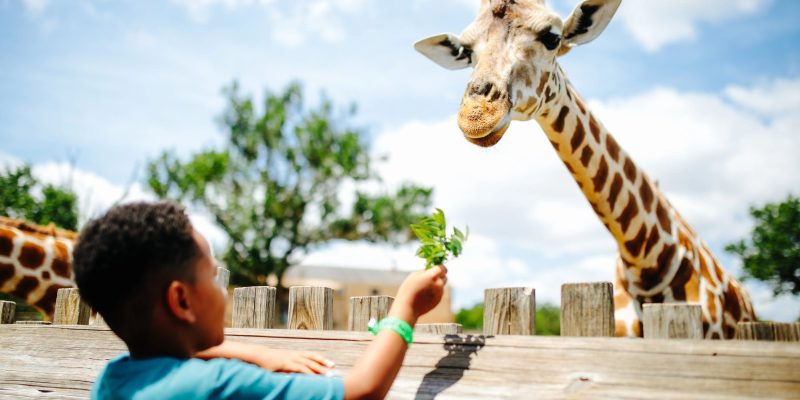
A female giraffe calf named Neema was born at the Oklahoma City Zoo and Botanical Garden on Wednesday, November 25, 2026, the first calf for a five-year-old mother named Tumani. Her keepers measured her at 5 feet 9 inches tall and about 112 pounds within hours of the birth. The name means grace in Swahili.
Mother and calf have been together inside the zoo’s Giraffe House barn at Expedition Africa, where caretakers report that Neema is nursing regularly and moving around the stalls under her own steam. Both of those are what keepers watch for in the first days, because a calf that nurses on schedule and gets itself upright and walking is a calf doing what it should.
“We’re thrilled for Tumani to become a mother and welcome a new addition to our giraffe family,” said Bill Smith, the zoo’s curator of ungulates. “Giraffes are facing many challenges in the wild, so every birth is significant for the future of this beloved species, and we’re so excited to watch Neema grow and thrive.”
Introductions to the rest of the herd have already started and are reported to be going well. The next step is access to the giraffe barn’s community stall, a shared indoor space the pair can explore at their own pace rather than on a schedule set for them. The zoo says guests may be able to see the two of them inside the barn as early as this weekend.
What does a giraffe calf do in its first week?
A newborn giraffe arrives at around six feet tall and grows fast enough to measure, as much as three centimeters a day in that first week. Neema’s 5 feet 9 inches puts her right at the expected size.
Calves are born with ossicones, the pair of horn-like structures on top of a giraffe’s head. At birth they are cartilage and they lie flat against the skull, which makes the delivery safer for mother and calf both: a giraffe gives birth standing up, and the calf falls some distance to the ground. The ossicones ossify later, meaning they turn to bone and fuse to the skull as the animal matures. That is why an adult giraffe’s ossicones stand up and a newborn’s do not.
Mothers do most of the feeding and protecting, but giraffes raise calves cooperatively. Females in a herd form nursery groups called creches and take turns watching the calves while the others forage. The arrangement buys the adults feeding time and gives the calves something harder to arrange: company their own age, and a gradual way to practice independence while somebody is still watching.
How many giraffes are left in the wild?
Giraffe is listed as Vulnerable on the IUCN Red List, which is the category the zoo cites and it is the right one. The assessment is worth reading closely, though, because the numbers attached to it have moved.
That assessment was carried out on 9 July 2016 and published in amended form in 2018. It counts 68,293 mature individuals and records the population trend as decreasing. The zoo’s release puts the wild population at about 117,000. The two figures are not so much in conflict as counting different things from different years: the Red List number is mature individuals only, and it is now a decade old.
The most recent whole-population estimate comes from the Giraffe Conservation Foundation, which puts the combined African giraffe population at roughly 140,000 animals today. That is higher than the zoo’s 117,000 and well above what the Red List reported in 2016, and the foundation is careful about why: it attributes the increase to better data gathering, better awareness and conservation that has worked, rather than to a sudden surge in giraffes. Where a facility’s figure and the assessment differ, we default to the assessment and say which number came from where. Here the correction runs in the encouraging direction.
The release’s statement that giraffes have gone extinct in seven African countries holds up. The Red List records the species as extinct in Eritrea, Guinea, Mauritania, Nigeria and Senegal, extinct and vagrant in Burkina Faso and Malawi, and possibly extinct in Mali.
One change is coming that will reshape all of these numbers. The IUCN now recognizes four distinct giraffe species rather than one, and new Red List assessments are underway on that basis. The foundation’s own 2025 assessment finds three of the four under serious threat, with the southern giraffe in much better shape than the northern. A single global category for giraffe is on its way out, and species-level numbers will tell a sharper story than one average ever could.
What does the OKC Zoo do for wild giraffes?
The pairing that produced Neema was made through the Association of Zoos and Aquariums Species Survival Plan, the breeding program that matches animals across accredited institutions to keep the population in human care genetically diverse.
The zoo’s field spending goes to the same organization whose population figure appears above. Through its Round Up for Conservation program, which adds a small amount to guest purchases, the Oklahoma City Zoo funds the Giraffe Conservation Foundation’s work training African wildlife veterinarians. The zoo says it has sponsored two African vets through a wildlife veterinary course covering how to immobilize, treat and translocate giraffes and other large mammals, and has funded grants for African students doing conservation research. Translocation is the skill that matters most for a species whose problem is habitat: moving giraffes safely is how small isolated populations get reinforced, and how animals are returned to range they were pushed out of.
Neema brings the zoo’s giraffe herd to eight, alongside Tumani, Demetri, Ellie, Solstice, Julu, Mashamba and Kamili. The herd shares the savanna habitat at Expedition Africa with ostriches, cranes, Nile lechwe and eland, roughly the company they would keep in the wild. Other recent arrivals on the beat include a Masai giraffe calf at the Potawatomi Zoo and a calf born on camera at the Cincinnati Zoo. Once Neema is out on the savanna, visitors get the thing that makes a giraffe calf worth the trip: a six-foot animal that is still the smallest one out there, learning to use legs already longer than most of the people watching her.
Quick answers
- When was the OKC Zoo giraffe calf born?
Neema was born on Wednesday, November 25, 2026, at the Oklahoma City Zoo and Botanical Garden. She is the first calf for her mother, Tumani, who is five. Her father is Demetri, who is nine.
- How big is a newborn giraffe?
Neema measured 5 feet 9 inches tall and about 112 pounds at a newborn exam shortly after the birth. Giraffe calves are generally around six feet tall at birth and can grow as much as three centimeters a day in their first week.
- What are ossicones?
The horn-like structures on top of a giraffe’s head. They are cartilage at birth and lie flat against the skull, which makes delivery safer, then ossify and fuse to the skull as the animal matures.
- Are giraffes endangered?
Giraffe is listed as Vulnerable on the IUCN Red List. That assessment was carried out on 9 July 2016 and counts 68,293 mature individuals, with the population trend decreasing. The Giraffe Conservation Foundation’s current estimate for the whole African population is about 140,000 animals.
- Can visitors see the calf?
The zoo said guests may be able to see Tumani and Neema inside the Giraffe House barn at Expedition Africa as early as the weekend after the announcement, as the pair are given access to the barn’s community stall.
- What does the OKC Zoo do for giraffes in the wild?
Through its Round Up for Conservation program the zoo funds the Giraffe Conservation Foundation, sponsoring two African veterinarians through a wildlife veterinary course covering immobilization, treatment and translocation, and funding grants for African students doing conservation research.