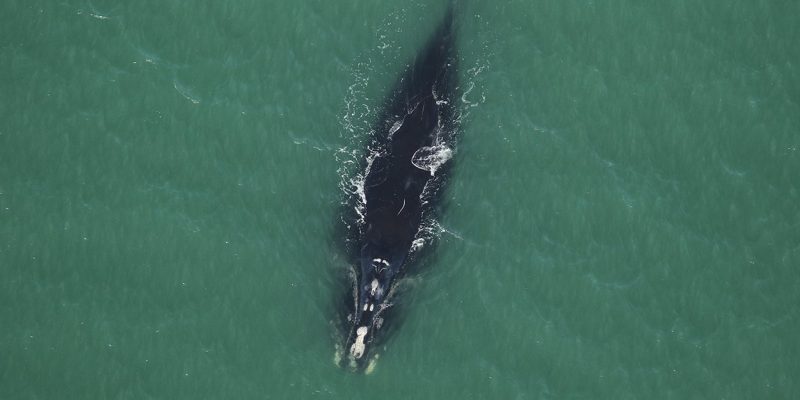
The 2026-2027 North Atlantic right whale calving season has its first mother and calf, and they turned up before the season officially began. A 16-year-old female named Curlew was sighted with a newborn about 11 nautical miles off St. Augustine Inlet, Florida, on November 10. Survey teams were not due to start looking until November 15.
It is her first known calf.
Who found her
Not a research aircraft. Two boaters, Sean Roberts and Mike Konopko, saw the pair and called the NOAA hotline, 1-877-WHALE-HELP. That is how a sighting outside the survey window gets into the record at all, and it is the reason the hotline number is worth repeating: in a population this small, a phone call from someone who happened to be on the water is data.
What the catalog knows about Curlew
Right whale researchers keep a detailed file on every mother and calf pair, including photographs, lineage, where the whales were last seen, how they were named and what each animal has survived. That file is the North Atlantic Right Whale Catalog, maintained by researchers at the New England Aquarium’s Anderson Cabot Center for Ocean Life.
Curlew is Catalog #4190. She was born in 2011 to a female called Tusk, Catalog #2790, and she is named for a scar on her back shaped like the curved bill of a shorebird. She has three sisters, of which only one, Babushka (Catalog #3890), is still seen regularly.
She has been entangled in fishing gear four times. Her family has recorded at least 11 entanglement events between them, most of those minor.
She is also, in the Aquarium’s telling, a whale with a taste for the spotlight. In 2025 Curlew became one of the first right whales ever documented in the Bahamas, during several months of traveling with another female, Koala (Catalog #3940). Right whales are generally solitary, so a pairing that lasts months is unusual enough that researchers noticed and said so.
Why one calf is news
Because there are not many whales left to have them. The IUCN Red List assessed the North Atlantic right whale in 2020 as Critically Endangered, with 200 to 250 mature individuals and a decreasing trend. The assessment names shipping lanes and fishing gear as the principal threats, which is the same list Curlew’s own scars come from.
The species also reproduces slowly. The Red List puts the generation length at 24 years, so a population this size does not recover on a schedule anyone watching will find satisfying. Each calf matters out of proportion to its number.
When is right whale calving season?
From November through April. The whales migrate to the warm shallow water off the southeastern United States to give birth, and researchers watch for mothers and calves from boats and from the air throughout. Surveys for this season were scheduled to begin November 15. The season officially wraps in late April, when the whales head back north for spring and summer.
The New England Aquarium maintains a running list of the season’s pairs and adds to it as each is identified, so the count will move.
The Aquarium’s right whale work this year has also included a drone study in Cape Cod Bay testing how the animals respond to approaching boats and ships, which is the other half of the problem: keeping the calves born this winter alive long enough to have their own.
For now the season’s tally is one pair, sighted five days early by two people who made a phone call.
Source: New England Aquarium, November 12, 2026.
Quick answers
- When is North Atlantic right whale calving season?
November through April. The whales migrate to the warm shallow water off the southeastern United States to give birth, and the season officially wraps in late April when they move back north. Survey teams were scheduled to begin work on November 15 this season.
- Which whale had the first calf of the 2026-2027 season?
Curlew, Catalog #4190, a 16-year-old female born in 2011 to a whale called Tusk. She was sighted with her first known calf about 11 nautical miles off St. Augustine Inlet, Florida, on November 10, 2026.
- How many North Atlantic right whales are left?
The IUCN Red List assessed the species in 2020 as Critically Endangered, with 200 to 250 mature individuals and a decreasing population trend.
- What should I do if I see a right whale?
Report it to the NOAA hotline on 1-877-WHALE-HELP (1-877-942-5343). The first pair of this season was found by two boaters who called it in, five days before surveys were due to start.