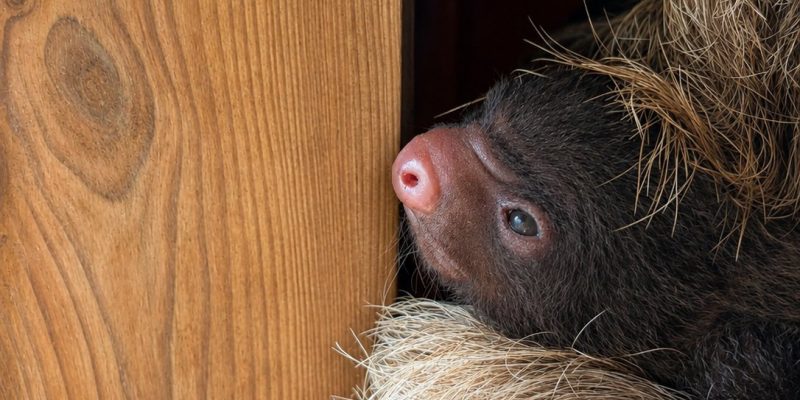
A Hoffmann’s two-toed sloth was born at Zoo Atlanta on October 30, 2026. The mother is Nutella, the father is Cocoa, and the infant is their third together. The pair were matched on a recommendation from the Association of Zoos and Aquariums Species Survival Plan.
Sloths are not currently outdoors at Zoo Atlanta, because they are tropical animals and Atlanta is not tropical in November. The zoo expects the infant to be visible alongside Nutella when the sloths return to their outdoor habitat in the spring.
A baby that arrives finished
Most mammals this size are born helpless. Sloths are not, and the reason is the length of the pregnancy.
Gestation in a two-toed sloth runs 11 to 12 months, which is extraordinarily long for an animal that weighs what a sloth weighs. What that buys is an infant born fully furred, with its eyes open, its teeth already in, and its claws fully formed. It needs every bit of that last item immediately, because a newborn sloth’s first job is to hold on to its mother, and its mother is hanging upside down in a tree.
That upside-down business is not a quirk. Two-toed sloths are almost entirely arboreal and rarely come down to the ground at all. They eat, sleep, mate and give birth suspended by their claws. A sloth’s internal anatomy is arranged for it, and an infant that could not grip from the first minute would simply fall.
“We are excited to welcome Nutella’s newest infant,” said Gina Ferrie, PhD, Vice President of Collections and Conservation at Zoo Atlanta. “Sloths have so many behaviors and adaptations that highlight the incredible biodiversity of our natural world.”
What is actually threatening sloths?
Not what most people assume. The IUCN Red List assessment of Choloepus hoffmanni, dated April 22, 2022, lists the species as Least Concern, with a decreasing population trend and no global figure for mature individuals. Least Concern is the right category and it is also the least interesting thing in the entry.
The interesting part is the threat list, which names utility and service lines alongside the familiar pressures of logging and habitat clearance. That is the electrocution problem, and it is specific to how sloths move. A sloth crossing between fragments of forest looks for something overhead to hang from. Where the forest has been cut into pieces, the thing overhead is frequently a power line. Zoo Atlanta puts the toll in the hundreds of animals a year.
It is a problem created by the animal doing exactly what it evolved to do in a landscape that changed underneath it, and it is also a tractable one. Insulating lines and installing canopy bridges are ordinary municipal work, not a breakthrough that has to be invented first.
A busy autumn in Atlanta
The infant arrives in the middle of the most-watched stretch Zoo Atlanta has had in years. Giant pandas Ping Ping and Fu Shuang landed in September, and the Arthur M. Blank Panda Grove has since opened to the public.
The sloth will not compete with that, and does not need to. The pandas drew a continent’s attention; a sloth infant is the kind of animal a family finds by accident and then stands in front of for twenty minutes. Both are why the building is there.
Nutella’s infant has a winter indoors ahead of it and a spring outdoors after that. Sloths do everything slowly. There is no rush on this one either.
Quick answers
- When was the sloth born at Zoo Atlanta?
October 30, 2026. The mother is Nutella, a Hoffmann's two-toed sloth, and the father is Cocoa. The infant is their third offspring together.
- When will the sloth infant be visible to visitors?
Zoo Atlanta expects the infant to be visible alongside Nutella when the sloths return to their outdoor habitat in the spring. Sloths are tropical animals and are not outdoors in cool weather.
- How long is a sloth pregnancy?
Eleven to twelve months in a two-toed sloth, which is unusually long for a mammal of that size.
- What are baby sloths like at birth?
They are born fully furred, with their eyes open, their teeth already present and their claws fully developed, so they can grip their mother immediately.
- Why do sloths hang upside down?
They are almost entirely arboreal and rarely travel to the ground, so they eat, sleep and give birth suspended by their claws.
- Are Hoffmann's two-toed sloths endangered?
No. The IUCN Red List assessment dated April 22, 2022 lists Choloepus hoffmanni as Least Concern, though the population trend is recorded as decreasing.
- What threatens sloths in the wild?
Habitat loss from logging and clearance, and electrocution. Sloths crossing between forest fragments use power lines as overhead routes. Zoo Atlanta puts the toll in the hundreds of animals a year.
- Where do Hoffmann's two-toed sloths come from?
Central and South America. The IUCN assessment records the species across ten countries including Costa Rica, Panama, Colombia, Peru and Brazil.