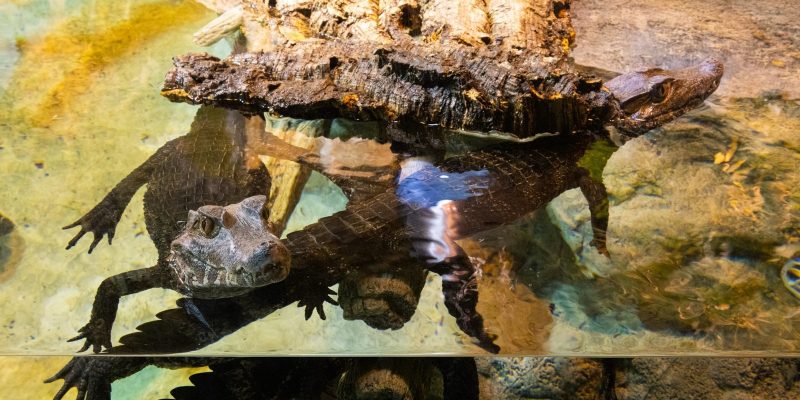
There are crocodilians at the Buffalo Zoo again. A male and a female dwarf caiman went on habitat this week inside the M&T Bank Rainforest Falls building, in the pool behind the waterfall, and they are the first crocodilian the zoo has held since 2021.
Crocodilian is the useful word here rather than crocodile, because a caiman is not one. Crocodylia is the order, and it contains three families: the crocodiles, the gharials, and the alligators and caimans. Dwarf caimans sit in that third family, Alligatoridae, which makes these two animals closer relatives of an American alligator than of a Nile crocodile.
Who they are
The pair came to Buffalo on a recommendation from the Association of Zoos and Aquariums’ Species Survival Plan. The male hatched at the Saint Louis Zoo on September 27, 2018, which makes him eight. The female hatched at the St. Augustine Alligator Farm Zoological Park on October 10, 2019, and is seven. Neither has a name yet.
“Our new pair of dwarf caimans are an incredibly exciting addition to M&T Bank Rainforest Falls,” said Buffalo Zoo President and CEO Lisa Smith. “Having a diverse collection of animals that allows our guests to learn about species from all over the world is at the core of our mission, and I am confident these caimans will be strong educational ambassadors for their wild counterparts.”
They are sharing the space with the yellow-spotted Amazon river turtles already living there, and the zoo reports the caimans have spent their first days swimming, exploring and getting used to the neighbors.
How big is a dwarf caiman?
Small enough that the name is doing real work. The dwarf caiman is the smallest living crocodilian. A female of this species tops out just under four feet and weighs 10 to 15 pounds, which is roughly the weight of a house cat on the body plan of an armored reptile. For scale, a black caiman, the largest member of the same family, reaches 16 feet and close to 800 pounds.
That size is what makes the animal viable in a rainforest building rather than a dedicated crocodile pool, and it is also why the species lives where it does. Dwarf caimans are semi-aquatic animals of fast-moving freshwater streams, and they spend as much time hauling themselves over logs, branches and steep banks as they do swimming. The agility is the adaptation; a 16-foot caiman cannot work a stream bank that way.
A note on the range
The zoo describes the species as native to north and central South America. The IUCN Red List assessment extends somewhat further south and east than that: it records Paleosuchus palpebrosus as resident in Bolivia, Brazil, Colombia, Ecuador, French Guiana, Guyana, Paraguay, Peru, Suriname, Trinidad and Tobago, and Venezuela, at elevations between 100 and 500 meters. Paraguay in particular is a long way south of central. We default to the assessment on range questions, and it is the kind of detail a release written for a local audience has no reason to spell out.
The same assessment lists the dwarf caiman as Least Concern with a stable population trend, assessed on April 30, 2018 and published in 2019. It is one of the more comfortable listings an animal arriving at an American zoo is likely to carry, and worth saying plainly: this is a species doing reasonably well.
One point of care with the common name. IUCN uses Dwarf Caiman for Paleosuchus palpebrosus alone. The other member of the genus, Paleosuchus trigonatus, is the smooth-fronted caiman, and it is a larger and differently built animal. Buffalo’s release does not give a scientific name, but the description it does give, the smallest crocodilian with females under four feet, belongs to P. palpebrosus.
It has been a busy autumn at the zoo: a European legless lizard hatched there in September, and in October both of its red panda cubs moved out onto habitat with their mother. The caimans are visible to the public now. Rainforest Falls is indoors, which in Buffalo in November is not a small consideration, and the pool sits behind the waterfall, so the animals are easiest to find by following the sound.
Source: Buffalo Zoo, “Pair of dwarf caimans now on habitat at the Buffalo Zoo,” November 4, 2026.
Quick answers
- Where are the Buffalo Zoo's dwarf caimans?
In the pool behind the waterfall inside the M&T Bank Rainforest Falls building, sharing the space with yellow-spotted Amazon river turtles. They are visible to the public now.
- Where did they come from?
The male hatched at the Saint Louis Zoo on September 27, 2018 and the female at the St. Augustine Alligator Farm Zoological Park on October 10, 2019. Both came on an AZA Species Survival Plan recommendation. Neither has a name yet.
- How big do dwarf caimans get?
They are the smallest living crocodilians. Females reach just under four feet and weigh 10 to 15 pounds. A black caiman, the largest member of the same family, reaches 16 feet and close to 800 pounds.
- Is a caiman a crocodile?
No. Crocodylia is the order, and it holds three families: crocodiles, gharials, and alligators and caimans. Dwarf caimans belong to Alligatoridae, which makes them closer relatives of the American alligator than of any crocodile.
- Are dwarf caimans endangered?
No. The IUCN Red List assesses Paleosuchus palpebrosus as Least Concern with a stable population trend, assessed on April 30, 2018 and published in 2019.
- Where do dwarf caimans live in the wild?
The Red List records them in Bolivia, Brazil, Colombia, Ecuador, French Guiana, Guyana, Paraguay, Peru, Suriname, Trinidad and Tobago, and Venezuela, at elevations between 100 and 500 meters, in and around fast-moving freshwater streams.