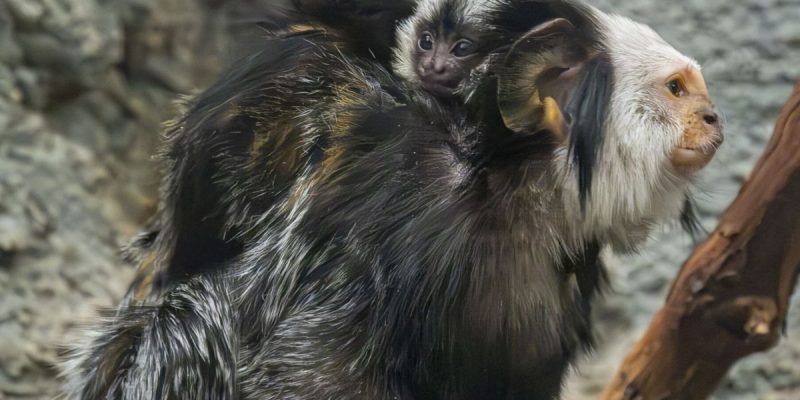
Two marmoset infants were born at the Milwaukee County Zoo on October 2, and for most of the day since then they have been riding on their father’s back. That is how the species works: the male carries, and the mother gets the infants back to nurse.
The zoo updated its animal blog on November 2, 2026 to say the pair are doing well. The parents are Brahma and Fiyero, white-fronted marmosets in the Primates of the World building.
Why the father does the carrying
Marmoset fathers are heavily involved parents, more so than most primates, and carrying is the clearest expression of it. An infant marmoset spends its early weeks clinging to an adult, and if the male takes most of those hours the female is freed to rest and keep up her milk supply. With twins, which are the normal marmoset litter, that division of labor stops being a nicety.
These are Fiyero’s first offspring. Brahma is an experienced mother and has had many before. The animal care team is staying hands-off, which is why the infants’ sexes are still unknown: nobody is picking them up to find out.
Where they came from
The pair arrived separately and recently. Brahma, 11, transferred from the Staten Island Zoo in New York. Fiyero, 9, came from the Chattanooga Zoo. Both completed the standard minimum 30-day quarantine before going on view in June, and the zoo said at the time that it hoped they would breed. They did, inside four months.
The two adults are easy enough to tell apart once you know the trick, and it is not a subtle one: Fiyero has a tail and Brahma does not.
Can you see them?
The family has access to the public habitat in Primates of the World but can also go behind the scenes whenever they prefer, so a sighting is not guaranteed. These are small monkeys, 9 to 13 ounces as adults, and worth looking twice for.
The species, and what it is called
Milwaukee calls them white-fronted marmosets and also gives the name Geoffrey’s marmoset. The scientific name is the only stable handle here: Callithrix geoffroyi, which the Red List files as Geoffroy’s Tufted-ear Marmoset and other references call the white-headed marmoset. They are native to the Atlantic Forest of eastern Brazil, and the zoo notes that the illegal pet trade is a threat, with a specific ask attached: do not share, like or comment on social media posts that show primates kept as pets.
The IUCN Red List lists the species as Least Concern, so there is no alarm to raise about the category. Two details in the assessment are worth having beside it. The population trend is recorded as decreasing, and the assessment was made on January 26, 2015, published in an amended version in 2021, and is annotated by the Red List as needing updating.
One small divergence: the zoo describes the animal as living in lowland rainforest, while the assessment puts it between 500 and 1,274 meters and lists its habitat as forest and savanna. Native range is Bahia, Espírito Santo and Minas Gerais, with an introduced population in Santa Catarina. None of that changes the animal in the habitat, which is a monkey the size of a squirrel with a white face and a pair of infants on its back.
Milwaukee has had a run of these. The zoo’s three scimitar-horned oryx calves arrived within eight days of each other in the spring, and in October the Aquatic & Reptile Center put an emerald tree boa on exhibit for the first time, a new species for the collection.
Quick answers
- When were the Milwaukee County Zoo marmosets born?
On October 2, 2026. The zoo confirmed on November 2 that both infants are doing well.
- Why is the male marmoset carrying the babies?
Marmoset fathers are unusually involved parents and carrying is the clearest form of it. An infant spends its early weeks clinging to an adult, and when the male takes most of those hours the mother can rest and maintain her milk supply. These are the first offspring for the father, Fiyero.
- Are the marmoset infants male or female?
Not yet known. The animal care team is staying hands-off, so nobody is handling them to find out.
- Where did Brahma and Fiyero come from?
Brahma, who is 11, transferred from the Staten Island Zoo in New York. Fiyero, who is 9, came from the Chattanooga Zoo. Both completed the standard minimum 30-day quarantine and went on view in June 2026.
- Can visitors see the marmoset family?
They have access to the public habitat in Primates of the World but can also stay behind the scenes, so a sighting is not guaranteed. Adults weigh only 9 to 13 ounces.
- What is the conservation status of the white-fronted marmoset?
The IUCN Red List assesses Callithrix geoffroyi, which it calls Geoffroy's Tufted-ear Marmoset, as Least Concern. The population trend is recorded as decreasing, and the assessment dates from January 26, 2015, was published in an amended version in 2021, and is annotated as needing updating. The zoo names the illegal pet trade as a threat.