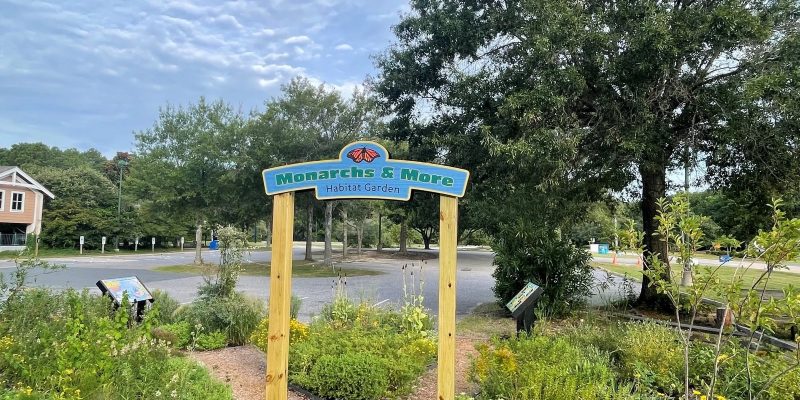
The North Carolina Aquarium on Roanoke Island finished its Monarch SAFE Garden on August 18 by putting up a sign. That is the whole of the last step, and it took the better part of two years to earn it.
The garden sits just outside the aquarium’s main entrance, off to one side, in a strip of ground that used to hold invasive pampas grass. It was finished on schedule for the start of the fall monarch migration and the annual tagging season on the Outer Banks, which is the only deadline that mattered.
What is a SAFE garden?
SAFE stands for Saving Animals From Extinction, the Association of Zoos and Aquariums program under which accredited institutions commit to coordinated conservation work on a named species. SAFE North American Monarch is the only insect program in the whole scheme, which tells you something about how zoo and aquarium conservation has historically been weighted, and something about how unusual an insect has to be before it gets that treatment.
A SAFE monarch garden is not decoration with a label on it. The plants are chosen to feed monarch caterpillars and adult pollinators, the layout is built to be walked through and monitored, and the point of the signage is that a visitor can work out what they are looking at without a staff member standing there.
How do you build one?
Slowly, and mostly before anything looks like a garden. The project was led by the aquarium’s head horticulturist, Rachel, and her timeline is a fair picture of what this kind of work actually involves.
In October 2024 the team pulled out the pampas grass that filled the site, then leveled the ground and dug out the remaining roots so it would not come back. Around the same time the aquarium applied for two Monarch Habitat Creation grants: one covering labor, site preparation and planning, and a second, through SAFE Monarch and Turtle Back Zoo, covering the educational signage and the plants. Both were awarded the following spring.
From January through March came edging, mulched pathways, compost and the first planting. By late March the crew had added border rails along the parking area, leveled the edges and prepared the space for volunteers. In April 2025 a local 4-H group came in to plant and to put up temporary signs. Then nothing visible happened for the rest of the year, because the rest of the year was watering, which is the stage where new plantings are either established or lost.
The permanent interpretive signs waited on money. Funding for the exhibits team to design and install them came through in 2026, and that is the step the August announcement marks.
What happens in it now?
Counting, mostly. The garden has become a base for community science, meaning research that depends on members of the public gathering usable data rather than just visiting. Three programs run there: Monarch Larval Monitoring, which tracks caterpillars and eggs on the milkweed; Eco-Explore and iNaturalist observations, where visitors photograph and log what they find; and seasonal monarch tagging during the migration.
Tagging is the one that travels furthest. A tagged monarch leaving the Outer Banks in autumn may be recovered thousands of miles away, and the tag is the only reason anybody can say so. A garden that produces tagged butterflies is contributing to a continental dataset from a strip of ground beside a parking lot.
Is it worth visiting?
It is outside the admission gate, so it costs nothing to walk through, and in migration season it is the part of the site with the most happening in it. The aquarium’s framing is the right one: a garden like this is a working demonstration that native plants and volunteer labor add up to something, on a scale a homeowner can copy.
The timing is tidy, too. The North Carolina Aquariums, the three-site state system this aquarium belongs to alongside Pine Knoll Shores and Fort Fisher, are marking fifty years in 2026. A pollinator garden paid for by two grants and planted partly by 4-H volunteers is a reasonable way to spend an anniversary.
The aquarium’s own account of the build is here, and the AZA SAFE North American Monarch program, which describes itself as the only insect program in SAFE, is here. We covered another aquarium opening a new gallery, Texas State Aquarium’s Ocean Odyssey, here.
Quick answers
- What is the Monarch SAFE Garden?
A pollinator habitat garden outside the main entrance of the North Carolina Aquarium on Roanoke Island, completed on August 18, 2026 with the installation of permanent educational signage.
- What does SAFE stand for?
Saving Animals From Extinction, the Association of Zoos and Aquariums program under which accredited institutions commit to coordinated conservation work on a named species. SAFE North American Monarch describes itself as the only insect program in the scheme.
- How long did it take to build?
Work began in October 2024 with the removal of invasive pampas grass. Planting ran through the first months of the following year, volunteers from a local 4-H group planted in April 2025, and the permanent signage was installed in 2026.
- Who paid for it?
Two Monarch Habitat Creation grants. One covered labor, site preparation and planning. The second, through SAFE Monarch and Turtle Back Zoo, covered the educational signage and the plants.
- What happens in the garden now?
Three community science programs: Monarch Larval Monitoring, Eco-Explore and iNaturalist observations, and seasonal monarch tagging during the fall migration.
- Do you need admission to see it?
No. The garden sits outside the aquarium’s main entrance.