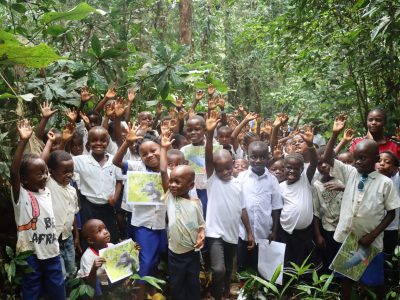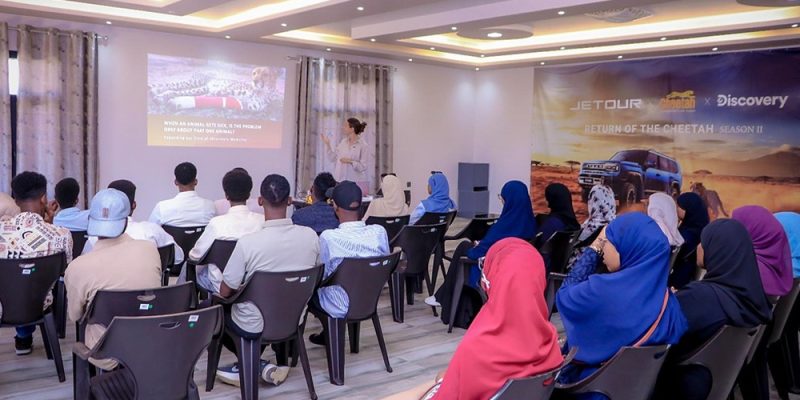
Twenty-four students from the University of Hargeisa spent a day at the Cheetah Conservation Fund’s Somaliland sanctuary in the first week of October, working through a veterinary case study on confiscated cheetah cubs and then walking into the clinic where real ones are treated. CCF has taught at the university before. This was the first time the students came to CCF.
The group was split evenly between veterinary medicine and environmental science, with one recent graduate in human medicine among them. That mix is the point of the exercise. The day was built around One Health, the working idea that human, animal and environmental health are a single system rather than three adjacent ones, and a room holding all three disciplines makes the argument before anybody says it out loud.
What does a cheetah with diarrhea have to do with public health?
More than it looks. The lecture, taught by CCF Somaliland’s resident veterinarian, opened on a question the students were asked to carry through the day: when an animal gets sick, is the problem only about that one animal?
The case study that followed was a group of confiscated cheetah cubs presenting with diarrhea. Building the list of possible causes is routine veterinary work, and it runs from nutritional problems through viral, bacterial, parasitic and protozoal infections including coccidia. What made it a One Health exercise was the next step, which was tracing which of those pathogens move across the interface between wildlife, domestic animals and people. Cheetahs, domestic cats and dogs, livestock and the families who share that landscape are all on the same list.
One student pushed the logic a step further and asked what diseases are circulating in the local goat population that feeds the sanctuary, and what that means for the cheetahs eating it. The honest answer, which CCF gave, is that nobody fully knows. Livestock disease in Somaliland has barely been studied. CCF says it has started work to close that gap.
What the students actually saw
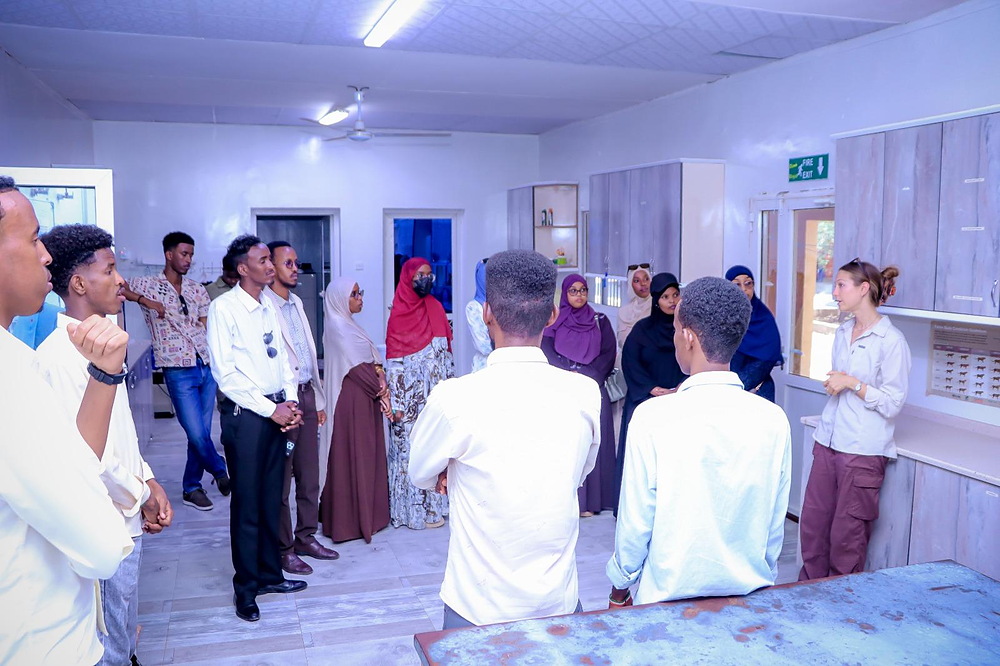
The afternoon was a tour of the grounds: the newest confiscated cubs, resident cheetahs in their bush enclosures, and then the diagnostic laboratory and the hospital treatment room. CCF’s head keeper walked the group through cheetah behavior and husbandry, from how the animals organize themselves in the wild to how diet and feeding schedules are managed at a sanctuary.
The last stop was Delphina, one of the sanctuary’s non-releasable cheetahs, who had been recovering from surgery in the clinic on the day of the visit and who had appeared in the morning’s lecture as the worked example. Meeting her after the case study was the structure of the whole day in miniature.
The visit was organized by Dr Abdisalan, a local veterinarian and University of Hargeisa alumnus who now supports the vet school’s research department. Dr Ahmed, a veterinarian, teacher and keeper at CCF, translated the harder material into Somali and said afterwards that several students had never considered wildlife as part of One Health at all, and that a number asked him how to get involved.
“Engaging local students to help their own community is critical right now,” Ahmed said. “We have to bring the community in if we want to help the cheetahs and stop the pet trade.”
Why Somaliland has a hundred cheetahs in the first place
CCF opened operations in Somaliland in 2022 to care for cheetahs taken out of the illegal pet trade, and the scale is the thing most readers will not expect. The organization now cares for more than a hundred cheetahs (Acinonyx jubatus) in the country, every one of them a confiscated rescue rather than a bred animal. For comparison, CCF notes that most accredited zoological facilities holding cheetahs keep somewhere between three and eight.
The classroom the students sat in exists because of that caseload. CCF opened a Cheetah Education and Training Center Complex on the Somaliland campus in August 2025: 15,000 square feet built around a common courtyard, with indoor and outdoor classrooms, a welcome center, offices, a kitchen and dining area and separate dormitories, designed to host up to 45 trainees at a time roughly an hour’s drive from Hargeisa. It was designed by SDI Architecture with Detour Habitats for a site that takes both extreme heat and hurricane-force winds.
Who paid for it
The complex was built with support from the Royal Commission for AlUla in Saudi Arabia, which CCF names as the sponsor in its own announcement and which supplied a quote for it. That is a regional conservation body rather than a zoo, and it is the only funder named for the building.
We went looking for an accredited zoological institution behind this particular work and did not find one. CCF does list a substantial roster of accredited zoos among its corporate supporters, including Columbus Zoo and Aquarium, Saint Louis Zoo, Dallas Zoo, Indianapolis Zoo, Toronto Zoo, Kansas City Zoo, Metro Richmond Zoo and Nashville Zoo at Grassmere, among others. None of them is credited with the Somaliland sanctuary, with the education complex, or with this visit. That is organization-level support rather than funding of the thing described here, and we are not going to present it as the latter. Readers who want to see our earlier reporting on CCF’s science can start with our piece on the genetics laboratory at Otjiwarongo.
What the day produced is harder to count than a grant: a cohort of Somaliland’s future veterinarians and environmental scientists who have now stood in a cheetah hospital, and a vet school coordinator who went in with little exposure to conservation and came out describing it as a question of balancing the needs of people and animals on shared land rather than keeping land untouched. CCF’s argument is that this is what makes the work last, and on the evidence of the questions the students asked, it is not a bad argument.
The visit is written up in full on the Cheetah Conservation Fund’s blog, and the education complex that hosted it was announced in August 2025.
Quick answers
- What happened at the Cheetah Conservation Fund sanctuary in Somaliland?
Twenty-four students from the University of Hargeisa visited on a day in early October 2026, as part of the university’s summer training series. They took a lecture on One Health, worked through a veterinary case study, and toured the sanctuary, the diagnostic laboratory and the hospital treatment room. CCF had taught at the university before, but this was the first time students came to CCF.
- What is One Health?
The working principle that human health, animal health and environmental health are a single connected system rather than three separate ones, so protecting any one of them depends on caring for all three.
- What was the case study?
A group of confiscated cheetah cubs presenting with diarrhea. The students built the list of possible causes together, covering nutritional problems and viral, bacterial, parasitic and protozoal infections including coccidia, then traced which of those pathogens move between wildlife, domestic animals and people.
- Why does the Cheetah Conservation Fund hold cheetahs in Somaliland?
CCF opened operations there in 2022 to care for cheetahs taken out of the illegal pet trade. It now cares for more than a hundred cheetahs in the country, every one of them a confiscated rescue rather than a bred animal. For comparison, CCF notes that most accredited zoological facilities holding cheetahs keep between three and eight.
- Where did the students have their lecture?
In the Cheetah Education and Training Centre Complex, which opened on the Somaliland campus in August 2025. It runs to 15,000 square feet around a common courtyard, with indoor and outdoor classrooms, a welcome center, offices, a kitchen and dining area and separate dormitories, and is built to host up to 45 trainees at a time about an hour’s drive from Hargeisa.
- Who paid for the education complex?
The Royal Commission for AlUla in Saudi Arabia, which CCF names as the sponsor in its own announcement of the opening. That is a regional conservation body rather than a zoo, and it is the only funder named for the building.
- Is an accredited zoo or aquarium funding this work?
Not that we could verify. CCF lists a long roster of accredited zoos among its corporate supporters, including Columbus Zoo and Aquarium, Saint Louis Zoo, Dallas Zoo, Indianapolis Zoo, Toronto Zoo, Kansas City Zoo, Metro Richmond Zoo and Nashville Zoo at Grassmere. None of them is credited with the Somaliland sanctuary, with the education complex or with this visit, so that is organization-level support rather than funding of the work described here.