A rhino with no horn is an uncomfortable photograph. It reads as damage, and the people who do it to their own animals know that, which is why Care for Wild Rhino Sanctuary published an explanation of the practice on 15 October 2026 rather than waiting to be asked.
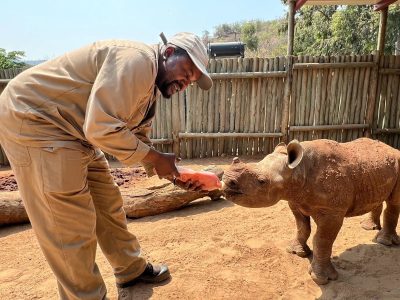
The sanctuary in Mpumalanga holds one of the larger orphan rhino populations in South Africa, most of them animals whose mothers were shot for horn. It trims their horns on purpose.
What does horn trimming actually involve?
Rhino horn is keratin, the protein in fingernails and hair, and it grows back. Trimming removes the bulk of it and leaves a margin above the sensitive tissue at the base, so the procedure is closer to cutting a nail than to an amputation, which is the comparison the word “dehorning” invites and the reason Care for Wild has moved to calling it trimming.
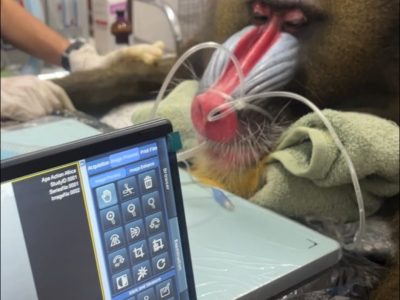
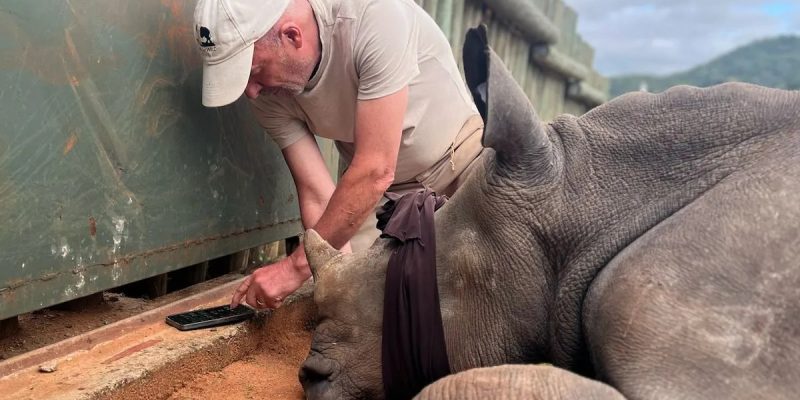
It is done under permit by registered wildlife veterinarians with a trained support team. The rhino is immobilized, then blindfolded and fitted with earplugs to cut out what it can see and hear. It is given supplementary oxygen, and its respiration and vital signs are monitored throughout. The horn is marked, cut with a chainsaw above the growth plate, and the cut face is then smoothed with a grinder so there is no sharp edge to injure the animal or another rhino. The cutting itself is quick. The veterinary care around the immobilization is the part that takes the time and carries the risk.
The horn does not stay at the sanctuary. Care for Wild says the removed horn remains the property and responsibility of the relevant conservation authority and leaves the property after the procedure, which matters, because a sanctuary that accumulated a horn stockpile would be doing something other than what it says it is doing.
Does it work?
This is the part a sanctuary explainer cannot settle on its own, and as of last year it does not have to. In June 2025, Science published the first large study to test the question across a real landscape, and the answer was unusually clear for conservation research.
A team led by Dr Tim Kuiper, working at the University of Cape Town and now at Nelson Mandela University, with colleagues at Stellenbosch and Oxford, examined 11 reserves in the Greater Kruger region between 2017 and 2023. That area holds roughly a quarter of Africa’s remaining rhinos. Eight of the reserves dehorned, 2,284 rhinos in all. The result was a 78 percent reduction in poaching, achieved with about 1.2 percent of the money those reserves spent on rhino protection. Over 2017 to 2021 the reserves spent roughly $74 million on anti-poaching: rangers, tracking dogs, helicopters, detection technology, arrests.
The uncomfortable half of the finding is what the other 98.8 percent of the budget bought. The study found no statistically significant reduction in poaching attributable to law enforcement effort by itself, in a system where arrested offenders frequently are not convicted.
So why keep the rangers?
Because trimming does not make a rhino safe, and the sanctuary says so in its own text.
Poachers still kill trimmed rhinos for the stump and the regrowth, and the study’s authors flag evidence from 2024 and 2025 that this is increasing. Horn regrows, so the procedure has to be repeated. And poaching pressure that leaves one reserve has to go somewhere, which usually means a neighboring population that still carries full horn. Care for Wild lists trimming alongside protection teams, rhino monitors, rangers, K9 and mounted units, and technology, and treats it as one layer among several rather than a solution.
That is the honest reading of the Science result too. Dehorning is the cheapest effective thing anyone has measured, and it is a holding action. It buys time for the enforcement and justice systems that the same study found are not currently delivering.
Which zoo is behind this?
None that we could verify, and we looked.
Care for Wild’s published partners and sponsors page names Investec, Caterpillar, the Oak Foundation, the Rhino Recovery Fund, Baby Rhino Rescue, Animal Survival International, the Singita Lowveld Trust and a list of South African businesses. No zoo and no aquarium appears on it, and searching from the zoos’ side, where conservation spending is usually the better documented half, produced nothing either. The Association of Zoos and Aquariums reports approximately $372.4 million in conservation spending by 235 accredited and certified members across 139 countries in 2025, and no published breakdown isolates an African share, so we will not quote one.
This is a privately funded South African sanctuary doing anti-poaching work with South African corporate money, and the absence of a zoo in the chain is part of what the story is.
We have written about the other side of the same arithmetic in Kenya, where Tsavo West’s rhino sanctuary expanded its fenced area rather than its horn program.
Source: Care for Wild Rhino Sanctuary, 15 October 2026, and Kuiper et al., University of Cape Town, June 2025.
Quick answers
- What is rhino horn trimming?
The controlled removal of most of a rhino’s horn, leaving a margin above the sensitive tissue at the base. Horn is keratin, the protein in fingernails and hair, and it grows back, so the procedure has to be repeated. Care for Wild uses the word trimming rather than dehorning for that reason.
- How is it done?
Under permit, by registered wildlife veterinarians with a trained support team. The rhino is immobilized, blindfolded and fitted with earplugs, given supplementary oxygen and monitored throughout. The horn is marked, cut with a chainsaw above the growth plate, and the cut face is smoothed with a grinder so no sharp edge is left.
- Does it hurt the rhino?
The cut itself is above the sensitive tissue, so it is closer to cutting a nail than to an amputation. The risk in the procedure is the immobilization, which is why a veterinary team monitors respiration and vital signs and stays with the animal through recovery.
- What happens to the removed horn?
Care for Wild says it remains the property and responsibility of the relevant conservation authority and is removed from the sanctuary after the procedure. It is not sold and not used commercially.
- Does trimming actually reduce poaching?
A study published in Science in June 2025 found a 78 percent reduction across 11 reserves in the Greater Kruger region between 2017 and 2023, where eight reserves dehorned 2,284 rhinos. It cost about 1.2 percent of what those reserves spent on rhino protection over the period, roughly $74 million between 2017 and 2021.
- Who did that study?
A team led by Dr Tim Kuiper, then a postdoctoral researcher at the University of Cape Town and now a senior lecturer at Nelson Mandela University, with colleagues at Stellenbosch and Oxford, working with the Greater Kruger Environmental Protection Foundation.
- So is dehorning enough on its own?
No, and neither the sanctuary nor the researchers claim it is. Poachers still take trimmed rhinos for the stump and the regrowth, and the study’s authors flag evidence from 2024 and 2025 that this is increasing. Care for Wild lists trimming alongside protection teams, rhino monitors, rangers, K9 and mounted units and technology, as one layer among several.
- What about law enforcement?
The same study found no statistically significant reduction in poaching attributable to law enforcement effort by itself over the period, in a system where arrested offenders frequently are not convicted. That is a finding about these eleven reserves in these years, not a verdict on enforcement everywhere.