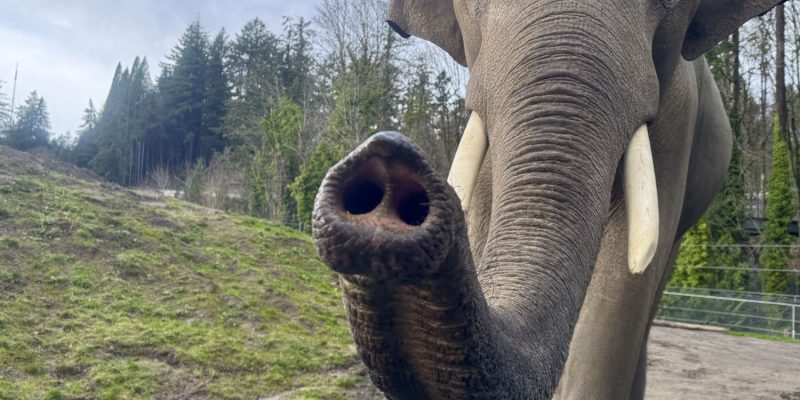
Samudra is 18 years old, weighs about 10,000 pounds, and is leaving the only herd he has ever known. The Oregon Zoo announced on October 13, 2026 that the Asian elephant will relocate to the Saint Louis Zoo in 2027, on a recommendation from the breeding and placement program that manages elephants across accredited North American zoos as a single population.
No departure date has been set. Steve Lefave, who oversees the Oregon Zoo’s elephant area, expects Samudra will stay in Portland at least until next spring, which gives anyone who wants to see him there most of a year to do it.
Why would a zoo send away an elephant it raised?
Because that is what happens to young bulls, and the move is built around it rather than in spite of it.
“As hard as it will be for us to say goodbye, we know this is the right thing for Samudra,” Lefave said. “Wild elephant herds are made up of related females and their offspring. Young males naturally move away from the herd they were raised in during their teen years. Samudra has reached that point, and he needs this opportunity to mingle freely with a different herd.”
The transfer follows a recommendation from the Association of Zoos and Aquariums’ Species Survival Plan for elephants. A Species Survival Plan is the cooperative program that treats the elephants at every accredited institution as one managed population rather than as separate collections, and decides where each individual should live. It is doing two jobs here at once: keeping social groups stable, and keeping the population genetically diverse enough to sustain itself.
Samudra counts on both. Born at the Oregon Zoo on August 23, 2008 at 286 pounds, he was the first third-generation elephant born in the United States. Care staff say he could put on another ton over the next couple of decades.
What is waiting for him in Missouri
The Saint Louis Zoo’s elephant habitat sits inside River’s Edge, a planted landscape of waterfalls, streams and large pools. Lefave, who has watched Samudra make a career of getting wet, expects that to land well.
“Knowing how much Samudra loves the water, I think he’s really going to like it there,” he said. “He’ll have access to a shallow splash pad as well as a deep pool where he can fully submerge and swim the length of the habitat. There are plenty of opportunities for him to play, swim and splash around.”
There is a longer hope behind the logistics. Caregivers want him to get on with the female herd in Saint Louis, and in time to add to it. Saint Louis has been in the elephant news this year for a different reason: in October the zoo reported on an mRNA vaccine trial against EEHV, the herpesvirus that is the leading killer of young Asian elephants in human care. Samudra’s younger sister Tula-Tu received a dose of the same vaccine in Portland.
The species behind the transfer
Asian elephants are in trouble, and the zoo is explicit that this is why one animal’s social arrangements get this much attention. The Oregon Zoo cites the IUCN Red List classification of endangered and an estimated 40,000 to 50,000 animals remaining, in fragmented populations running from India to Borneo. More than half the world’s Asian elephants have been lost over the past 80 years, mostly to habitat loss, conflict with people and disease.
One figure explains that conflict better than any other: roughly 20 percent of the world’s human population lives in or beside Asian elephant habitat.
The Oregon Zoo has kept elephants for more than 60 years and has built a $1 million endowment fund for the species, including support for the AZA’s SAFE program across all 13 Asian elephant range countries. It also works with partners in Borneo on replanting forests, establishing protected corridors and easing conflict between elephants and the communities around them.
Dr. Farina Othman, director of the Borneo group Seratu Aatai, makes the case for why the animal in Portland and the animals in Sabah belong in the same conversation.
“Zoos reach a broad public that it would be extremely difficult for us to reach on our own,” Othman said. “When visitors can see an animal up close, they can form an emotional connection, and that connection can inspire them to care about protecting wildlife in places like Borneo. That’s how we can turn that connection into meaningful change for wildlife.”
For now Samudra is still in Portland, still growing, and still getting in the water. The zoo’s announcement reads less like a goodbye than a long notice period.
Quick answers
- Where is Samudra going?
To the Saint Louis Zoo, in 2027. No exact departure date has been set, and Steve Lefave, who oversees the Oregon Zoo elephant area, expects Samudra to remain in Portland at least until next spring.
- Why is the Oregon Zoo moving an elephant it bred?
Because young bulls leave. Wild elephant herds are made up of related females and their offspring, and males move away from the herd they were raised in during their teen years. Samudra is 18 and has reached that point.
- What is a Species Survival Plan?
The Association of Zoos and Aquariums cooperative program that manages animals across accredited institutions as a single population rather than as separate collections, and decides where each individual should live. It is working on two things at once here: stable social groups, and a genetically diverse population that can sustain itself.
- Who is Samudra?
An Asian elephant born at the Oregon Zoo on August 23, 2008, weighing 286 pounds. He was the first third-generation elephant born in the United States. He now weighs about 10,000 pounds and care staff say he could add another ton over the next couple of decades.
- What is the Saint Louis habitat like?
The elephant habitat is part of River’s Edge, a planted landscape of waterfalls, streams and large pools. Samudra will have a shallow splash pad and a deep pool he can fully submerge in and swim the length of.
- How threatened are Asian elephants?
The Oregon Zoo cites the IUCN Red List classification of endangered and an estimated 40,000 to 50,000 animals remaining, in fragmented populations from India to Borneo. More than half the world’s Asian elephants have been lost over the past 80 years, and about 20 percent of the world’s people live in or beside Asian elephant habitat.
- What does the Oregon Zoo do for wild Asian elephants?
It has kept elephants for more than 60 years and has established a $1 million endowment fund for the species, including support for the AZA SAFE program across all 13 Asian elephant range countries. It also works with partners in Borneo on forest replanting, protected corridors and reducing conflict between elephants and the communities around them.