
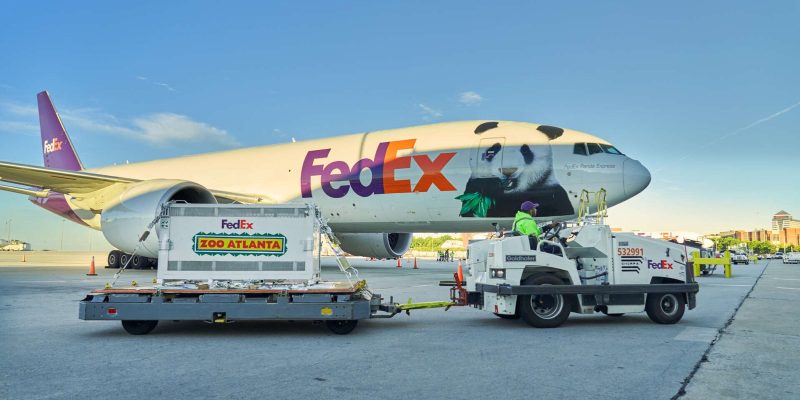
Giant pandas are back in Atlanta. Ping Ping and Fu Shuang landed at Hartsfield-Jackson International Airport on Sunday, September 27, 2026, aboard a dedicated Boeing 777 that FedEx flew and donated for the trip, closing a gap of almost two years since Zoo Atlanta’s previous pandas left for China. The two bears are not on view, and they will not be for a while. Both went straight into a biosecure area of the zoo’s new giant panda complex for a routine quarantine of about a month.
The quarantine is the first thing to understand, because it is the part a visitor is most likely to get wrong. A biosecure area is holding space kept deliberately separate from the rest of the collection, with its own equipment and its own staff routines, so that an animal arriving from another country cannot pass anything to the resident population before a veterinary team has cleared it. Zoo Atlanta says it will announce a viewing date in the coming weeks, along with the name of the pandas’ new home and the design details of their expanded habitat. Media access is closed for the quarantine period as well.
Who are Ping Ping and Fu Shuang?
Both were born at the Chengdu Research Base of Giant Panda Breeding in China. Ping Ping, a male, was born on March 17, 2020, and turned six this spring. Fu Shuang, a female, was born on October 18, 2020, which means she turns six three weeks after landing in Atlanta. Her name is pronounced “Foo Shwong.”
Both names carry something. Ping Ping shares part of a name given at birth to him and his twin brother, a blessing for a smooth and healthy life. Fu Shuang’s comes from “Fu Lu,” a reference to her and her mother, and it means happiness.
With the two of them on the ground, Zoo Atlanta becomes one of three zoos in the United States to house giant pandas, and the only zoological organization in the Southeast where the species lives.
What the new agreement actually is
The pandas are in Atlanta under a new International Cooperative Research Agreement on Giant Panda Conservation between Zoo Atlanta and the China Wildlife Conservation Association. The wording is worth reading closely: this is a research agreement rather than a straightforward loan of two animals, and it is the successor to an arrangement that ran for a quarter of a century.
“This is a thrilling day for Zoo Atlanta and a historic moment for the City of Atlanta, the state of Georgia, and beyond,” said Raymond B. King, Zoo Atlanta’s President and CEO. “We are elated to welcome Ping Ping and Fu Shuang and could not be more excited about sharing that joy with our Members, guests, city, and community in the coming weeks. Zoo Atlanta is honored to partner with the China Wildlife Conservation Association to see important work continue toward the conservation of giant pandas, which is the most important benefit of guarding this species.”
The zoo announced the agreement in April 2026, when it confirmed that two giant pandas would be returning to Atlanta. The building that will hold them has been in progress for longer than that: Zoo Atlanta began design work on the panda complex expansion in early 2025.
A partnership that produced seven cubs
Zoo Atlanta’s first panda agreement with China began in 1999 and concluded in 2024, and the cooperation behind it goes back to the 1990s, when the zoo opened its first round of giant panda conservation work with the Chengdu Research Base as a Signature Partner. Across those 25 years the pair Lun Lun and Yang Yang produced seven offspring between 2006 and 2016, two sets of twins among them. That is a hard result with this species under any conditions.
Lun Lun, Yang Yang and their two youngest, Ya Lun and Xi Lun, left Atlanta for the Chengdu Research Base in October 2024. The pair’s first five offspring were already there. Over the same period the zoo’s support in China went into habitat restoration, nature reserve management and ranger support.
How many giant pandas are left in the wild?
Fewer than most people assume, though the direction of travel is good. The IUCN Red List lists the giant panda, Ailuropoda melanoleuca, as Vulnerable, reclassified down from Endangered in 2016, and records the population trend as increasing. The species holds on in the wild in three Chinese provinces: Sichuan, Shaanxi and Gansu. It is already gone from Hunan and Hubei.
Much of that recovery has been built on land. The Chinese government has established 67 giant panda reserves, and in 2021 the Giant Panda National Park took shape as the backbone of a national protection system meant to connect those fragments to one another rather than leave them as islands.
One figure deserves a footnote. Zoo Atlanta puts the wild population at nearly 1,900 animals, 72 percent of them strictly protected on nature reserves. The IUCN assessment records 500 to 1,000 mature individuals. Both can be correct, because they count different things: “mature individuals” is a Red List term for animals capable of reproducing, and it leaves out the cubs and juveniles that a total population count includes. Where a facility’s figure and the assessment diverge we default to the assessment, and it is worth knowing that this one was last assessed on April 11, 2016, which makes it ten years old. The zoo’s account of the category is exactly right: Endangered until 2016, Vulnerable since.
What happens next
For about a month, not much that anyone outside the animal care team will see. Quarantine is deliberately dull, and a dull quarantine is the good outcome. After that, Zoo Atlanta has three announcements queued up: what the pandas’ home will be called, what the expanded habitat looks like, and the date the doors open.
That last one is the one Atlanta is waiting for. Some morning this fall, a city that spent 25 years with pandas and then two years without them gets to stand in front of one again.
Quick answers
- When can visitors see Ping Ping and Fu Shuang?
Not yet. The two pandas went into a biosecure area of Zoo Atlanta's new giant panda complex on arrival for a routine quarantine of about a month, and the zoo says it will announce a viewing date in the coming weeks along with the name of their new home and the design of their expanded habitat.
- Where did the pandas come from, and how old are they?
Both were born at the Chengdu Research Base of Giant Panda Breeding in China. Ping Ping, a male, was born on March 17, 2020. Fu Shuang, a female, was born on October 18, 2020, so she turns six three weeks after arriving in Atlanta. Her name is pronounced Foo Shwong.
- How did they travel to Atlanta?
On a dedicated Boeing 777 that FedEx flew and donated for the trip. The aircraft landed at Hartsfield-Jackson International Airport on Sunday, September 27, 2026.
- How many zoos in the United States have giant pandas?
Three, with Zoo Atlanta's arrival. Zoo Atlanta is the only zoological organization in the Southeast where the species lives.
- Are giant pandas still endangered?
Not in the IUCN Red List's terms. The giant panda, Ailuropoda melanoleuca, was reclassified from Endangered to Vulnerable in 2016 and the assessment records the population trend as increasing. The assessment lists 500 to 1,000 mature individuals, which counts breeding-age animals only; Zoo Atlanta's figure of nearly 1,900 is a total wild population count, and the two measure different things.
- What happened to Zoo Atlanta's previous pandas?
Lun Lun, Yang Yang and their two youngest offspring, Ya Lun and Xi Lun, left Atlanta for the Chengdu Research Base in October 2024 when the zoo's 1999 agreement with China concluded. The pair's first five offspring were already there. Lun Lun and Yang Yang produced seven cubs in Atlanta between 2006 and 2016, including two sets of twins.