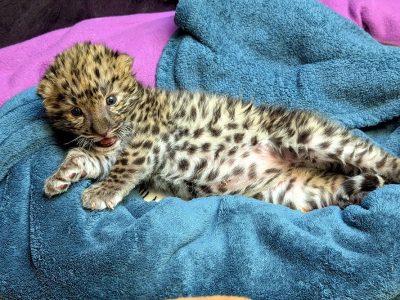

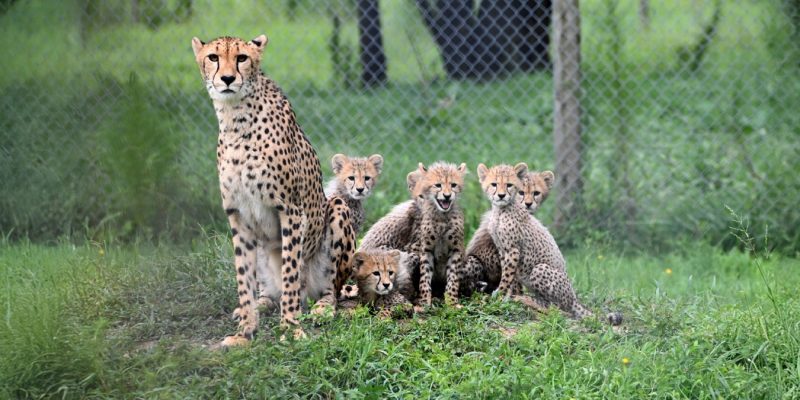
Six cheetah cubs walked out onto the public habitat at the Metro Richmond Zoo in August 2025, three months after they were born. Their mother is Zuri, their father is Ramses, and the litter is three males, Lagos, Bukavu and Cairo, and three females, Matola, Kampala and Lusaka.
Six is a large litter for a species whose litters usually run three to five, and the number is the least remarkable thing about it. The zoo says 167 cheetahs have been born on its property since 2013.
The cubs spent their first months somewhere the public never sees
They were born on May 13 after a gestation of about three months, and they did not start life on the habitat guests walk past. Zuri raised them at the zoo’s Cheetah Conservation Center, a separate facility on the property with 19 habitats given over entirely to cheetahs.
That is the part worth slowing down on, because it explains the rest. A breeding center is not a display. It is a set of yards designed so that adults can be kept apart, introduced on a schedule, and left alone at the moments that matter, which for this species is most of them. Cheetahs have a long reputation as one of the harder cats to breed in human care, and the management answer has generally been more space and less traffic rather than more intervention. Nineteen habitats is a great deal of room to hold in reserve for animals nobody is looking at, and it is the reason the number 167 exists.
Zuri, by the zoo’s account, has been an attentive and playful mother. Once the cubs were old enough, mother and litter moved together to the public habitat, where guests can now watch cheetah cubs at close range with their mother, which is not a common thing to be able to do.
What the veterinary side of six cubs looks like
The zoo’s veterinary staff monitor cubs closely through the first months, with repeated checkups for weigh-ins, deworming and vaccinations. Multiply that by six, on a schedule, for a mother who has to be managed around each handling, and the routine care is a substantial piece of work in its own right.
Where the cheetah actually stands
The zoo describes the cheetah as Africa’s most endangered big cat, and cites a 93 percent population decline over the past 120 years and an occupied range of about 9 percent of what the species once held.
Those two figures are the zoo’s, and they are widely repeated. On the category, we default to the IUCN Red List, which lists the cheetah as Vulnerable, assessed in 2021 and published in 2022, with a global estimate of roughly 6,500 mature individuals and a decreasing trend. That is the same category the Red List gives the African lion and the leopard, so “most endangered big cat” is a comparison rather than a listing. Two cheetah subspecies do carry heavier categories of their own: the Asiatic cheetah, now confined to Iran, and the northwest African cheetah are both assessed as Critically Endangered.
None of which changes the arithmetic the breeding center is built around. Roughly 6,500 mature cheetahs is a small number for a species spread across a continent, and a genetically diverse insurance population in human care is the reason facilities like this one keep 19 yards standing.
How does a small Virginia zoo end up with 167 cheetahs?
By treating it as the institution’s specialty rather than an exhibit. The Metro Richmond Zoo opened in 1995, is accredited by the Zoological Association of America, and has built its reputation on cheetah propagation. Other collections take a similar approach at larger scale. The Smithsonian’s National Zoo and Conservation Biology Institute runs its cheetah program on 3,200 acres in Front Royal, and announced its own litter to mother Amabala in late 2025, about two hours up the road.
Six cubs on a Virginia hillside in front of a chain-link fence is what that work looks like on the one day a year it is visible.
Sources: Metro Richmond Zoo, “Six Cheetah Cubs Now on Habitat,” August 26, 2025; IUCN Red List, Acinonyx jubatus, assessed 2021.
Quick answers
- How many cheetahs have been born at the Metro Richmond Zoo?
The zoo says 167 cheetahs have been born on its property since 2013.
- Where were the six cubs raised?
At the zoo's Cheetah Conservation Center, a separate on-site facility with 19 habitats used only for cheetahs. They moved to the public habitat with their mother at about three months old.
- Is the cheetah endangered?
The IUCN Red List assessed the cheetah as Vulnerable in 2021, with roughly 6,500 mature individuals and a decreasing trend. The Asiatic and northwest African subspecies are assessed as Critically Endangered.
- What are the cubs named?
Lagos, Bukavu and Cairo are the males; Matola, Kampala and Lusaka are the females. Their parents are Zuri and Ramses.