
Aquariums almost always organize themselves by geography. A Pacific gallery, an Amazon gallery, a local-waters gallery. Adventure Aquarium opened a 2,000-square-foot exhibit on June 28, 2025 that throws that out and organizes by color instead.
Kaleidoscope Cove groups its tanks as yellow species, blue species and so on, putting animals side by side that share nothing but a wavelength. It was the aquarium’s most ambitious renovation in more than a decade.
Why color is a real organizing principle
Sorting by color sounds like a design conceit, and it would be if the exhibit stopped there. It does not. The educational content running through the space is about the science underneath the look: how bioluminescence works, what color actually does for an animal in the ocean, and what happens to marine environments deprived of light.
Those are questions a geography-based gallery never raises, because geography groups a bright reef fish with the drab bottom-dweller from the same latitude and calls that the relationship worth showing. Grouping by color asks the visitor to notice a pattern across unrelated species, and then explains it. Color in the ocean is signaling, camouflage, warning and mate choice, and it evolved independently more times than anyone can count.
What is in it
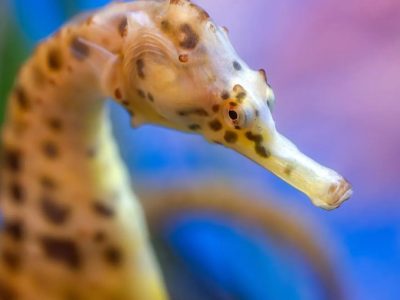
More than 100 aquatic species, including ten to twelve never previously shown at the aquarium: flashlight fish, flamboyant cuttlefish, poison dart frogs, purple-striped jellyfish, alongside familiar residents like clownfish and hippo tangs.
The build sits along the aquarium’s waterfront windows and uses real sunlight together with programmable lighting, so the space shifts through the day. Every tank is framed with lighting tuned to the exhibit’s atmosphere, and a soundscape runs underneath it, calm in the reflective areas and livelier where the exhibit wants people playing.
“We challenged ourselves to think beyond the traditional aquarium experience,” said Mallory Hall, creative director at Herschend Creative Studios. “Instead of focusing solely on habitat, we explored how elements like color and light could shape a new kind of exhibit.”
The interactive half
Kaleidoscope Cove leans harder on technology than most aquarium galleries dare to.
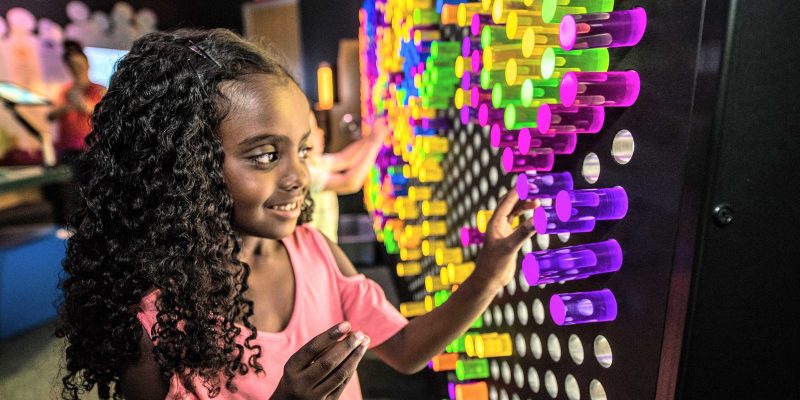
There is a glowing jellyfish display lit to bring out the motion. There is Sea Star Shores, a guided hands-on touch experience. There is a wall-sized grid of colored light pins, a Lite-Brite blown up to human scale. There is a digital sand table that reads touch and movement and turns it into topography and shifting light. And there is Draw Alive, where a visitor sketches a sea creature and watches it animate and swim off across a projected ocean.
The risk with all of this is obvious: screens in an aquarium can end up competing with the animals rather than pointing at them. What keeps this build on the right side of that line is that the interactives are about the same ideas the tanks are about, light, color, pattern, so a child who spends ten minutes on the light wall has been doing something adjacent to what the exhibit is teaching, not just being entertained in a corner.
The exhibit was also designed to be reconfigured, with digital animal identification displays and groupings that can change, so what is in it is not fixed for the next decade.
Where it sits
“Kaleidoscope Cove is our most ambitious renovation in over ten years, marking an exciting milestone for Adventure Aquarium,” said Jennifer Porter, executive director and vice president.
Adventure Aquarium, in Camden, New Jersey, holds one of the more diverse collections in the United States, the largest shark collection in the Northeast, and the world’s longest shark bridge. It has been AZA-accredited for more than 30 years.
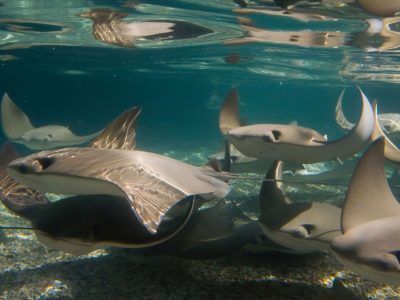
The aquarium has kept building since. In May 2026 it introduced five spotted eagle rays into Ocean Realm, becoming the only place in the Northeast to see the endangered species.