
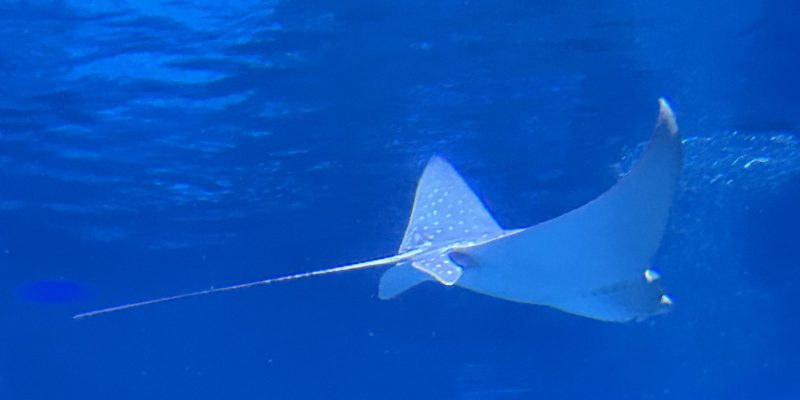
Five spotted eagle rays now live in Ocean Realm at Adventure Aquarium in Camden, New Jersey, making it the only aquarium in the Northeast where the public can see the endangered species up close.
The rays made their public debut over Memorial Day weekend 2026, after months of behind-the-scenes preparation and around-the-clock monitoring by the aquarium’s biologists and veterinary staff. They are permanent residents rather than a temporary exhibit.
What visitors actually see
Ocean Realm holds more than 760,000 gallons, and the rays share it with sharks, sea turtles and a long list of other marine animals. Spotted eagle rays are built for open water, and it shows in how they move: the pectoral fins beat rather than ripple, so the animal appears to fly through the tank instead of gliding along the bottom the way a stingray does.
That flattened body has a name. It is called the disc: the single plate formed by the head and the fused pectoral fins, and it is what a ray is measured across, rather than nose to tail the way you would measure a fish. The white spotting on the dark upper surface of the disc is the species’ signature, and the pattern is individual enough that researchers studying wild populations have used it to tell one animal from another.
The five are currently two to three feet across the disc and weigh between 25 and 33 pounds. They have a long way to grow. Adults reach wingspans of up to five feet and weigh several hundred pounds, which means the exhibit visitors see this year is not the one they will see in a decade.
An endangered animal, and the reason why
Aetobatus ocellatus is listed as endangered on the IUCN Red List. Overfishing is the primary driver, along with habitat loss.
Rays are unusually exposed to fishing pressure for a reason that has nothing to do with how many are caught deliberately. They are slow to mature, produce very few young, and are taken as bycatch in fisheries aimed at other species, a combination that lets a population fall much faster than it can rebuild. Sharks and rays as a group have declined sharply worldwide on exactly that arithmetic.
Adventure Aquarium participates in AZA SAFE Shark and Ray, the Association of Zoos and Aquariums program that coordinates member institutions on shark and ray research, public awareness and field conservation.
“Spotted Eagle Rays are such a dynamic species, and our animal care team has worked tirelessly to ensure they thrive in their new home,” said Nikki Grandinetti, general curator at Adventure Aquarium.
Rays as an exhibit animal
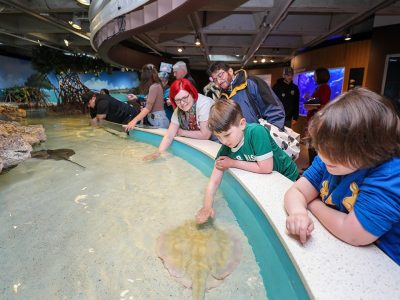
Putting rays in front of people is having a moment in American zoos and aquariums, and the reason is straightforward: they are among the few large marine animals a visitor can watch closely, at eye level, without any of it feeling staged. Memphis Zoo broke ground on a stingray habitat at Mangrove Cove on much the same logic.
Adventure Aquarium has been an AZA-accredited institution for more than 30 years. It holds about two million gallons of water in total, the largest shark collection in the Northeast, and Button and Genny, the only Nile hippos exhibited at an aquarium anywhere in the world. We have covered the facility before, including the little blue penguin chick that hatched there.