
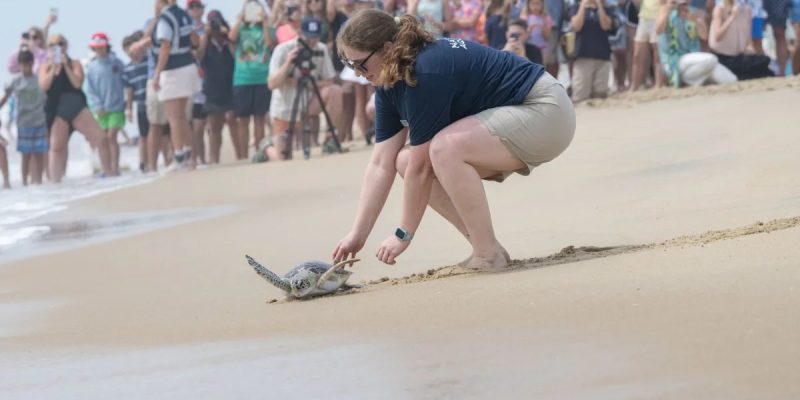
Nine rehabilitated sea turtles went back into the Atlantic at Ocean City, Maryland on July 15, 2026, in front of several hundred people who came to the 40th Street beach access to watch.
They are named for Baltimore neighborhoods: St. Paul, Fells Point, Glen, Mount Vernon, Hamilton, Cherry Hill, Little Italy, Lakeland and Brooklyn. Baltimoreans picked the names in a contest last fall, when the turtles arrived.
Where they came from
All nine were among 40 turtles brought to the National Aquarium last December after being rescued from the cooling water off Cape Cod.
Of those 40: 29 were released at Oak Island, North Carolina on April 14. One died on arrival at the aquarium last fall. One, named Patterson Park, is still in the off-exhibit rehabilitation pool being treated for a mycobacterial infection, a course that usually runs about three months. These nine are the rest.
“We are always so happy to be able to share the release of successfully rehabilitated sea turtles with our community,” said Malia Hale, the aquarium’s director of animal rescue. “Public releases allow Aquarium members and friends to see the results of the rehab work that we undertake each year.”
What cold stunning does
Sea turtles are reptiles and cannot generate their own heat. When water temperature falls fast, as it does off Massachusetts in late autumn, a turtle’s systems slow until it can no longer swim or feed. It floats, and it washes up.
What arrives at a rehabilitation facility is rarely just a cold animal. Cold-stunned turtles come in with pneumonia and other respiratory complications, dehydration, malnutrition, infections, and injuries from predators and boat strikes sustained while they were helpless.
Cold-stunned turtles turn up on the Pacific side too, if less often: a loggerhead found freezing in British Columbia in 2024 was flown to San Diego and released there after eight months of care.
Cape Cod produces more of these cases than anywhere else in the country because of its shape. The hook of the peninsula traps turtles that have drifted north; when the water turns, they cannot get around it to go south.
Numbers along the East Coast have climbed over the past decade. Experts attribute it to warming water, which draws young turtles further north in summer than they historically ranged, leaving more of them on the wrong side of the hook when autumn arrives.
Getting cleared to go
A turtle does not leave when it looks better. Each animal is assessed by aquarium staff and then cleared for release by the National Oceanic and Atmospheric Administration, and the standard is functional: fully recovered from injury and infection, and able to swim and forage independently.
Speed matters too. The teams aim to return animals as soon as they are genuinely ready, so that foraging and migration instincts stay intact. This winter was colder than usual along the East Coast, and this year’s turtles stayed longer than expected as a result.
The work runs through the Sea Turtle Stranding and Salvage Network, which NOAA oversees and which triages stranded animals to facilities like the National Aquarium.
Paid for by nobody in particular
The National Aquarium’s animal rescue program receives no dedicated federal funding for sea turtle rescue and rehabilitation. Every cold-stunning season, with its hundreds of animals and its months of veterinary care, is paid for out of the institution’s own resources and donations.
The aquarium supports the Sea Turtle Rescue Assistance and Rehabilitation Act, a bipartisan bill that would put the funding on a stable footing.