
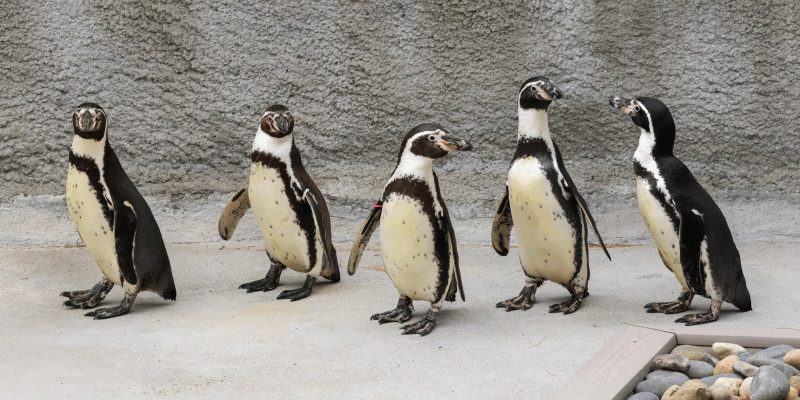
Roger Williams Park Zoo is getting penguins back. A dozen Humboldt penguins move into Penguin Point, a habitat built for them, when the Providence zoo opens the exhibit over Memorial Day weekend. It is the first time the zoo has kept penguins since 2013, and it puts the zoo among only 24 facilities in North America caring for this species.
Penguin Point is built to be watched from two positions rather than one. Guests see the colony on land, on the rocks where the birds stand and preen, and then below the waterline, where a Humboldt stops looking like a comic waddler and starts looking like what it is, a fast pursuit predator with its wings turned into paddles. That second view is the whole argument for building a penguin habitat rather than a penguin pen.
Why does a penguin live in the desert?
Most people picture snow. Humboldt penguins come from the hot, arid coast of Chile and Peru, nesting on rocky ground above water that is cold for an entirely different reason. The Humboldt Current runs north along that coastline carrying cold water up from the south, and it is one of the most productive stretches of ocean on earth. The air above it is desert. The water in it is full of fish.
That is the arrangement a Humboldt penguin is built for. The birds stand 15 to 18 inches tall and weigh about nine pounds, small as penguins go. Their feathers are waterproofed by constant preening with oil from a preen gland, which is why a penguin that appears to be fussing at itself is in fact doing maintenance on the only thing keeping it warm. They eat fish, squid and crustaceans, all of it hunted underwater.
How many Humboldt penguins are left?
The species is listed as Vulnerable on the IUCN Red List, the category the zoo cites, and the assessment backs the number it cites too. BirdLife International assessed the species on 21 August 2020 and counted 23,800 mature individuals, with the population trend decreasing. The zoo puts the population at about 12,000 breeding pairs. Those are the same quantity in different units, which is a pleasant thing to be able to report: 12,000 pairs is 24,000 breeding adults, and the assessment counts 23,800.
What is driving the decline is a list of ordinary industrial pressures rather than one dramatic cause. Overfishing removes the prey. Fishing nets catch the birds themselves. Climate change moves the food around. And guano harvesting, which is the collection of accumulated seabird droppings for fertilizer, takes away nesting ground: the zoo names it as a threat to crucial nest sites, which is what a guano bed on that coast is before anyone digs it up.
The Red List assessment counts 20 locations for the species across its breeding range in Chile and Peru. For a bird that nests in colonies on a narrow band of coast, that is not many places for things to go wrong in.
What is the zoo doing besides displaying them?
Roger Williams Park Zoo takes part in the Humboldt penguin Species Survival Plan, the Association of Zoos and Aquariums program that matches birds for breeding and arranges transfers between accredited institutions so the population in human care stays genetically diverse rather than drifting into a handful of related family lines. With only 24 North American facilities holding the species, every one of them counts for more in that arithmetic than it would for a common animal.
The habitat is the zoo’s second substantial build in as many years, after the Red Panda Paradise habitat. Penguin habitats have been a quiet growth area across the field: the Philadelphia Zoo opened its own Penguin Point for Magellanic penguins, and Yorkshire Wildlife Park built one for African penguins, a species in considerably worse trouble than the Humboldt.
Daily keeper chats are planned at the habitat, which is where the conservation argument actually lands, because it is easier to care about overfishing off Peru once you have watched a bird that eats Peruvian fish swim past your face. Memorial Day weekend is the start of it.
Quick answers
- When does Penguin Point open at Roger Williams Park Zoo?
Memorial Day weekend. The zoo announced the habitat in April 2025 and it houses a dozen Humboldt penguins.
- Has Roger Williams Park Zoo had penguins before?
Yes. The zoo last kept penguins in 2013. Penguin Point makes it one of only 24 facilities in North America caring for Humboldt penguins.
- Where do Humboldt penguins come from?
The hot, arid coast of Chile and Peru. They nest on rocky ground above the Humboldt Current, which carries cold, highly productive water north along that coastline.
- How big is a Humboldt penguin?
Fifteen to eighteen inches tall and about nine pounds. They eat fish, squid and crustaceans, and waterproof their feathers by preening them with oil from a preen gland.
- Are Humboldt penguins endangered?
They are listed as Vulnerable on the IUCN Red List. BirdLife International assessed the species on 21 August 2020 and counted 23,800 mature individuals across 20 locations, with the population decreasing. The zoo’s figure of about 12,000 breeding pairs is the same quantity stated in pairs rather than individuals.
- What threatens Humboldt penguins?
Overfishing of the prey they depend on, accidental capture in fishing nets, climate change shifting their food supply, and guano harvesting, which removes the accumulated seabird droppings they nest in.