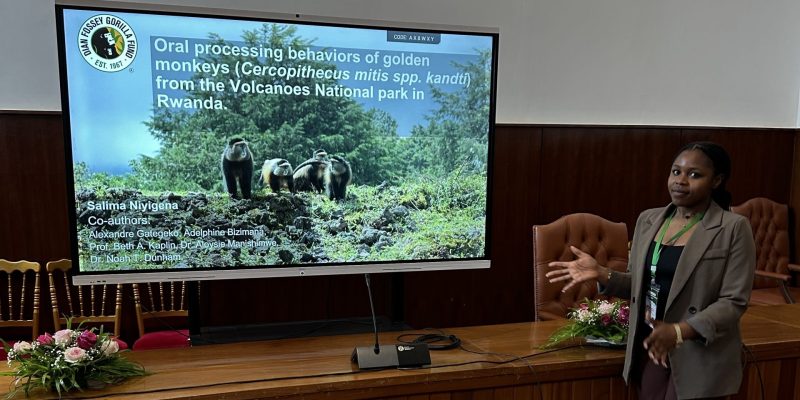
Salima Niyigena studies how golden monkeys chew. In September she took that work to the 4th African Primatological Society Congress in Cameroon, where she presented research on the feeding behaviors of the golden monkeys of Rwanda’s Volcanoes National Park, and on what those behaviors leave behind on the animals’ teeth.
Niyigena is a research assistant in the Dian Fossey Gorilla Fund’s biodiversity program in Rwanda. The Fossey Fund announced her presentation on October 13. The congress itself ran in Cameroon from September 8 to 11 under the theme “Recognising the Role of Indigenous and Local Communities in the Conservation of African Primates.”
What the research found
Her work examines how golden monkeys use different oral processing techniques on different foods, and how those techniques relate to patterns of wear on their teeth. Feeding ecology of this kind is one of the few ways to read a primate’s relationship with its habitat without handling the animal: what an animal eats, and how hard it has to work to eat it, shows up in the dentition.
Her title slide credits five co-authors alongside her: Alexandre Gategeko, Adelphine Bizimana, Prof. Beth A. Kaplin, Dr. Aloysie Manishimwe and Dr. Noah T. Dunham. The Fossey Fund says the findings were published last year in the American Journal of Primatology. We were not able to open that paper from any source available to us today, so we are reporting the journal as the Fossey Fund states it rather than citing the article ourselves.
Niyigena came to the Fossey Fund in 2023 as a professional intern while finishing her senior bachelor’s research project on golden monkey diets and feeding behavior, and has been a full-time research assistant since. The organization was also represented at the congress by Urbain Ngobobo, its director of Congo programs, who presented on the conservation of Grauer’s gorillas in the Democratic Republic of the Congo.
“As an early-career primatologist, I found it inspiring to meet other young researchers passionate about making a difference,” Niyigena said in the Fossey Fund’s announcement. “This experience broadened my perspective and motivated me to continue growing professionally.”
The animal in question
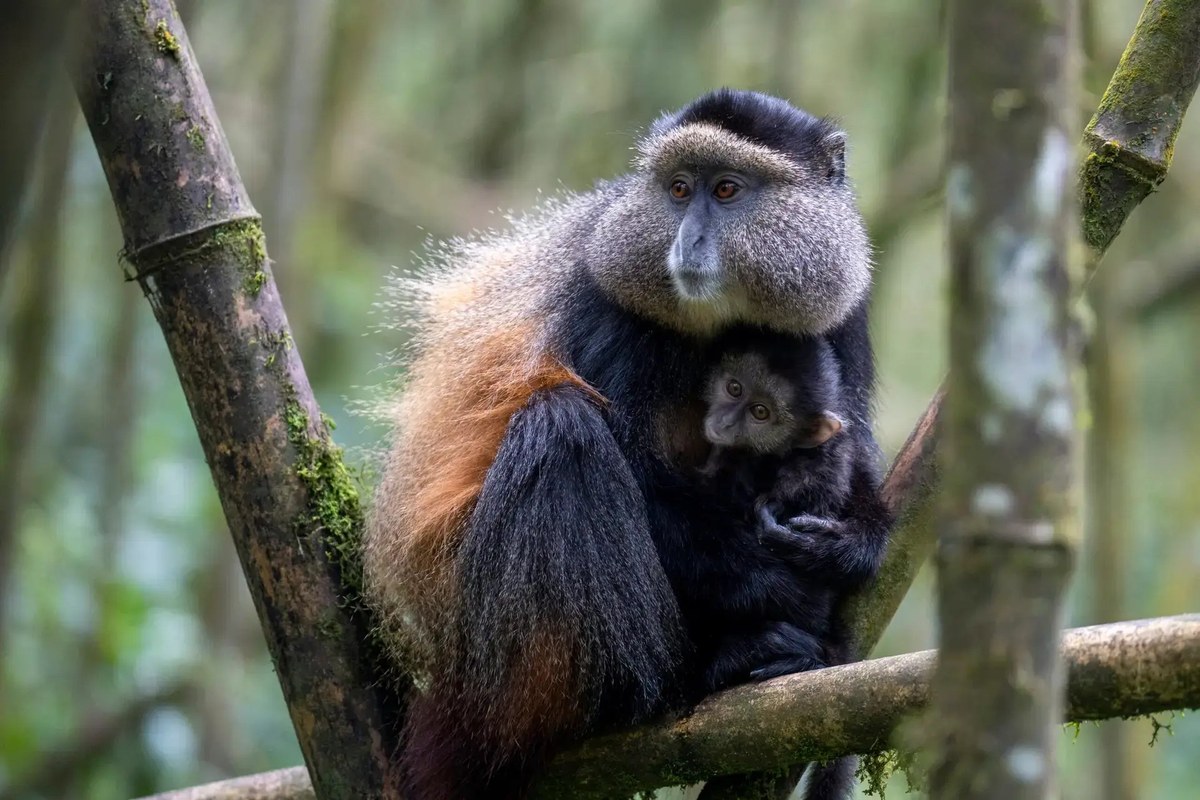
The golden monkey is Endangered, and its situation is narrower than its name suggests. The IUCN’s Regional golden monkey conservation action plan 2023-2028, published in Gland, Switzerland in 2023, records the animal as surviving in only two small populations in the central part of the Albertine Rift, across the Democratic Republic of the Congo, Rwanda and Uganda. The plan puts habitat loss in Rwanda’s portion of the Virunga massif, Volcanoes National Park, at roughly 50 percent, and in the Gishwati forest at roughly 98 percent.
That document is itself largely Fossey Fund work. Its lead author is Deogratias Tuyisingize, who manages the organization’s biodiversity research program, and its co-authors include Winnie Eckardt and Tara Stoinski, the Fossey Fund’s chief executive. The plan was issued with the IUCN Species Survival Commission.
One point of nomenclature, offered as a footnote rather than a correction. The IUCN action plan treats the golden monkey as Cercopithecus mitis kandti, a subspecies of the blue monkey, and Niyigena’s own title slide writes it the same way. A number of other references elevate it to a full species, Cercopithecus kandti. The assessment is the one we follow, and both forms refer to the same animal.
Which zoos are behind this
The scientist-training pipeline that produced this presentation has an American zoo in it, and it is not the first time the Fossey Fund’s Rwandan work has traced back to one. Cleveland Metroparks Zoo runs the Memoirs Program with the Fossey Fund, a partnership now past its tenth year in which University of Rwanda undergraduates write a senior thesis under a scientific supervisor. Zoo scientists each advise a student and travel to Rwanda at the start and end of the academic year. The Cleveland Zoological Society and the zoo also fund four professional internships at the Fossey Fund each year for Memoirs graduates. By the zoo’s own count, 155 students have come through the program and more than 70 have been mentored by its scientists over the last decade. Dr. Kristen Lukas, the zoo’s director of conservation and science, sits on the Fossey Fund’s board.
Niyigena’s described path, a senior bachelor’s research project followed by a professional internship at the Fossey Fund in 2023, is the exact shape of that program. Neither organization names her as a Memoirs student or as a Cleveland Metroparks Zoo intern, so we are not going to say that she was. What is documented is that the zoo funds and staffs the pipeline that trains early-career Rwandan biologists at the Fossey Fund, which is what this story is about.
Behind that sits a wider group. In 2017 the Association of Zoos and Aquariums gave top honors in its International Conservation Award to the Fossey Fund and ten AZA-accredited institutions, naming Zoo Atlanta, Columbus Zoo and Aquarium, Cleveland Metroparks Zoo, Dallas Zoo, Oklahoma City Zoo, Disney’s Animal Kingdom, Indianapolis Zoo, San Diego Zoo, Birmingham Zoo and Louisville Zoo, and describing their support as financial, programmatic and governance support across much of the organization’s history. Zoo Atlanta became the Fossey Fund’s international headquarters in 1995, and Stoinski came to the organization from Zoo Atlanta’s primate research department.
What no source names is a funder for this particular study or for Niyigena’s travel to Cameroon. The Fossey Fund does not say, and we are not going to supply one.
Quick answers
- What did Salima Niyigena present?
Research on the feeding behaviors of golden monkeys in Rwanda’s Volcanoes National Park: how the animals use different oral processing techniques on different foods, and how those techniques relate to patterns of wear on their teeth. She presented it at the 4th African Primatological Society Congress, held in Cameroon from September 8 to 11, 2026.
- Who is she?
A research assistant in the Dian Fossey Gorilla Fund’s biodiversity program in Rwanda. She joined the organization in 2023 as a professional intern while finishing her senior bachelor’s research project on golden monkey diets and feeding behavior, and has been a full-time research assistant since.
- Where was the research published?
The Fossey Fund says the findings were published last year in the American Journal of Primatology. We could not open that paper from any source available to us, so we report the journal as the organization states it rather than citing the article ourselves.
- How endangered is the golden monkey?
Endangered. The IUCN’s Regional golden monkey conservation action plan 2023-2028, published in Gland, Switzerland in 2023 with the IUCN Species Survival Commission, records the animal surviving in only two small populations in the central Albertine Rift, across the Democratic Republic of the Congo, Rwanda and Uganda. It puts habitat loss in Volcanoes National Park at roughly 50 percent and in the Gishwati forest at roughly 98 percent.
- Is the golden monkey a species or a subspecies?
The IUCN action plan treats it as Cercopithecus mitis kandti, a subspecies of the blue monkey, and Niyigena’s own title slide writes it the same way. A number of other references elevate it to a full species, Cercopithecus kandti. Both forms refer to the same animal; we follow the assessment.
- Which zoos are behind this work?
Cleveland Metroparks Zoo runs the Memoirs Program with the Fossey Fund, in which University of Rwanda undergraduates write a senior thesis under a scientific supervisor. The zoo lends its scientists to Rwanda twice a year, and it and the Cleveland Zoological Society fund four professional internships at the Fossey Fund each year. Behind that, the Association of Zoos and Aquariums gave top honors in its 2017 International Conservation Award to the Fossey Fund and ten AZA-accredited institutions.
- Did a zoo fund this particular study?
No source names one. The Fossey Fund does not identify a funder for the golden monkey study or for Niyigena’s travel to Cameroon, and neither it nor Cleveland Metroparks Zoo names her as a Memoirs student. We are reporting the program the zoo funds, not placing her inside it.