
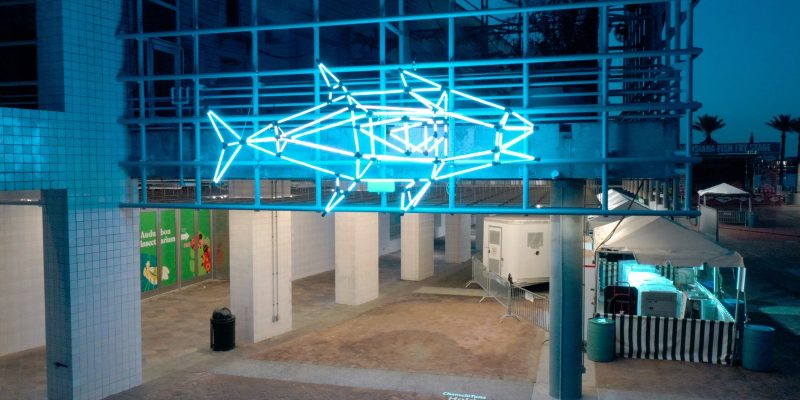
There is a new reason to walk past Audubon Aquarium after dark. ChamäleTuna, an interactive light sculpture by the artist Ilya Sobol, was unveiled at the aquarium’s entrance at 1 Canal Street in New Orleans in June 2026, and it reads the colors people are wearing and changes to match them.
The piece is on view from sunset until 10 p.m. every evening. It is free, it sits on the public sidewalk outside the ticket gate, and you do not need to be visiting the aquarium to see it.
A tuna that behaves like a chameleon
The form is a bluefin tuna. The behavior is borrowed from somewhere else entirely.
Sensors read the colors in front of the sculpture and the lighting shifts in real time to reflect them. A red jacket, a blue shirt, a patterned dress: each one pushes the palette somewhere new, so the artwork is never the same twice and never finished. Stand in front of it in a crowd and you are looking at a picture of the crowd.
That is the chameleon half of the name, and it is a reasonable piece of biology to build a sculpture around. Chameleons change color by rearranging pigment cells and light-reflecting crystals in their skin, largely to signal to each other and to regulate temperature, not to disappear into wallpaper. Responding to what is nearby is the honest version of the trick.
Who put it there?
ChamäleTuna is a partnership between the Downtown Development District of the City of New Orleans, Arts New Orleans and Audubon Nature Institute. The DDD is a business improvement district created by the Louisiana Legislature in 1974, the first assessment-based district of its kind in the country, and its remit includes public space in the downtown core.
“The DDD is committed to enhancing downtown livability through creative placemaking projects that make our public spaces more vibrant, welcoming, and safe,” said Seth Knudsen, the district’s president and CEO. “Artist Ilya Sobol’s light installation presented a unique opportunity to beautify the area around the Aquarium, elevate the visitor experience, and draw even more attention to one of Downtown New Orleans’ premier attractions.”
“We are excited to welcome ChamäleTuna as a new extension of the Audubon Aquarium experience, bringing its sense of wonder beyond regular operating hours and into the heart of the public realm,” said Michael J. Sawaya, president and CEO of Audubon Nature Institute.
Arts New Orleans, the city’s official arts agency since 1975, places the work in a growing collection of permanent light pieces around the city. “These pieces build upon the creative momentum and artistic energy showcased during LUNA Fête, transforming temporary moments into lasting public artworks,” said president and CEO Joycelyn Reynolds, referring to the city’s annual light festival.
Why an aquarium wants art on the sidewalk
An aquarium closes in the late afternoon. The building does not, and neither does the block it sits on.
A piece like this extends the institution past its operating hours and past its admission gate, which is a different proposition from anything inside the building. Sobol frames it as a portrait of the people who happen to be there. “ChamäleTuna reminds us that our individuality contributes to something larger,” he said. “The installation evolves through human interaction.”
Aquariums have been commissioning serious artists for a while now on much the same logic. Artis Amsterdam recently opened an Olafur Eliasson installation inside its own aquarium building, where the work and the tanks share a room.
Audubon Aquarium sits on the Mississippi riverfront and is part of Audubon Nature Institute, which also runs Audubon Zoo and takes part in AZA Saving Animals From Extinction programs for African penguins, whooping cranes and orangutans.
Go at dusk, wear something loud, and watch what the fish does about it.