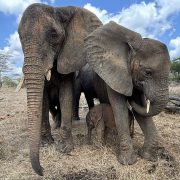

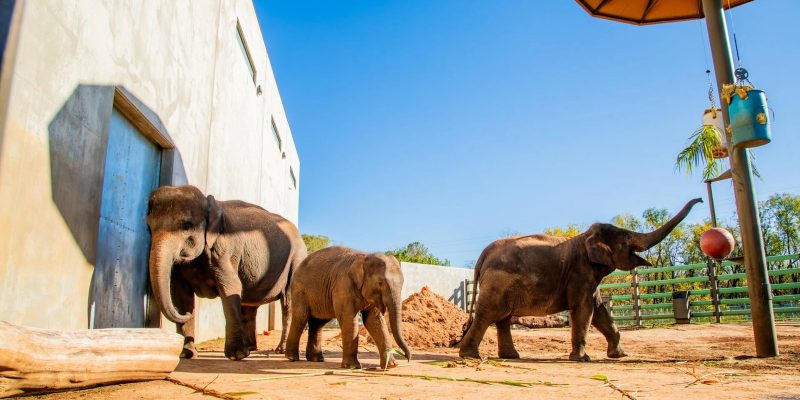
Three Asian elephants arrived at the Tulsa Zoo on Tuesday, November 3, and they came as a family. Shanti, 36, made the trip from the Houston Zoo with both of her daughters: Joy, who is nine, and Kirby, who is one and still nursing. The zoo’s herd now stands at ten animals spanning three generations, which is the thing Tulsa has been building toward for most of a decade.
That matters more than a headcount. Elephants live in matriarchal family groups, and a facility that holds only adults is holding a fragment of a social species. Moving a grandmother-aged female, her grown daughter and her calf together, rather than one animal at a time, keeps a working family intact inside a herd that already had seven members.
What was the Elephant Preserve built for?
“The Mary K. and John T. Oxley Family Elephant Experience and Preserve was designed to care for Asian elephants at every stage of life, including geriatric and breeding-age adults, and calves,” said Tulsa Zoo President and CEO Lindsay Hutchison. “We’re thrilled to see the hard work and dedication of our staff, volunteers, board members, donors and Tulsa voters come to fruition as we welcome these three new additions into our Tulsa Zoo family.”
The complex she is describing covers 17 of the zoo’s 124 acres and was finished in April 2025, when the Oxley Family Elephant Experience opened as the last piece of the build. A barn, holding areas and outdoor yards sized for calves and for geriatric animals are not decorative distinctions: they decide which elephants a facility can accept at all. Shanti, Joy and Kirby are the first test of that design with three generations in the building at once.
Both Shanti and Joy arrived carrying breeding recommendations through the Association of Zoos and Aquariums’ Species Survival Plan, the program that manages Asian elephant placements across accredited North American facilities.
Joy survived the virus that kills young elephants
In the spring of 2019, Joy’s care team at the Houston Zoo found that she had an active case of elephant endotheliotropic herpesvirus, usually shortened to EEHV. The virus is present in most elephants and stays dormant in the great majority of them, but when it activates it can kill a young elephant within days by attacking the lining of the blood vessels. Joy was given round-the-clock care, antiviral medication, and blood and plasma transfusions. She recovered, and has been in good health since.
Kirby, born November 15, 2024 at 314 pounds, was among the first calves in the United States to receive the EEHV vaccine. That is the same line of work the Saint Louis Zoo described in October, when its calf Jet received a third dose of an experimental mRNA vaccine. Two elephants in one family, one who fought the virus off with transfusions and one who was vaccinated against it before she turned two, is about as clear a picture of the last seven years of elephant medicine as a zoo is likely to produce.
The zoo records that Kirby stood six minutes after she was born, walked 25 minutes after that and was nursing inside 90 minutes. She is named for Kirby Drive, a nod to her hometown.
How to tell them apart
Shanti is the largest of the three and the easiest to pick out: a broad heart-shaped head, strawberry-blonde hair at the openings of her ears, and a pronounced heart-shaped tip to her trunk. Straight after a bath her skin darkens, which makes the pink freckling on her trunk and ear edges stand out. Kirby is usually somewhere underneath her. Joy, by the zoo’s account, earns her name, and keepers describe her as energetic and curious.
Where the species stands
The IUCN Red List assesses the Asian elephant, Elephas maximus, as Endangered under criterion A2c. The assessment was carried out on September 18, 2019 and published in 2020. It records a decreasing population, severely fragmented across 13 range states, and it gives no global count of mature individuals. The species is listed as extinct in Pakistan.
Tulsa has held accreditation since 1976 and was among the first 11 zoos the AZA ever accredited, a run it marked at 50 unbroken years in October.
The three are together while they settle in and learn their keepers, and they are not on exhibit yet. Guests may still catch sight of them now and then as they begin exploring the Elephant Preserve Barn. When they do come out, the herd they are joining is males Billy, Hank and Sneezy and females Booper, Connie, Joy, Kirby, Shanti, Sooky and Tina.
Quick answers
- Which elephants arrived at the Tulsa Zoo?
Shanti, 36, and her two daughters, Joy, nine, and Kirby, one. All three came from the Houston Zoo and arrived on Tuesday, November 3, 2026.
- How many elephants does the Tulsa Zoo have now?
Ten, across three generations: males Billy, Hank and Sneezy, and females Booper, Connie, Joy, Kirby, Shanti, Sooky and Tina.
- Can visitors see the new elephants?
Not on exhibit yet. The three are settling in and building relationships with their keepers, and may occasionally be visible as they start exploring the Elephant Preserve Barn.
- What is EEHV?
Elephant endotheliotropic herpesvirus. It is present in most elephants and stays dormant in the great majority of them, but when it activates it can kill a young elephant within days by attacking the lining of the blood vessels. Joy had an active case in 2019 and recovered after antivirals and blood and plasma transfusions. Kirby was among the first calves in the United States to receive the EEHV vaccine.
- Is the Asian elephant endangered?
Yes. The IUCN Red List assesses Elephas maximus as Endangered under criterion A2c, assessed on September 18, 2019 and published in 2020. The population is decreasing and severely fragmented, and the species is listed as extinct in Pakistan. The Red List gives no global count of mature individuals.
- Why did three elephants move together?
Shanti, Joy and Kirby are a family group, and Kirby is still nursing. Both Shanti and Joy carry breeding recommendations through the AZA Species Survival Plan, which manages Asian elephant placements across accredited facilities.