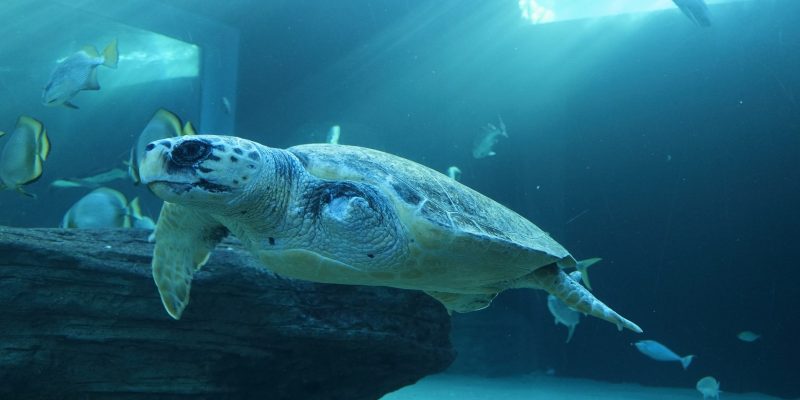
Habanero arrived at the Two Oceans Aquarium Foundation’s Turtle Conservation Centre in Cape Town on 8 February 2025, after a member of the public found him washed ashore at Witsand. He weighed about 75 kilograms, measured roughly 82 centimeters, and was covered in leeches and their eggs. The leeches were on his eyes. They had made him so anemic that the team was not confident he would survive the first week.
On 15 October 2026, the aquarium said he has been declared free of infection and has entered the last phase of his rehabilitation, which is the phase that ends in a release.
Why did he lose a flipper?
The leeches were not the worst of it. On admission the turtle team noticed a swollen, painful left elbow, and X-rays showed severe destruction of the bone in the joint, almost certainly from a chronic infection that predated the stranding. Dr Bernice van Huyssteen, the center’s turtle veterinarian, had the dead and infected tissue surgically debrided, and the joint flushed, because antibiotics alone were not going to clear it.
They did not clear it. By December 2025 the infection was still there and still spreading, and after consulting turtle veterinarians internationally, van Huyssteen amputated the front left flipper. The surgery itself went well. The problem was what the flipper had already seeded: small areas of infection in his other limbs, which then had to be treated with a long antibiotic course while the team watched his bloodwork and CT scans for nine months.
“For the past nine months, our veterinary team has been anxiously monitoring Habanero for signs of ongoing infection.”
In September 2026 he moved back into the aquarium’s I&J Ocean Exhibit, where he had lived before the surgery. A final CT scan at Winelands Radiology in mid-September came back clean, and the team declared him free of infection after nearly two years.
How do you get a three-flippered turtle fit for the ocean?
By making him work for his food, and by making sure he does not associate the food with people.
Each of the larger turtles at the center has its own patterned paddle, a target. Staff put the target in the water and present food in front of it, so the turtle learns to key on the paddle rather than on a human being. For an animal that is going back into an ocean where people fish, that distinction matters more than it sounds.
For Habanero the target work doubles as physical therapy. A team member on scuba or on a breath-hold holds out his paddle and swims away with it, and feeds him at varying depths, so he has to chase, turn and change level with one front flipper missing. The aquarium reports he is fast, unfussy and, in van Huyssteen’s word, mischievous. His preferred food is Cape redfish.
Is a loggerhead endangered?
The aquarium describes Habanero as able to “contribute to the future of his endangered species.” The IUCN assessment is more specific than that, and a little less severe.
Globally, the loggerhead, Caretta caretta, is assessed as Vulnerable. The Red List also assesses ten separate loggerhead subpopulations, and they range from Least Concern to Critically Endangered, because a loggerhead in the Mediterranean and a loggerhead in the North West Indian Ocean are in completely different situations. The South West Indian Ocean subpopulation, which nests mainly on South African and Mozambican beaches, is assessed as Near Threatened by the IUCN Marine Turtle Specialist Group, and nest counts there have risen over the past generation, which the assessors credit to protected areas and long-running beach monitoring.
Which subpopulation Habanero belongs to is an open question, and the barnacles on his shell are the reason. When he arrived he was carrying two turtle barnacles that the team did not recognize as South African, and that were later identified as Gulf of Mexico and Mediterranean animals. We default to the assessment over a facility’s wording as a matter of house practice, but the aquarium’s underlying point stands either way: he is an adult male of a species under pressure, and an adult male is worth a great deal to it.
Who pays for this?
The aquarium itself, which is the answer that makes this story different from most rescue stories out of this region. The Turtle Conservation Centre is run by the Two Oceans Aquarium Foundation, the conservation arm of an accredited public aquarium, so the institution doing the surgery, housing the animal and funding the ward is the same one. Habanero’s adopters, the Morukuru Goodwill Foundation, have supported his care since the early days after his rescue.
We looked for an outside zoological funder and did not find one for this particular work. Two Oceans does name three, the Florida Aquarium, Georgia Aquarium and Zoos Victoria, but they support its African penguin campaign, not the turtle center, so they are not part of this story and we are not going to imply that they are.
He is the latest of several patients we have followed through this center, after Amber the hawksbill, who is at a much earlier stage of the same process. No release date has been given for Habanero.
Source: Two Oceans Aquarium, 15 October 2026.
Quick answers
- Who is Habanero?
An adult male loggerhead turtle at the Two Oceans Aquarium Foundation’s Turtle Conservation Centre in Cape Town. He stranded at Witsand and was admitted on 8 February 2025 at about 75 kilograms and 82 centimeters, covered in leeches that had left him severely anemic.
- How did he get his name?
The centre names its adult turtles on a theme each year, and that year the theme was herbs and spices. Two barnacles on his shell were identified as Gulf of Mexico and Mediterranean species rather than South African ones, which suggested a long journey, and the team named him for it.
- Why was his flipper amputated?
A chronic bone infection in his left elbow that would not clear. X-rays on admission showed severe destruction of the joint. Surgical debridement and antibiotics failed to resolve it, and in December 2025 Dr Bernice van Huyssteen amputated the front left flipper to save his life.
- Why did it take so long after the surgery?
Because the infection had already spread to his other limbs, and sea turtles heal slowly. He spent nine months on antibiotics with blood tests and repeated CT scans. A final scan at Winelands Radiology in mid-September 2026 was clean.
- How is he being prepared for release?
By target feeding. Each large turtle has its own patterned paddle, and food is presented at the paddle so the turtle associates feeding with the target rather than with people. For Habanero a diver holds the target and swims away with it, and feeds him at different depths, so he builds speed and maneuvering strength with three flippers.
- Can a three-flippered turtle survive in the wild?
The aquarium’s assessment is that he can, and its release standard is that a turtle must be strong, healthy and able to contribute to its species. It reports he is fast and food-motivated despite the missing flipper. No release date has been announced.
- Is the loggerhead endangered?
The IUCN Red List assesses the loggerhead globally as Vulnerable, and assesses ten subpopulations separately, from Least Concern to Critically Endangered. The South West Indian Ocean subpopulation, which nests mainly in South Africa and Mozambique, is Near Threatened and its nest counts have risen over the past generation. The aquarium describes the species as endangered.