
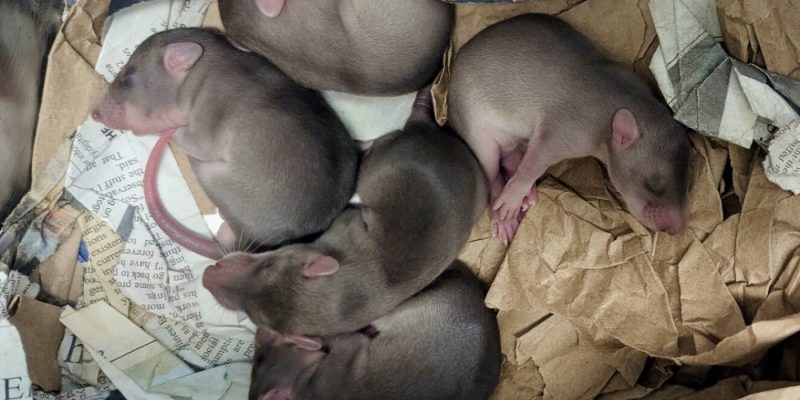
Five southern giant pouched rat pups were born at Utah’s Hogle Zoo on August 12, 2026, and in less than two weeks they went from pink and hairless to covered in fur. They are the second litter for their mother, Acacia. Their father is Baobab.
A first veterinary exam is coming up for the litter. That is when the pups will be weighed and their sexes determined.
Where can you see the pups?
They are in the Small Animal Building, and sightings are limited for the moment. Guests may catch a glimpse of the pups nursing, or of one of them venturing out of the nest box for the first time. That window will not stay open long. Pouched rats grow quickly and can be fully independent of their mother within 12 weeks of birth.
Why five rat pups count as news
Breeding pouched rats successfully under human care is rare, so every litter gives keepers a look at something the field does not often get to observe: how the species cycles reproductively, how the pups develop week by week, and what a mother needs in order to do the job herself.
“Acacia is doing a great job as a second-time mother and has been very attentive to her pups. We’ve watched her nurse and groom throughout the day. As their caregivers, we’ve learned it’s best to trust Acacia’s instincts as a mom during this exciting time and make sure we provide all the food, fresh bedding, and warm spaces she needs,” said Brittany Wildman, supervisor of the Small Animal Building at Utah’s Hogle Zoo.
What is a southern giant pouched rat?
The southern giant pouched rat (Cricetomys ansorgei) is a large African rodent native to savanna habitats across East and Southern Africa, including Angola, Botswana, Kenya, Malawi, Mozambique, South Africa, Tanzania, Uganda, Zambia and Zimbabwe. An adult weighs about three to four pounds. The pouch in the name is a cheek pouch, the same equipment a hamster carries, scaled up to an animal the length of a house cat.
What sets the species apart is the nose. Pouched rats are intelligent, and their sense of smell is good enough that people have built entire jobs around it.
The hero rats
Trained pouched rats detect landmines. They detect tuberculosis. They sniff out trafficked wildlife products, including pangolin scales and elephant ivory. They work search and rescue.
Their size is part of why the landmine work is possible. At three to four pounds, a pouched rat can search ground where mines may be buried without putting down enough weight to trigger one. Some search-and-rescue rats wear small vests fitted with cameras, flashlights and GPS transmitters, so a rat that gets into a space no person can reach can show the team what is in there.
Where the pups go next
At about three months old, the pups will likely move to another accredited zoo. There they will support the Association of Zoos and Aquariums Rodent Taxon Advisory Group, the body that coordinates population planning and care standards for rodents across accredited institutions, and they will work as ambassadors for their species.
That is the long game. The short version is that there are five fast-growing rodents in the Small Animal Building right now, they have their fur, and one of these days soon one of them is going to put a nose out of the nest box while somebody is standing there watching.
More from Utah’s Hogle Zoo: the zoo’s Amur leopard cubs made their first trip outdoors.
Quick answers
- What is a southern giant pouched rat?
A large African rodent native to savanna habitats across East and Southern Africa, including Kenya, Tanzania, Mozambique and South Africa. Adults weigh about three to four pounds and carry food in cheek pouches.
- Why are pouched rats called hero rats?
Trained pouched rats detect landmines and tuberculosis, sniff out trafficked wildlife products such as pangolin scales and elephant ivory, and assist search-and-rescue teams. At three to four pounds they are light enough to search minefields without triggering mines.
- Where can I see the pups at Utah's Hogle Zoo?
The pups are in the Small Animal Building. Sightings are limited for now, but guests may see them nursing or exploring outside the nest box.
- What happens to the pups next?
At about three months old they will likely move to another accredited zoo, where they will support the Association of Zoos and Aquariums Rodent Taxon Advisory Group and work as ambassadors for their species.