
For Hispanic Heritage Month, which runs September 15 to October 15, the Phoenix Zoo has been publishing a species at a time from Latin America: black-handed spider monkeys on September 15, black howler monkeys on September 24, and the Andean bear on September 29. Each one runs in English and in Spanish on the same page, which is the part worth noticing. It is a small series, it is free to read, and it closes on October 15.
Taken together the three make an argument the zoo does not quite state out loud, which is that the Neotropics are held up by animals that move seeds around.
The loudest land mammal on the continent
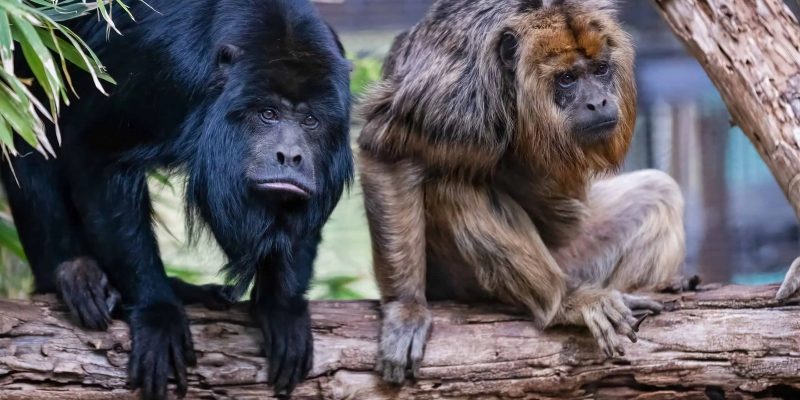
Black howler monkeys range through the tropical forests of eastern Bolivia, southern Brazil, Paraguay and northern Argentina, and they are among the loudest land mammals on Earth. The reason is a piece of anatomy: an enlarged hyoid bone, the small bone that anchors the tongue and the voice box in the throat, which in howlers is hollowed into a resonating chamber that works as a natural amplifier. The call carries up to three miles.
What they use it for is the interesting part. Troops do not fight over feeding trees. They broadcast where they are, hear where everyone else is, and spread out so they are not competing for the same leaves. It is territorial negotiation conducted entirely by shouting, and it saves the energy a fight would cost.
Energy is the constraint on everything a howler does. They eat mostly leaves, which are abundant and nearly worthless per mouthful, so digesting them is slow and expensive. The animals spend roughly 80 percent of the day resting. They move through the canopy on all four limbs plus a prehensile tail, meaning a tail that grips: the underside is hairless and highly sensitive, and it can hold the animal’s entire body weight, which effectively gives them a fifth hand.
The Phoenix Zoo’s troop lives on the Outer Tropics trail just past Monkey Village. Bennie and Maddie arrived together in January 2023 from Brevard Zoo, and the male, Malcolm, joined in March 2026 from the Cleveland Zoo on a Species Survival Plan recommendation, the cooperative breeding and transfer program accredited North American facilities use to manage a species across institutions rather than one collection at a time. The three are easy to tell apart, because black howlers are sexually dimorphic in color: Malcolm is solid black, while Bennie and Maddie are blonde to golden tan. On the IUCN Red List, Alouatta caraya is assessed as Near Threatened.
Forest acrobats with a fruit problem
Black-handed spider monkeys live in the tropical forests of Central America and northern South America and are among the largest of the New World monkeys, standing around two feet tall on absurdly long limbs. They travel by brachiation, the arm-over-arm swing that gibbons are famous for, with the prehensile tail acting as an extra limb at the far end of each reach.
They live in communities of 20 to 30 and split into smaller foraging parties through the day. Between 80 and 90 percent of the diet is ripe tropical fruit, which makes them one of the most important seed dispersers in Latin American forests: a fruit specialist that ranges widely is a forest’s distribution system. It is also why they are in trouble. A monkey that needs large connected stands of fruiting trees has nowhere to go when the forest is cut into pieces. Ateles geoffroyi is assessed as Endangered on the IUCN Red List, which is the category the zoo itself uses.
Phoenix holds a pair, Bruno and Renetta. Renetta, at 38, is one of the zoo’s senior residents and came from Baton Rouge Zoo. Bruno, 31, arrived in late 2018 from Lee Richardson Zoo in Garden City, Kansas, and is the darker of the two across the arms, head and face. Spider monkeys live into their mid-20s in the wild and 30 to 40 years in human care, so both animals are well past what the forest would have given them.
South America’s only bear
The Andean bear is the last one standing of a lineage that once included the short-faced bears, and it is the only bear native to South America. It lives in the forests along the Andes from Venezuela down to Bolivia, and it is also called the spectacled bear for the pale rings that frame the eyes on most individuals.
It is built for a life in trees rather than on the ground. Long curved claws make it a capable climber, and it spends much of its time in the canopy foraging and building leafy sleeping nests to lie up in. Because the mountain forests supply food year round, it does not hibernate and is active during the day. Bears live into their early 20s in the wild and between 20 and 30 years in human care, and the oldest on record reached 39.
Mostly vegetarian, it is the same story as the spider monkeys at a larger size: an animal that eats fruit across a wide range and deposits the seeds somewhere else is doing the work of replanting a cloud forest. That is what a keystone species means, a species whose removal changes the structure of the habitat out of all proportion to its numbers.
Phoenix has one, a male called Agapito, known as Auggie, born in 2020 and arrived from the San Diego Zoo. He weighs around 286 pounds. His diet includes meat, rabbit and trout, which is his favorite whole-prey item, but the snacks he actually wants are avocados and jicama. Twice a week he gets bones, which he carries up into his favorite trees or hammock beds to work on. His keepers report that his favorite scent is cherry extract, and that left to himself he digs for insects and breaks branches and bamboo to build a better nest. On the IUCN Red List, Tremarctos ornatus is assessed as Vulnerable, which again is the category the zoo uses. The Phoenix Zoo supports the species through the Association of Zoos and Aquariums SAFE Andean Bear program.
Why run it in two languages?
Because Phoenix is a city where that is simply the correct way to publish. Arizona’s Latino population is not a demographic the zoo is reaching out to, it is a large part of the zoo’s actual audience, and a Hispanic Heritage Month series about Latin American animals written only in English would be a strange artifact. Running the Spanish text underneath the English on the same page, rather than on a separate page nobody links to, is the version of this that costs the most effort and works the best.
The series sits on the zoo’s blog and stays up after the month ends, but October 15 is the last of it. If you are going in person, the three animals are a short loop: the howler troop and the spider monkeys on Outer Tropics, and Auggie not far off. The Phoenix Zoo has been building out this kind of local-facing work for a while, including its ranger partnership across Papago Park.
Quick answers
- What is the Phoenix Zoo's Hispanic Heritage Month series?
A set of species profiles on Latin American wildlife published during Hispanic Heritage Month, September 15 to October 15. The 2026 run covered black-handed spider monkeys on September 15, black howler monkeys on September 24 and the Andean bear on September 29. Each one is published in English and in Spanish on the same page.
- Why are howler monkeys so loud?
An enlarged hyoid bone, the small bone that anchors the tongue and voice box in the throat, is hollowed into a resonating chamber that acts as a natural amplifier. The call carries up to three miles. Troops use it to broadcast their positions and spread out rather than fight over feeding trees.
- Which animals can I see at the zoo?
The black howler troop, Malcolm, Bennie and Maddie, is on the Outer Tropics trail just past Monkey Village. Bruno and Renetta, the black-handed spider monkeys, are nearby, and Agapito, known as Auggie, is the zoo's male Andean bear.
- How threatened are these three species?
On the IUCN Red List, the black-handed spider monkey (Ateles geoffroyi) is assessed as Endangered, the Andean bear (Tremarctos ornatus) as Vulnerable and the black howler monkey (Alouatta caraya) as Near Threatened.
- What is a keystone species?
A species whose removal changes the structure of its habitat out of all proportion to its numbers. All three of these animals eat fruit across a wide range and deposit the seeds elsewhere, which is how a Neotropical forest replants itself.
- Is the Andean bear the same as the spectacled bear?
Yes. It is the only bear native to South America, living along the Andes from Venezuela to Bolivia, and it is called the spectacled bear for the pale rings that frame the eyes on most individuals.